
Everyday weather update listener
Wants to listen to a familiar radio station in the living room without using an app, and prioritises reception and simple controls. NPO Radio 1 lists FM frequencies and near-national coverage via DAB+.


Choose a radio that can pick up the station you want to listen to in your living room and makes speech easy to hear. FM and DAB+ offer different reception options, so check reception at home. If you also want to listen during a power cut, look for a model that can run without mains power and check which local emergency broadcaster to tune into, as advised by Denk vooruit and the Dutch government.
Wants to listen to a familiar radio station in the living room without using an app, and prioritises reception and simple controls. NPO Radio 1 lists FM frequencies and near-national coverage via DAB+.
Wants to check how the built-in speaker sounds from their usual listening spot and whether the controls are easy to use. A stated power rating or manufacturer’s description alone doesn’t tell you how easy a radio is to understand in your living room.
Wants to receive local information without mains power, so needs a suitable power source. The Dutch government identifies the regional broadcaster as a possible emergency broadcaster.
A good fit if: you’re mainly looking for a station that’s easy to receive and simple controls.
Bear in mind: Sony doesn’t list DAB+ reception for the ICF-P27. Check FM reception and speech clarity where you plan to listen.
A good fit if: you want the option to choose DAB+ stations as well as FM stations.
Bear in mind: check DAB+ reception where you’ll listen, and charge the battery before listening without mains power.
A good fit if: you want to be able to receive local information during a power cut.
Bear in mind: have the right batteries or a charged battery ready. Based on its tests of emergency radios, the Consumers’ Association warns that a small solar panel or hand crank isn’t necessarily a reliable source of charge.
| What to consider | What should you check? | Who should consider this? |
|---|---|---|
| Reception where you listen | Check whether the station you want comes through there via FM or DAB+. NPO Radio 1 lists FM frequencies and near-national DAB+ coverage, but that doesn’t automatically mean you’ll get reception everywhere indoors. | I want to receive my familiar station in the living room without using an app. Around 36% of consumers prioritise reception. |
| Speech clarity | If possible, listen at a normal volume and compare the built-in speaker with any headphone socket. A stated power rating doesn’t prove how clearly you’ll hear the radio in your room. | I want to follow a spoken weather forecast at a comfortable volume. Around 29% of consumers prioritise speech clarity. |
| Listening without mains power | Check whether the exact model runs on batteries or a charged battery, and which power source it needs. For emergency information, find out which local emergency broadcaster serves your area; the Dutch government identifies regional broadcasters as possible emergency broadcasters. | I want to be able to listen to the radio during a power cut, so I make sure the required power source is available. Around 21% of consumers prioritise a backup power supply. |
| Controls and available space | Compare the dimensions, display and station buttons of the exact model with the space you have available. | I want to tune the radio easily and fit it into a small space. Around 14% of consumers prioritise ease of use and placement. |
A portable radio may still need to be plugged in or rely on a battery that has been charged in advance.
Check the power source for the exact model, and keep the required batteries or a charged battery ready.
Extra charging features fell short in the emergency radios tested by the Consumers’ Association in 2025. That finding applies to the models tested and isn’t automatically a verdict on every model.
Check what power source the device actually uses and, if needed, have suitable batteries or a charged battery ready too.
NPO Radio 1 lists near-national DAB+ coverage, but this doesn’t guarantee reception everywhere in your home.
Check whether the station you want comes through where you plan to use the radio, and compare FM as an alternative.
The ICF-P27 is an example of a compact analogue FM radio powered by separate batteries.
The TAR5600/00 is an example of a portable FM/DAB+ radio, while the TAR1659/00 is an FM radio with emergency power options.
The RF-D10 is an example of an FM/DAB+ tabletop radio with a handle and direct station buttons.
This Joybuy selection includes portable AM/FM radios, an FM clock radio and a speaker with FM radio for listening at home. If you want to use a radio during a power cut, check that the power source for the exact model is suitable. The Dutch Authority for Digital Infrastructure says that radio equipment sold in Europe must carry a CE mark; check the specific device.
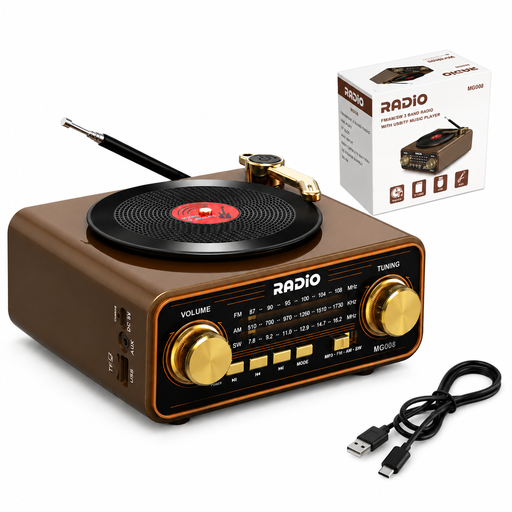 Image unavailable
A portable option to compare if you want to listen to the radio without a fixed mains connection. Check in advance that the stations you want are available where you plan to use it.
The product name lists AM/FM and shortwave, Bluetooth 6.0, USB-C, a TF card slot, AUX and a 2000 mAh battery.
 Image unavailable
An FM clock radio may suit you if you want to listen to a radio station in a fixed spot. Check that the clock and alarm functions work for you.
The product name lists a digital FM tuner, two alarms, a USB charging port, a night light and a backup battery. Check what the backup battery is for before assuming the radio works without mains power.
 Image unavailable
An option to compare if you’re looking for an FM radio and speaker in one device. Check that the controls are easy to reach where you plan to use it.
The product information lists FM radio with an antenna, a built-in rechargeable lithium battery, an LCD screen and physical buttons. The product name also mentions AUX, USB and a TF card slot.
No, not necessarily. Choose a radio station with the information you want to hear and check that you can receive it at home. NPO Radio 1 lists FM frequencies and near-national DAB+ coverage; a radio won’t automatically give you an alert or an on-demand weather forecast.
Check the batteries or charge the battery, and find out which local emergency broadcaster serves your area. Denk vooruit recommends a radio powered by batteries, solar energy or a dynamo. Check which power sources your chosen radio supports and have them ready.
No, it depends on how you’ll use it. ACM ConsuWijzer explains that, alongside any manufacturer’s or retailer’s guarantee, you have a legal guarantee from the seller; what you can reasonably expect from a product is a factor. The Consumers’ Association reported that extra charging features disappointed in the emergency radios it tested, so don’t assume a hand crank or solar panel can replace a suitable battery or rechargeable battery power source.
Radio equipment sold in Europe must meet the relevant requirements and carry a CE mark. The Dutch Authority for Digital Infrastructure explains this requirement; check the mark on the specific device.