
Listeners with patchy attic reception
You want to be able to hear a suitable weather or regional station in your usual listening spot. The Dutch Authority for Digital Infrastructure distinguishes between mobile reception and reception indoors.


First, choose a weather or regional station and check whether you can receive it via FM or DAB+ in your usual listening spot; choosing a particular radio band alone won’t guarantee reception in the attic. If you want to use the radio without a mains socket, compare the battery or rechargeable battery options. For spoken updates, a built-in speaker and simple controls may matter more than extra features.
You want to be able to hear a suitable weather or regional station in your usual listening spot. The Dutch Authority for Digital Infrastructure distinguishes between mobile reception and reception indoors.
You want to be able to move the radio around or keep using it during a power cut, so check how it is actually powered by batteries or a rechargeable battery.
You want to hear a message straight away, so look for a built-in speaker, clear tuning and easy access to your chosen station.
Start with the station and reception in the place where you want to listen. Then compare the power options and how you want to hear spoken updates.
| What to consider | What should you check? | Who is this important for? |
|---|---|---|
| Reception of your chosen station | Check whether the station is available via FM, DAB+ or both, and test the radio in your usual listening spot. | I first want to know whether my chosen weather or regional station comes through in my usual listening spot. Around 37% of consumers rank reception as their top buying priority. |
| Power without a mains socket | Check whether the model runs on standard batteries or a rechargeable battery, and find out which battery type or charging method it needs. | If I want to move the radio around or use it without mains power, its power supply needs to suit. Around 27% of consumers prioritise being able to listen independently of a mains socket. |
| Hearing spoken updates clearly | If you want to listen without headphones, check whether the model has a built-in speaker; also look for a headphone socket. | I want to be able to follow spoken messages in a way that suits my listening spot. Around 18% of consumers prioritise clear sound through their preferred listening method. |
| Finding your station again quickly | Compare the tuning controls or presets, and check how to scan for DAB+ stations if you want to use DAB+. | If I want to switch quickly to a familiar station, it needs to be easy to find again. Around 18% of consumers put ease of use at the top of their list. |
In 2025, the Dutch Consumers’ Association found that the small solar panels and hand cranks on the emergency radios it tested were of limited use for charging. This does not tell you how any individual model performs.
First, choose a station you can receive where you plan to listen, then decide on your main power source. Treat a hand crank or solar panel as a backup, not as an automatic replacement for a charged battery or spare batteries.
A station being available does not mean you can receive it everywhere indoors.
Test your chosen station where you want to listen and, where possible, try FM as an alternative too.
A socket for earphones does not necessarily mean there is also a built-in speaker. The Sangean DPR-39 has an earphone socket, while Sony lists a built-in speaker for the ICF-P27.
If you want to listen without earphones, check the audio output of the exact version you’re considering.
The ICF-P27 is a straightforward portable AM/FM radio for anyone who can receive their chosen station via FM.
The TAR5505/10 combines FM and DAB+; Bluetooth is an additional playback feature.
The MMR-88 is an FM emergency radio with several power options, while the DPR-39 is a compact DAB+/FM pocket radio.
The DAB-18LW offers FM and DAB+, so you can compare mains and battery use.
This selection focuses on portable radios for spoken updates, including rechargeable models and versions with additional emergency charging features.
 No image available
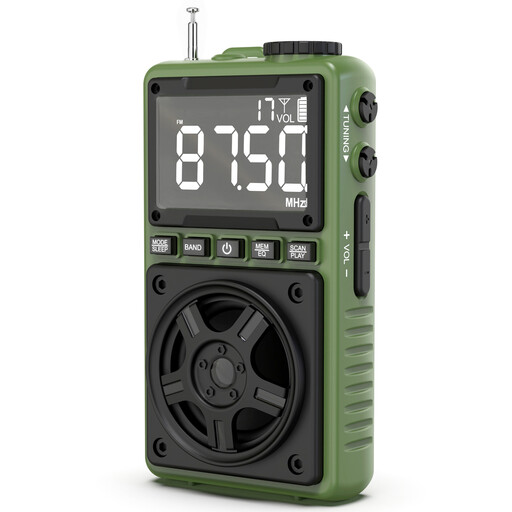
The product title mentions a speaker, which could suit you if you want to listen without earphones; check whether your chosen station comes through where you plan to listen.
The title mentions LED lighting, USB-C charging and playback from a TF card. The product description lists AM/FM/SW reception and physical tuning and volume controls.
 No image available
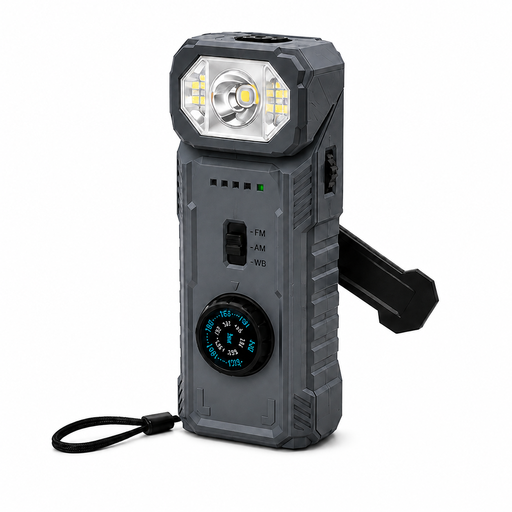
The title lists AM/FM reception; check whether you can receive your chosen station in the attic on one of the listed bands.
The title lists a rechargeable battery, hand crank, USB power, power bank function, SOS alarm, magnetic base and 180° LED light. In 2025, the Dutch Consumers’ Association warned that hand cranks and small solar panels on the emergency radios it tested were of limited use for charging; this was not a test of this model.
 No image available
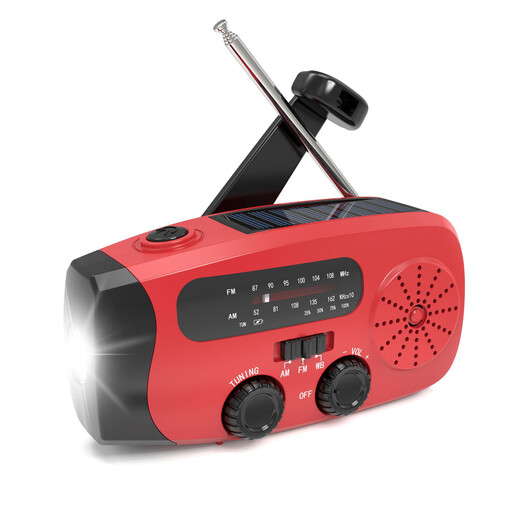
The title lists AM/FM reception; check whether your chosen station is available on one of the listed bands where you plan to listen.
The title lists a rechargeable battery, solar charging, LED light, power bank function and IPX-3 water resistance. In 2025, the Dutch Consumers’ Association warned that hand cranks and small solar panels on the emergency radios it tested were of limited use for charging; this was not a test of this model.
 No image available
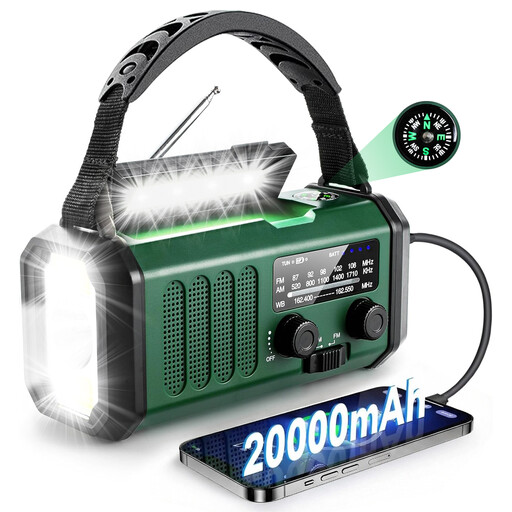
The title lists AM/FM reception; test your chosen station where you plan to listen.
The product title lists a 20000 mAh battery, solar panel, hand crank, USB-C power, LED light, reading light, SOS alarm and compass. In 2025, the Dutch Consumers’ Association warned that hand cranks and small solar panels on the emergency radios it tested were of limited use for charging; this was not a test of this model.
 No image available
The title lists AM/FM reception; check whether your chosen station comes through on one of those bands where you plan to listen.
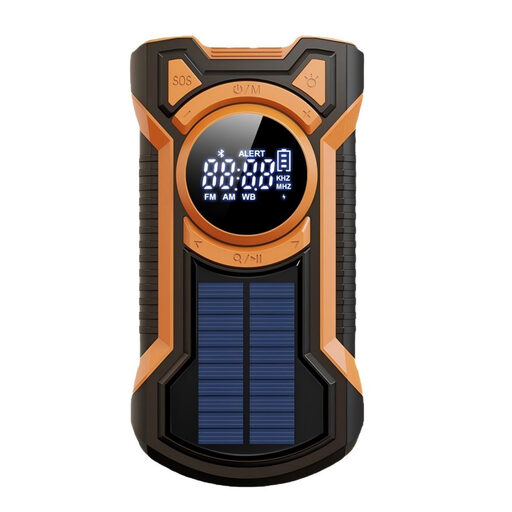
The title lists Bluetooth, a 5000 mAh power bank, hand crank, solar panel, USB-C, SOS function and LED lighting. In 2025, the Dutch Consumers’ Association warned that hand cranks and small solar panels on the emergency radios it tested were of limited use for charging; this was not a test of this model.
A standard FM or DAB+ radio receives broadcasts from stations; it does not automatically receive every KNMI warning. KNMI issues official weather warnings. Find a station that broadcasts the information you want to follow and check its schedule.
Find the regional broadcaster for your area and tune your radio to it. The Dutch government recommends regional broadcasters for information in emergencies; the Denk vooruit campaign lists regional FM frequencies and DAB channels. Reception depends on your area and where you are in your home.
Try the radio in a different spot and, if your model supports it, scan for stations again. Pure explains how to scan on its Evoke models, but the controls vary between radios. Also check whether your chosen station is available and receivable via FM.
Check which battery type the radio needs, whether batteries are included and how to charge any rechargeable battery. According to ACM ConsuWijzer, the seller is responsible for the legal guarantee if a product does not perform as you could reasonably expect under normal use. For a standard online consumer purchase, you will generally have a statutory 14-day cooling-off period from delivery; check the terms for trying the product carefully and for any exceptions.