
Listener in a shared space
Wants to follow spoken updates without disturbing others with the speaker, so looks for ways to listen privately.


First, check whether you can receive your preferred news or regional station where you plan to listen; a radio cannot guarantee that a weather forecast will be broadcast whenever you want. If you want to listen without disturbing others, a confirmed headphone or earphone socket is a clear point to look for. However, it does not prove that speech will remain clear through the speaker at very low volume. If you also want to use the radio during a power cut, look for a power source that works independently of the mains and tune in to your regional broadcaster in advance.
Wants to follow spoken updates without disturbing others with the speaker, so looks for ways to listen privately.
Wants to find a suitable news or regional station and switch between available FM and digital reception.
Wants to use the radio without a mains socket to receive information from their regional broadcaster. The Dutch government lists regional broadcasters as possible emergency stations.
First, check which station you want to listen to and whether you can receive it where you plan to listen. Then choose the reception band, listening options and power source that suit how you intend to use the radio.
| What to consider | What should you check? | Who is this important for? |
|---|---|---|
| Private listening at low volume | Check for a headphone or earphone socket and, if possible, try listening to spoken radio at your preferred volume. | If I want to hear updates without disturbing the people I live with, I look for a proper headphone output. Around 34% of consumers say private listening is their main consideration. |
| Receiving your preferred station | Decide which station you want and check the reception band and signal where you plan to listen. DAB+ only works where the signal is usable. | If you mainly want to find a particular news or regional station, it’s worth taking reception in your own location into account. Around 33% of consumers put station reception first. |
| Using the radio without a mains socket | Check the battery type or charging options and make sure the power source is available. Battery life is not necessarily the same at every volume or in every reception mode. | If I want to use the radio during a power cut too, I look for a power source that works without mains electricity. Around 20% of consumers prioritise independent power. |
| Easy tuning | Compare analogue tuning controls with digital presets and check that the controls feel comfortable to use. | For short listening sessions, I want to find the right station quickly without having to scroll through unnecessary menus. Around 13% of consumers say ease of use is most important. |
A product description or speaker output rating doesn’t tell you how easy it is to understand spoken weather reports at a very low volume.
Check whether the radio has a headphone output and, if possible, try listening to spoken radio at your preferred volume.
Reception varies by location, and the digital signal can drop out during a fault. A radio can only broadcast what the station you’ve selected is scheduled to air at that time.
Check the station and reception where you plan to listen. Consider FM too if you want to follow regional emergency information.
When Consumentenbond tested emergency radios, charging one fully with a hand crank fell short of expectations.
For emergency preparations, first look for a power source you can use independently and keep ready to go.
Bear in mind that you’ll need to keep batteries available or a rechargeable battery charged; you may also need an additional charging option.
The ICF-P27 is a compact analogue FM/AM radio for anyone looking for replaceable AA batteries and private listening.
The TAR2509/10 is a portable analogue FM/AM radio with a large tuning knob and a manufacturer-set news mode.
The DPR-35BT combines DAB+/FM, station presets and private listening in a pocket radio.
The DAB-46DGR is a portable DAB+/FM radio that runs from the mains or AA batteries.
The Play 11 offers DAB/DAB+/FM reception and a choice of battery or USB-C power.
This selection includes portable radios for everyday FM listening and models with features for use without a mains socket. Check that each product’s connections and power supply suit your listening needs.
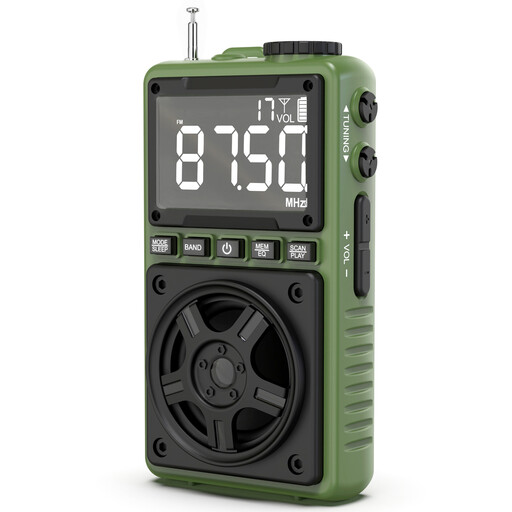 No image available
Suitable if you’re looking for a portable FM radio with the option to listen privately.
The product information lists FM/AM/SW, a headphone socket, a rechargeable battery, USB-C charging and playback from a TF card.
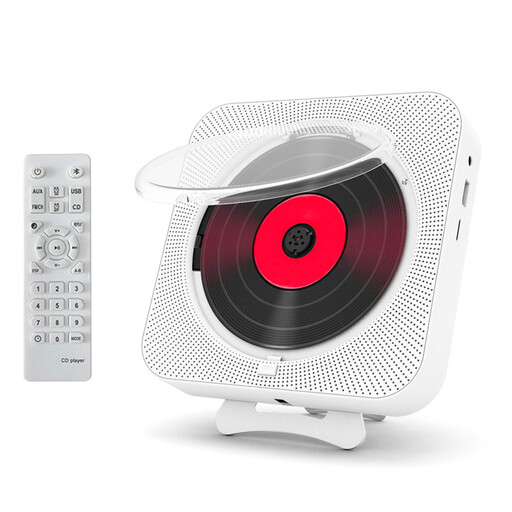 No image available
Suitable if you want a CD player as well as an FM radio and value the option to listen privately.
The product name lists a headphone socket, built-in speaker and remote control.
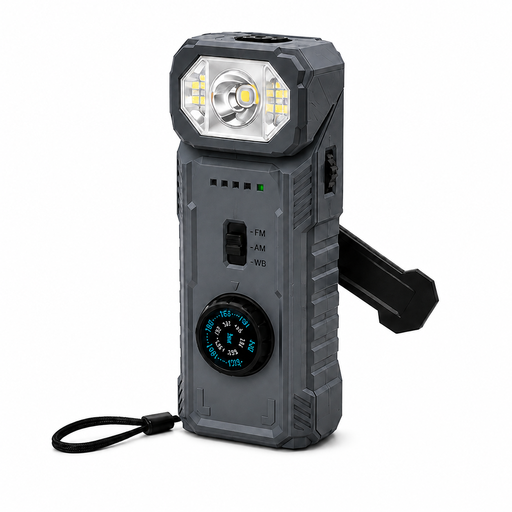 No image available
Suitable if you’re also looking for a radio with AM/FM reception that you can use without a mains socket.
The product name lists AM/FM/SW, a hand crank, USB power, a power bank function and an SOS alarm.
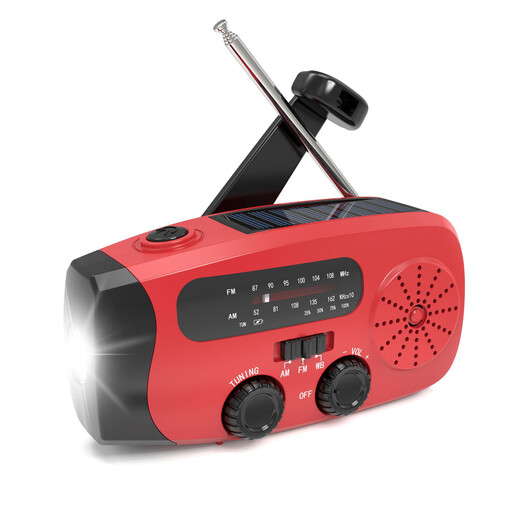 No image available
Suitable if you’re looking for AM/FM reception and several listed power options for use without a mains socket.
The product name lists AM/FM/WB reception, USB-C, a solar panel, a power bank function, an LED light and IPX-3 water resistance.
 No image available
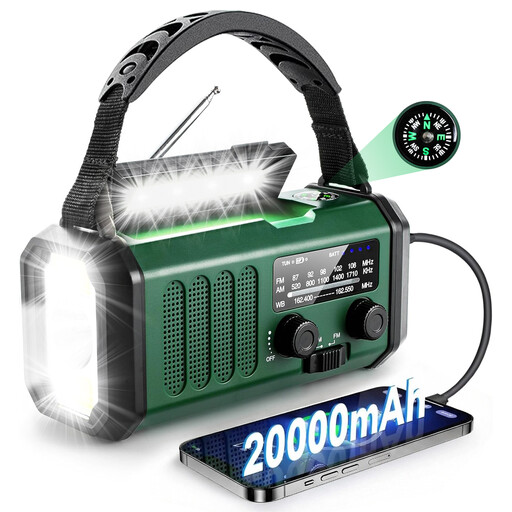
Suitable if you’re looking for a portable AM/FM radio to use outdoors or somewhere without a fixed power supply.
The product name lists a 20000 mAh battery, a hand crank, a solar panel, NOAA reception, an LED light and an SOS alarm.
No. A radio receives broadcasts from available stations, so decide in advance which news or regional station you want to follow and check its reception and schedule where you plan to listen. On 14 October 2026, KNMI announced that from November it would issue more targeted warnings about dangerous weather. However, this does not confirm that a specific station will broadcast continuously or at a set time.
Look up your regional broadcaster and its frequency in information from the Dutch government, tune your radio in advance and make sure its independent power source is ready to use. This is advice for preparedness, not a legal requirement to buy a radio.
Don’t assume it is. When Consumentenbond tested emergency radios, charging one fully with a hand crank fell short of expectations, and the solar panel was not powerful enough to charge the battery. These findings apply to the radios tested and not necessarily to every model.
According to ACM ConsuWijzer, online purchases generally come with a 14-day cooling-off period after delivery, although there are exceptions. You’re also covered by the legal guarantee if the product does not work as you could reasonably expect under normal use; the seller must then offer an appropriate solution.