
Rush-hour listener
You want to quickly find a station with updates for your journey before you leave. ANWB says NPO Radio 1 broadcasts every half hour, and every 15 minutes during rush hour.


Start by choosing a station that broadcasts traffic updates when you need them. A simple FM radio may be enough if you can get a good signal from that station where you listen. DAB+/FM gives you an additional reception option, but it doesn’t guarantee indoor reception. Also choose a power source that suits how often you move the radio.
You want to quickly find a station with updates for your journey before you leave. ANWB says NPO Radio 1 broadcasts every half hour, and every 15 minutes during rush hour.
You want to be able to follow traffic updates from a fixed spot at home. In 2015, the Dutch Authority for Digital Infrastructure described indoor DAB+ reception as uncertain. Having FM as well as DAB+ gives you another reception option, but doesn’t tell you what the signal will be like in your living room.
You want to be able to place the radio somewhere without a nearby power socket. Sony specifies two AA batteries for the ICF-P27; Sangean specifies a rechargeable battery for the DPR-35BT.
ANWB says NPO Radio 1 broadcasts every half hour, and every 15 minutes during rush hour. So first choose a station and broadcast time that fit your departure. Then compare reception, power and controls.
| What to consider | What to look for when buying | Who is this important for? |
|---|---|---|
| Updates at the right time | Check whether you can receive your preferred station on FM or DAB+, and when it broadcasts updates. | If I want to hear traffic updates before setting off, I choose a radio based on the station and broadcast time. Around 36% of consumers prioritise this. |
| Reception where you listen | Try your preferred station where you plan to listen. Compare FM and DAB+ if the radio supports both. | If reception is uncertain where I usually listen, I want to find out which option works there. Around 29% of consumers prioritise indoor reception. |
| Power when moving the radio | Check whether the radio runs on batteries, a rechargeable battery or mains power, and see what’s included. | If I want to move the radio somewhere without a nearby power socket, I check how it’s powered and whether batteries need charging or replacing. Around 21% of consumers prioritise portability. |
| Easy to use | Check the tuning method, buttons and speaker on the version being offered. Don’t judge how clearly speech will sound on the stated wattage alone. | If I mainly want to hear spoken updates in a small living room, I want to be able to switch on and tune the radio easily. Around 14% of consumers prioritise ease of use. |
A radio with DAB+ can only help if you can receive your preferred station where you listen. The RDI’s 2015 description isn’t a current coverage check for your address.
Check your preferred station and try reception where you plan to listen. FM as a second reception option may provide an alternative.
How often traffic updates are broadcast depends on the station and the time, not on Bluetooth or other extra features.
Choose the station and broadcast time first. Then compare only the radio features you actually want to use.
A model name on a product page doesn’t, by itself, confirm which version you’ll receive or which product documentation applies to it.
Before buying, check the details of the version being offered and the relevant product documentation. The European Commission explains EU requirements for radio equipment and the role of importers and distributors.
The Sony ICF-P27 is a straightforward portable AM/FM radio.
The Philips TAR5505/10 combines DAB+ and FM.
The Sangean DPR-35BT is a portable DAB+/FM radio.
These options are aimed at FM listening, including portable use without a fixed power supply. The product titles shown don’t mention DAB+.
 No image available
Could suit you if you want to listen to FM traffic updates through a portable speaker, even without a fixed power socket.
The product description lists a built-in rechargeable battery, an external aerial and an LCD screen showing the mode and frequency.
Before buying, check the documentation and applicable CE marking for the version being offered.
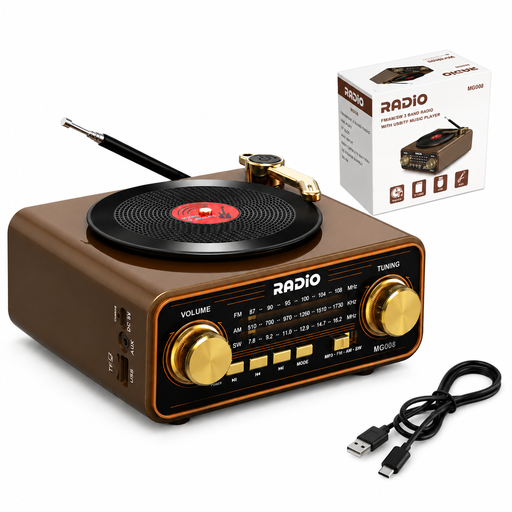 No image available
Could suit you if you want FM radio with the option to use it without a fixed power socket.
The product title lists AM, FM and shortwave reception, a 2000 mAh battery, USB-C, Bluetooth 6.0, a TF card slot and an AUX socket.
Before buying, check the documentation and applicable CE marking for the version being offered.
ANWB mentions NPO Radio 1, which broadcasts every half hour and every 15 minutes during rush hour. Check that the station and broadcast time fit your departure; a national bulletin isn’t automatically an update for your specific route.
Try your preferred station where you plan to listen and compare FM and DAB+ if the radio supports both. The RDI provides a list of stations, but this doesn’t confirm indoor reception at a specific address.
No. A radio having DAB+ doesn’t guarantee reception in your living room. In a 2015 report, the RDI described indoor reception as uncertain, so test your preferred station where you plan to listen.
Check the applicable CE marking and product documentation for the version being offered. The European Commission explains the EU rules for radio equipment. Information about a product model alone doesn’t confirm the documentation for a specific listing.
For applicable online purchases by consumers in the Netherlands, the cooling-off period is generally 14 days. If a product is faulty, contact the seller. Before ordering, check who the seller is and the terms that apply to your purchase.