
Listener in an open-plan living space
You usually listen from one spot and want a portable radio chosen for more than just its compact size. Pure and JBL describe models with different speaker set-ups.


First, choose a radio that can receive the music programme you want to listen to where you plan to use it. Digital Radio NL explains that indoor reception also depends on the building and its construction. If you usually listen in one place, compare the speaker set-up; if you often move the radio around, focus on the battery and controls. A manufacturer’s speaker specifications alone can’t tell you how a radio will sound in your flat.
You usually listen from one spot and want a portable radio chosen for more than just its compact size. Pure and JBL describe models with different speaker set-ups.
You take the radio between rooms, such as the kitchen and sitting area, so battery life, portability and quick station selection matter. JBL and Philips describe models to suit different needs.
Your main priority is receiving the programme you want where you plan to listen; extra playback features matter less. Digital Radio NL points out that indoor reception also depends on the local buildings and their construction.
First, find out how your programme is broadcast and test reception where you plan to listen. Then compare the speaker set-up, power options and controls with how often you move the radio around.
| What to consider | What should you check? | Who is this important for? |
|---|---|---|
| Sound in your living space | Check the number of speakers, whether one unit delivers stereo sound and whether the size suits your listening spot. If possible, listen to it yourself in a similar-sized room. | If I usually listen from my seat, I want to know whether the speaker set-up suits that distance, not just how compact the radio is. Around 25% of consumers prioritise sound in their living space. |
| Receiving your programme | Check whether your preferred station broadcasts on FM or DAB+. Test the radio in your usual listening spot and, if needed, try a new station scan. | If I want to listen to one particular music programme, I want to know whether I can receive the station where I plan to listen. Around 25% of consumers give receiving their preferred programme top priority. |
| Moving it around without a plug socket | Check whether a battery is included, what power source is needed and what battery life is quoted for the exact version. | If I move between the kitchen and sitting area while listening, I want to take the radio with me without having to look for a plug socket each time. Around 25% of consumers prioritise being able to move it around without a cable. |
| Easy tuning | Check how many preset buttons there are and whether you can quickly select your station without going through menus. | If I always tune in to the same programme, I want to find it quickly without unnecessary steps. Around 25% of consumers say ease of use is their top priority when choosing. |
The Pure Evoke Play needs a ChargePAK for battery-powered use. Without one, you can’t use it wirelessly straight away.
Check what’s included with the exact version and what power source it needs.
The ChargePAK for the Pure Evoke Play is sold separately, so remember that you’ll need to buy one for battery-powered use.
Indoor reception also depends on the buildings and construction in your area. As a result, a station may come through better in one spot than another.
Test your preferred station where you’ll actually listen, and try a new station scan if you have any problems. Digital Radio NL recommends both as practical steps.
The stereo playback JBL describes for the Tuner 3 requires two Tuner 3 units. That’s different from getting stereo sound from a single compact radio.
Check whether the speaker set-up you want comes from one radio or requires pairing it with a second unit.
JBL’s stereo pairing feature requires two Tuner 3 units.
The Evoke Play is a portable DAB+/FM and internet radio with stereo speakers, according to Pure.
The Tuner 3 combines DAB+/FM, Bluetooth, a battery and direct station selection.
The TAR5600/00 combines DAB+/FM with Bluetooth and a replaceable built-in battery; the TAR2509/10 is an FM/AM alternative.
The ODR-160GY is a portable DAB+/FM radio with Bluetooth and a handle.
The CR-M30DAB-B is a compact DAB+/FM radio with Bluetooth, a built-in battery and presets.
These product picks focus on portable FM radios for anyone who wants to listen to a music programme and move the radio around their flat. Check that the programme is broadcast on FM and that reception is good enough where you plan to listen.
For each specific product, check that it has the correct CE marking before deciding it’s suitable. The Dutch Authority for Digital Infrastructure says the marking must be on the equipment.
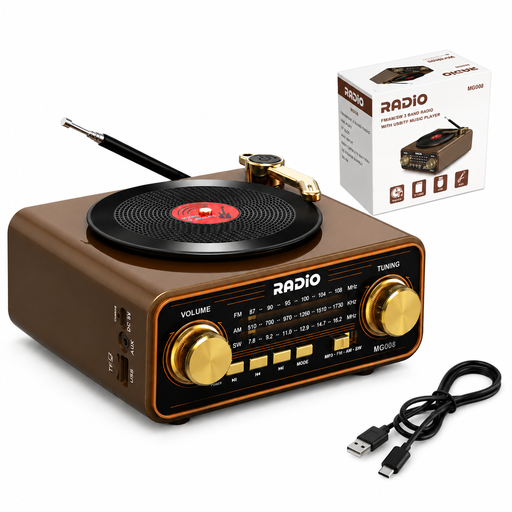 No image available
Worth considering if your programme is broadcast on FM and you want to move the radio around.
FM, AM and shortwave; Bluetooth 6.0; 2000 mAh battery; USB-C, TF card and AUX.
 No image available
Worth considering if you’re looking for a portable speaker with FM radio to listen to a programme broadcast on FM.
FM radio, LCD screen, aerial, AUX input, USB port and TF card slot. The product description warns against exposing the unit to rain or moisture.
No. DAB+ receives broadcasts over the air and doesn’t require an internet connection. However, check that your preferred station broadcasts on DAB+ and that you can receive it indoors where you plan to listen, as Digital Radio NL advises.
First, try a new automatic station scan, then test the radio where you plan to listen. Digital Radio NL points out that indoor reception also depends on the local buildings and their construction.
Check that the correct CE marking is shown on the device. The Dutch Authority for Digital Infrastructure says the marking must be on the equipment and advises against using equipment with no CE marking or an incorrect one.
In the Netherlands, you’re entitled to a product that meets reasonable expectations, with no fixed statutory warranty period. According to the Dutch Government, the seller must provide a solution if a product is faulty; a manufacturer’s warranty doesn’t replace this right.