
News listener in an open-plan living space
Wants to follow speech from their usual spot, so considers indoor reception and sound quality separately. The Consumers' Association discussed these points in its review of emergency radios.


Start by checking whether your preferred news station comes through where you plan to put the radio, and whether speech is clear at your usual listening distance. A stated speaker output does not prove that it will be. Then choose between FM, DAB+ or both, and decide whether mains power, replaceable batteries or a rechargeable battery suits you when moving the radio between the kitchen and sitting area. If you also want to listen during a power cut, Think Ahead recommends a radio with an independent power source and FM and/or DAB reception. That’s a separate requirement, not a necessity for every morning radio.
Wants to follow speech from their usual spot, so considers indoor reception and sound quality separately. The Consumers' Association discussed these points in its review of emergency radios.
Wants to move the radio around and is looking for the right combination of size, power and controls. Pure and Lenco describe different power options for their portable models.
Wants to tune in to a familiar station quickly and may find preset buttons, a clock or an alarm useful. Panasonic and Lenco describe these features on specific models.
Choose this if: your preferred news station is available on FM and you’re looking for a simple radio, perhaps one that runs on replaceable batteries.
Trade-off: an FM-only model won’t receive DAB+ stations. Check reception where you plan to listen.
Choose this if: you want access to digital stations while keeping FM as a second reception option.
Trade-off: DAB+ reception dropped out during interference on the emergency radios tested by the Consumers' Association. This finding does not apply to every portable model.
| What to consider | What should you check? | Who is this important for? |
|---|---|---|
| Speech clarity | Consider the speaker's position and the volume controls. Don’t treat the stated wattage as a test of how clearly speech will come through in your home. | I want to follow the news from the kitchen without judging the radio by its wattage alone. Around 27% of consumers prioritise speech clarity at their listening distance. |
| Station reception | Check whether the model receives FM, DAB+ or both, then tune in to your preferred station where you plan to put the radio. | I want to know whether my regular news station comes through there before weighing up extra features. Around 27% of consumers give reception of their preferred station top priority. |
| Power when moving the radio | Compare mains power, replaceable batteries and a built-in rechargeable battery. Also check which cables or adapters are included. | If I’m taking the radio between the kitchen and sitting area, I want a power option that suits my routine. Around 20% of consumers prioritise portability and power. |
| Ease of use in the morning | Check whether the exact model has physical preset buttons, an alarm or a timer. | I want to turn on my usual station quickly in the morning or use an alarm. Around 13% of consumers make straightforward controls their main priority. |
| Listening without mains power | Check whether the radio has an independent power source and can receive your preferred FM and/or DAB station. | If I want to use the radio during a power cut too, it needs to work without mains power. Around 13% of consumers prioritise use without mains power. |
The Consumers' Association found that DAB+ reception could drop out during interference on the emergency radios it tested. This doesn’t predict how a specific model will perform where you listen.
Tune in to your preferred station where the radio will normally sit, and consider FM as a second reception option.
A power rating doesn’t tell you how clearly you’ll hear speech at your listening distance. Panasonic also gives different power ratings for the RF-D15 on mains power and batteries.
Compare power ratings only when using the same power source. When choosing, focus on speaker placement and the volume controls.
Lenco lists a USB-C cable as included with the PDR-034GY, but not a USB-C power adapter.
Check what’s in the box and what power source the exact model needs. You may need to supply a compatible adapter yourself.
Charging features fell short on the emergency radios tested by the Consumers' Association. This matters most if you need to rely on the radio during a prolonged power cut.
For this specific use, check that the radio has an independent power source rather than relying on extra charging features alone.
Philips describes the TAR5600/00 as a portable DAB+/FM radio with Bluetooth, a clock, a kitchen timer and a replaceable built-in battery.
According to Pure, the Pure Elan One² combines DAB+/FM with power from a cable or four AA batteries.
According to Lenco, the Lenco PDR-034GY is a compact DAB+/FM radio with a built-in rechargeable battery, Bluetooth and preset buttons.
According to Sony, the Sony ICF-P27 is a compact AM/FM radio powered by two AA batteries.
According to Panasonic, the RF-D15 is a portable DAB+/FM radio with Bluetooth, direct preset buttons, an alarm and a sleep timer.
These radios are suited to FM listening and morning routines. Check each model’s power source and features to make sure they meet your needs.
 No image available
Suited to anyone who wants to listen to the news on FM and use a radio alarm as part of their morning routine.
FM tuner; two settable alarms; Gentle Wake.
 No image available
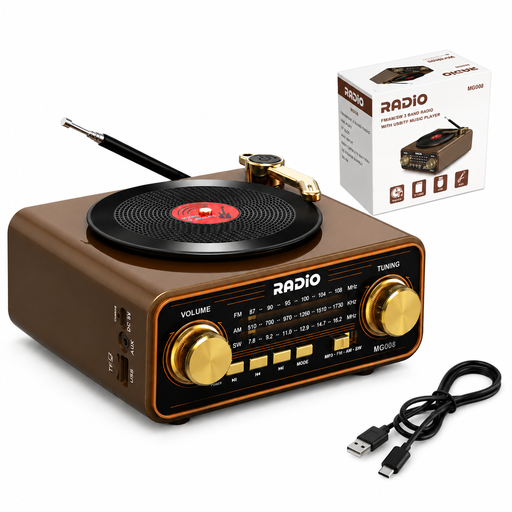
A possible choice if you’re looking for a portable radio with FM reception and a range of connection options.
AM, FM and shortwave; Bluetooth 6.0; USB-C, TF card and AUX; 2000 mAh battery.
No. Choose based on the station you want and reception where you listen. A DAB+/FM model offers both reception options. FM was clear enough for speech on the emergency radios tested by the Consumers' Association, while DAB+ reception could drop out during interference. That finding doesn’t automatically apply to every portable model.
Tune in to the station you want to hear, then check reception and speech clarity in the places where you plan to put the radio. If you buy a radio online, you’ll generally have a statutory 14-day cooling-off period from delivery. Check the applicable terms before returning the product.
Check whether the model runs on replaceable batteries, a built-in rechargeable battery or a power cable, and which parts are included. Pure lists four AA batteries as an option for the Elan One². Lenco includes a USB-C cable with the PDR-034GY, but not a USB-C power adapter.
Choose a model with an independent power source and FM and/or DAB reception. Think Ahead recommends a radio powered by batteries or solar energy, or one with a dynamo, and suggests tuning in to your local station in advance. Based on its emergency radio test, the Consumers' Association warns against relying too heavily on small solar panels or hand cranks.
Your statutory consumer rights apply alongside any manufacturer’s or seller’s guarantee. If a product breaks sooner than you could reasonably expect under normal use, the seller must provide an appropriate free remedy, according to ACM ConsuWijzer. There is no single fixed statutory guarantee period for every radio.