
Listeners looking for a specific local station
If you mainly want to listen to your local station, check whether it broadcasts via FM or DAB+ in your area before comparing features. Then try reception where you plan to put the radio.


First, check whether your preferred local station broadcasts via FM, DAB+ or the internet; a DAB+ receiver doesn’t guarantee that you’ll be able to receive the station at home. Then consider the power supply and portability, and prioritise a headphone socket if you want to listen privately in a shared space. Internet radio offers an extra option only if the station broadcasts online and you have a working internet connection.
If you mainly want to listen to your local station, check whether it broadcasts via FM or DAB+ in your area before comparing features. Then try reception where you plan to put the radio.
If you move the radio between, for example, the living area and kitchen, its power supply, size and controls matter. ‘Portable’ doesn’t automatically mean that a rechargeable battery or batteries are included.
In a shared open-plan space, a headphone socket can be important if you sometimes want to listen privately rather than through the speaker.
Start by checking reception for the station you want. The listening location, power supply and whether you share the space will then help you decide which features matter to you.
| What to consider | What should you check? | Who is this important for? |
|---|---|---|
| Reception for your local station | Check whether the station broadcasts via FM or DAB+ in your area. Try reception where you want to listen. | I specifically want to listen to my local station; an additional tuner only helps if that station broadcasts on it and I can receive it where I listen. Around 36% of consumers say receiving their preferred station is their top priority. |
| Clarity and controls | Check the speaker configuration, volume controls and any preset buttons. If possible, listen for yourself at the volume you want to use. | What matters to me is that speech is clear and the controls are easy to use where I listen; the stated power output alone won’t tell me how easy the sound is to understand. Clarity is the top priority for around 29% of consumers. |
| Portability and power | For each version, check whether batteries or a rechargeable battery are included, what power supply it needs and whether the aerial is practical to position. | If I move the radio around the house, I want to know how it will be powered in each location. Being able to move it without relying on a fixed socket is the top priority for around 21% of consumers. |
| Private listening | Check whether the exact model has a headphone socket and what type of connection you need. | When other people are using the same room, I want to be able to listen through headphones. Private listening is the top priority for around 14% of consumers. |
DAB+ doesn’t guarantee that your preferred station broadcasts on the platform or that you can receive it where you listen. A broadcasting licence and reception in your home are two different things.
Check which platforms your preferred station uses, and keep FM in mind as another possible way to receive it. Test reception where you plan to use the radio.
A handle doesn’t mean that a rechargeable battery or batteries are included. Pure lists the battery for the Evoke Play as optional.
Check the power supply for the exact version and what’s included before you choose.
To use the Pure Evoke Play wirelessly, you may need to buy a separate battery.
A power rating isn’t a comparative listening test and doesn’t, by itself, tell you how clear the radio will sound where you listen.
Use the specifications as a starting point and, if possible, judge the clarity for yourself at the volume you plan to use.
Philips describes the portable TAV2000DB/00 and TAR5505/10, among others, as offering FM and DAB+.
Sony describes the XDR-S60DBP as a portable FM/DAB+ radio that runs on batteries or mains power.
According to Roberts, the Revival Petite 2 combines FM and DAB+ with Bluetooth and a rechargeable battery.
Pure describes the Evoke Play as a radio with FM, DAB+ and internet radio, and a carrying handle.
On its Dutch manufacturer page, Panasonic describes the RF-D40 as a radio with FM, DAB+ and internet radio.
This selection includes a portable AM/FM radio and a Philips clock radio with FM. Consider them as options for listening to FM, rather than as two comparable portable models.
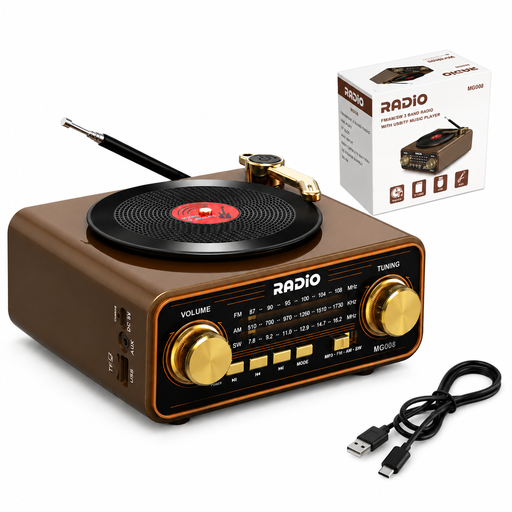 No image available
This portable radio with FM is an option if your local station broadcasts via FM; the product name lists a 2000 mAh battery.
The product name lists AM, FM and shortwave, Bluetooth 6.0, USB-C, a TF card slot and an AUX connection.
 No image available
This clock radio is an option if FM is the way to receive your station; the product name lists a digital FM tuner.
The product name lists two alarms, a USB charging port, a night light and battery backup.
No. Also check whether your preferred station broadcasts locally via DAB+ and whether you can receive it where you listen. The Dutch Authority for Digital Infrastructure keeps information on local DAB+ broadcasting licences; this doesn’t automatically confirm reception in your home. Try FM too, if necessary.
First, run an automatic station scan again; this is Digital Radio NL’s advice for reception problems. Then try the radio or aerial in a different location and check whether your preferred station is available there.
Not always: check the power supply for each version. Sony lists batteries or mains power for the XDR-S60DBP, Roberts lists a rechargeable battery for the Revival Petite 2, and Pure lists an optional battery for the Evoke Play.
According to ACM ConsuWijzer, the retailer must resolve a problem covered by the statutory guarantee free of charge. For an online purchase from a business, the Dutch government says you usually have a 14-day cooling-off period; check the applicable terms and exceptions.