
Listener who mainly tunes into one local station
You’ll mainly want to know whether your favourite station comes through where you plan to put the radio. Check the station’s broadcast information and choose a tuner to match.


First, check how your local station broadcasts, then test reception where you plan to use the radio in your kitchen-diner: a DAB+ tuner doesn’t guarantee that the station you want will be available there. The Dutch Authority for Digital Infrastructure describes FM and DAB+ as separate licensing options for local broadcasters. Choose FM if you get a good signal from your preferred station, or DAB+/FM if you’d also like to try DAB+ stations. If you want to move the radio around, check how it’s powered too.
You’ll mainly want to know whether your favourite station comes through where you plan to put the radio. Check the station’s broadcast information and choose a tuner to match.
If you listen in different places, such as by the worktop and at the table, you may want a radio that works without a mains socket. Denver lists AA batteries and a mains adapter supplied with the DAB-46W; Philips specifies mains or battery power for the TAR2509/10.
You’ll want to find your station quickly and choose a suitable spot for the radio. JBL lists six preset buttons and an IP68 rating for the Tuner 3; check the features and placement instructions for the exact model.
Choose this if: your preferred local station broadcasts on FM and comes through clearly where you plan to listen.
Bear in mind: an FM-only radio can’t receive DAB+ stations, and with analogue tuning you’ll need to find the right frequency yourself.
Choose this if: you’d like to try both FM and DAB+ stations, and your preferred station broadcasts on one of these bands.
Bear in mind: having an additional tuner doesn’t guarantee that your local station will be available in your kitchen.
Consider this if: your preferred station broadcasts online and you have a reliable internet connection where you plan to listen.
Bear in mind: listening depends on your internet connection, so check the model’s Wi-Fi requirements and power supply too.
| What to consider | What should you check? | Who is this for? |
|---|---|---|
| Reception of your local station | Check how the station broadcasts and test reception where you plan to put the radio. | If I mainly want to listen to my local station, I want to check first that I can get it there. Around 36% of consumers give reception of their preferred station top priority. |
| Power when moving the radio | Check whether the model runs on batteries, a rechargeable battery and/or mains power, and which items are included. | If you move the radio between the kitchen and dining area, you won’t want to rely on a mains socket all the time. Around 29% of consumers prioritise being able to use their radio without a mains socket. |
| Quickly tuning into your station | Check the tuning method, controls and available presets on the exact model. | If I want to switch back to my regular station quickly while cooking, I look for simple controls. Around 21% of consumers say being able to find their station quickly is most important. |
| Placement and audibility | Measure the available space, keep the radio away from splashes, and check reception and sound where you plan to listen. | If you want to listen at the table, think about where the radio will go and how clearly you’ll hear it in your room. Around 14% of consumers prioritise suitable placement and audibility. |
A DAB+ tuner doesn’t prove that a particular local station broadcasts or can be received where you are.
First check how your preferred station broadcasts, then test the radio where you plan to listen.
Power options vary by model. Denver lists AA batteries and a mains adapter for the DAB-46W; JBL describes the Tuner 3 as having a rechargeable battery.
Check whether the exact version needs batteries, a rechargeable battery or mains power, and what’s included.
Denver states that the DAB-46W isn’t splashproof; JBL gives the Tuner 3 an IP68 rating. These specifications apply to those models and not automatically to other radios from the same brands.
Where possible, choose a spot away from direct splashes. If the radio could get wet, check the protection rating and instructions for the exact model.
The TAR2509/10 is a portable analogue FM/AM radio for anyone who wants to tune in to a familiar frequency manually.
The DAB-46W combines DAB+ and FM for anyone who wants both types of reception in a radio they can move around.
The Tuner 3 combines DAB+/FM with Bluetooth, a rechargeable battery and preset buttons for anyone who’d also like to use other audio features.
The ICF-P27 is a small AM/FM radio for anyone mainly looking for a portable device to listen to an FM station.
Joybuy radio picks for listening in the kitchen-diner, including FM radios and portable models.
 No image available
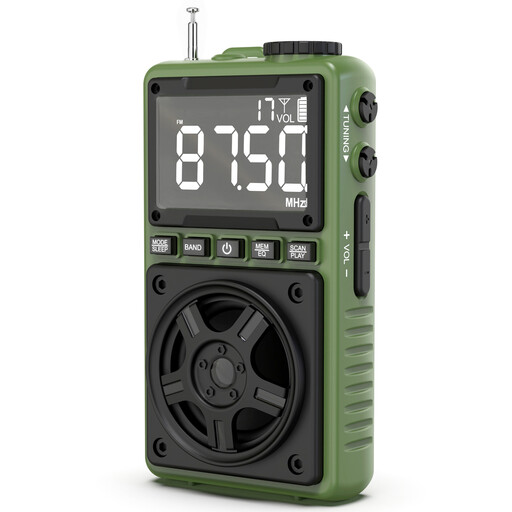
An option to consider if you’re looking for Bluetooth and other playback options as well as radio.
The product name mentions LED lighting, USB-C charging and playback from a TF card.
Before buying, check that the tuner supports the way your local station broadcasts.
 No image available
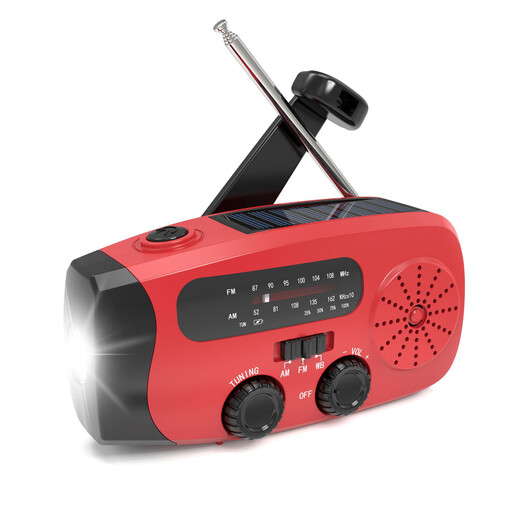
This model is designed for anyone looking for a radio with several charging options and extra emergency features.
The product name mentions a 2000mAh battery, an LED torch, a power bank function and IPX-3 water resistance.
Check that the listed reception bands are suitable for your local station.
 No image available
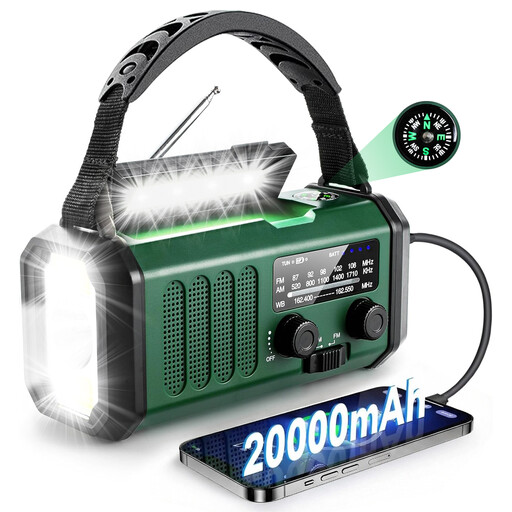
A portable emergency radio for anyone looking to combine AM/FM reception with extra features for outdoor use.
The product name mentions a 20000mAh battery, hand-crank operation, a 14W LED lamp, NOAA reception, an SOS alarm and a compass.
Check that the listed FM reception covers the frequency of your local station.
 No image available
A clock radio to consider if you’d like to combine FM listening with an alarm.
The product name mentions a dual alarm, USB charging port, night light and battery backup.
Check that the radio and its power supply are suitable for the place where you plan to use it.
It depends on the station and where you are. The Dutch Authority for Digital Infrastructure describes licensing options for local broadcasters on FM and DAB+, but that doesn’t mean a particular station will be available on both bands in your kitchen. First check the station’s broadcast information, then choose the right tuner.
Run a new station scan; Digital Radio NL recommends this as the first step when you have reception problems. If the station is still missing, check whether it broadcasts locally on DAB+ and try moving the radio to another spot.
Not all models do. Philips lists mains or battery power for the TAR2509/10; Denver lists AA batteries and a mains adapter supplied with the DAB-46W. Check the power requirements and included items for the exact version.
In many cases, you have 14 days to change your mind when you buy at a distance, according to the Dutch Government. Separately, the seller is responsible for the statutory guarantee if the product doesn’t meet what you’re entitled to expect from it. The Netherlands Authority for Consumers and Markets explains that this doesn’t mean every radio has a fixed two-year guarantee.