
Listener with a regular folk music station
Wants to check first that the radio can receive the programme where they want to listen. For example, NPO Radio 5 is not available on FM radio, according to NPO Radio 5.


Start with the station: check how the folk music programme is available and whether the radio can receive it where you want to listen. Then choose based on how you listen: through built-in speakers, with headphones or somewhere without a mains socket. A quoted speaker output on its own is no proof that a radio will sound better in your flat.
Wants to check first that the radio can receive the programme where they want to listen. For example, NPO Radio 5 is not available on FM radio, according to NPO Radio 5.
Wants to listen through built-in speakers and take housemates into account. Speaker specifications are no substitute for testing how a radio sounds in the room.
Wants to move it between places such as the living room, kitchen and workspace, so considers its size and the choice of mains power, batteries or a rechargeable battery. Philips and Denver describe these power options for specific models.
First check whether the station broadcasts the programme via FM, DAB+ or the internet, and whether you can get reception where you want to listen. Then compare the power supply and listening options for the exact model.
| What to consider | What to look for | Who is this important for? |
|---|---|---|
| Programme reception | Find the station and check the available ways to receive it. See whether the model offers FM, DAB+ or internet radio, and test reception where you plan to listen. | If I want to listen to a particular folk music programme, I first check which station broadcasts it and how I can receive it. Around 36% of consumers give programme reception the highest priority. |
| Hearing the radio in the room | Check the speaker configuration and dimensions of the exact model. If possible, assess the sound in the setup where you plan to listen. | If you listen in an open-plan living space, you want to be able to follow the programme from wherever you plan to sit. Around 29% of consumers prioritise being able to hear the radio in the room. |
| Moving the radio and power supply | Check whether the exact model runs on mains power, batteries or a rechargeable battery, and whether the power source is included. | If I want to use the radio in different places, I check whether there’s a mains socket nearby and what the radio needs to run without mains power. Around 21% of consumers put portability and power supply first. |
| Listening without disturbing others | Check whether the model has a headphone socket and whether it’s compatible with the headphones you want to use. | If you want to listen in the same room as your housemates without using the speakers, a compatible headphone socket is useful. Around 14% of consumers give quiet listening the highest priority. |
Not every station is available on FM radio. NPO Radio 5 is one example, but that doesn’t tell you which station broadcasts your folk music programme.
Before buying, check how the station that broadcasts the programme can be received.
‘Portable’ doesn’t automatically mean you can use the radio without a mains socket. The Pure Evoke Play needs a separately available ChargePAK for wireless use; the Denver DAB-18 can run on four C batteries.
Check what power source the exact model needs and what’s included in the box.
The Denver DAB-18 needs C batteries to run on battery power. The ChargePAK is a separate purchase for wireless use of the Pure Evoke Play.
A quoted speaker output doesn’t tell you how folk music will sound from your listening spot.
Use the figures as model specifications, not as proof of how the radio will sound in your flat. If possible, assess the sound in the setup where you plan to use it.
Philips describes the TAR5600/00 as offering DAB+/FM and a replaceable built-in battery, while the TAV2000DB/00 offers DAB+/FM and a headphone socket.
According to Denver, the DAB-18 combines DAB+/FM with two speakers and power from the mains or four C batteries.
Roberts describes the Revival Petite 2 as a compact model with DAB+/FM, Bluetooth, USB-C charging and a headphone socket.
According to Pure, the Evoke Play offers FM, DAB+ and internet radio.
Sony describes the XDR-S60DBP as a DAB+/FM radio with preset stations, a headphone socket and the option to run on batteries or mains power.
This product selection focuses on FM listening: a Philips clock radio and a portable Mlove Bluetooth speaker with FM radio.
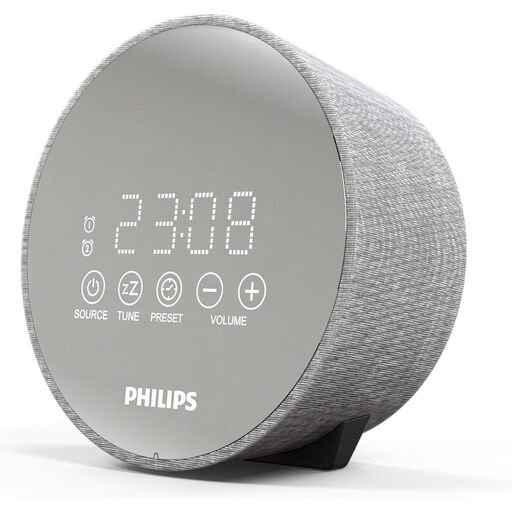 Image unavailable
Suitable for listening via FM if the station can be received where you want to listen.
The product name lists an FM digital tuner, dual alarm, USB charging port, night light and battery backup.
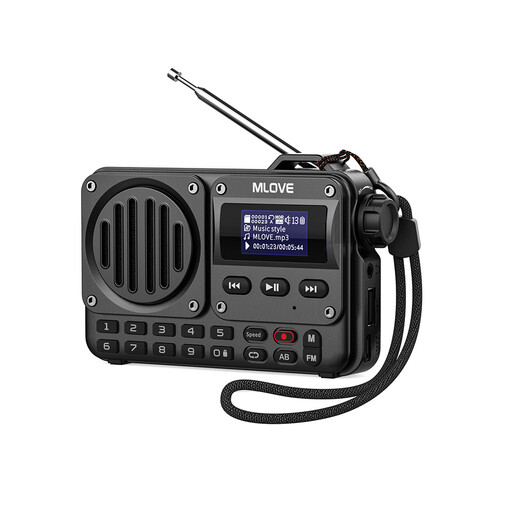 Image unavailable
Suitable for listening via FM if the station can be received where you want to listen.
The product name lists Bluetooth, an LCD screen, an aerial, an AUX input and support for USB and TF cards.
Only if the station broadcasts the programme on FM and you can receive it where you want to listen. For example, NPO Radio 5 doesn’t have an FM frequency and can be heard via DAB+ and the internet, among other options. That doesn’t mean the folk music programme you have in mind is broadcast on NPO Radio 5.
Move the radio or aerial and run an automatic station scan again. NPO Radio 5 recommends this as a reception check, but it doesn’t guarantee coverage in every home.
Check whether the exact model needs mains power, batteries or a rechargeable battery, and whether it’s included. The Pure Evoke Play needs a separate ChargePAK for wireless use; the Denver DAB-18 can run on four C batteries.
For a standard online purchase from a business, you generally have a statutory 14-day cooling-off period from the day after delivery. ACM ConsuWijzer explains the cooling-off period; check the terms and exceptions that apply to your purchase.