
Photographers discussing colour
Want to view images with a small group and weigh up colour specifications and screen performance against the light at the location.


For a photo portfolio on a day out, choose a portable monitor based on colour reproduction and screen finish if you’ll be discussing images, or on standalone power if there’s no mains socket available. Then check that your source device can send a picture through the right USB-C video function or HDMI, and can supply the power needed. Any stated battery life applies only under the manufacturer’s test conditions.
Want to view images with a small group and weigh up colour specifications and screen performance against the light at the location.
Show photos while out and about, in places where access to a mains socket isn’t guaranteed.
Want to check in advance whether their laptop, phone or camera can send a picture to the screen and, where needed, supply power.
Start by thinking about the conditions in which you’ll show your photos, then check the power supply, video connection and portability.
| What to consider | What should you check? | Who should give this more weight? |
|---|---|---|
| Picture and colour | Compare the stated colour gamut, brightness and matte or glossy finish of the exact model. | If I’m discussing photos with others, I want to assess colour and detail in the light at the location. Around 31% of consumers make display quality their top priority. |
| Power supply | Check whether the model has a battery, the conditions under which its battery life was measured and what power the setup requires. | Without a mains socket, I want to know whether the monitor can run on its own or needs power from my source device. Around 25% of consumers prioritise standalone power. |
| Video connection | Check whether your source device has DisplayPort Alt Mode or a suitable HDMI output, and find out which cables and power supply are required. | If I’m bringing a laptop, phone or camera, I want to know in advance whether it can send a picture to the monitor. Around 25% of consumers make connectivity their top priority. |
| Carrying and setting up | Compare the weight and screen size, and check that the stand suits your bag and the place where you’ll be showing your photos. | When I’m carrying my kit, I want a screen that’s practical to take with me and easy to use at the location. Around 19% of consumers prioritise portability and setup. |
For a single USB-C cable connection to the ASUS ProArt PA148CTV, ASUS requires DisplayPort Alt Mode and at least 10 W of output power from the source device.
Before buying, check the video and power specifications of your exact source device and monitor.
Colour specifications and screen finishes vary by model. For example, ViewSonic lists a glossy finish and typical coverage of 64% sRGB for the TD1655.
For colour-critical discussions, compare the model-specific colour specifications as well as the screen finish.
ASUS states that the MB16AHP offers up to four hours of use under the specified test conditions. This isn’t a guaranteed running time for every day out.
Charge the monitor in advance and test your own setup. Take an extra power source if needed.
The ProArt PA148CTV is a compact option for discussing images, while the ZenScreen Go MB16AHP has a built-in battery for mobile use.
The ThinkVision M14d is a 14-inch screen for anyone who wants to carry a lightweight monitor and show photos with their details.
The TD1655 combines touch control with USB-C and mini-HDMI for presentations to one or a few people.
The E14 G4 is a portable screen for anyone considering its stated brightness of 400 nits and anti-glare finish.
These Joybuy picks are portable monitors that give you an extra screen for showing photos. Connections, power requirements and stated display specifications vary by model, so check that your chosen monitor suits your source device and how you plan to use it.
 No image available
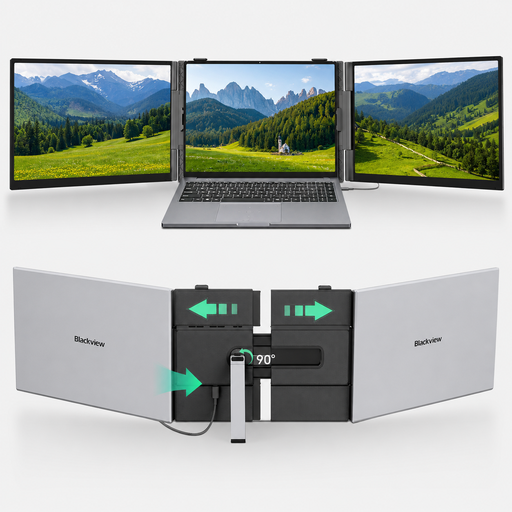
An extra screen for a laptop may suit anyone who wants to show photos alongside their computer; the product title lists laptops from 13–17.3 inches as compatible.
The product information lists Full HD resolution at 1920 × 1080 pixels.
Check your own laptop’s video connection and power supply before relying on the monitor.
 No image available
The listed screen specifications may be useful if you want to show photos and details; also check that the connection is compatible with your source device.
The product information lists 1920 × 1200 pixels, a 16:10 aspect ratio, an IPS screen and 100% sRGB.
The title describes a single-cable USB-C setup; check your own device’s video and power requirements.
 No image available
The built-in stand may come in handy when you want to set up a monitor at your location; check that the connections work with your source device.
The title lists Full HD, an IPS screen, a 16:10 aspect ratio, 144 Hz, two USB-C ports and mini-HDMI.
 No image available
The stated display specifications may be worth considering when discussing photos and details; check compatibility with your source device separately.
The title lists 2.5K, an IPS screen, a 16:10 aspect ratio, 100% sRGB and 10-bit colour.
The title also mentions two USB-C ports and mini-HDMI; check which connections your device actually supports.
 No image available
A touchscreen may suit a presentation where you want to point things out on your photos; check in advance that your source device can output video through a compatible connection.
The product information lists 1080p (1920 × 1080 pixels), USB-C and mini-HDMI.
The product description mentions a protective cover that also works as a stand. Check which cables and power supply your setup requires.
No. Check more than just the shape of the connector. For a single USB-C cable connection to the ASUS ProArt PA148CTV, ASUS requires DisplayPort Alt Mode and at least 10 W of output power. Check your own device’s specifications.
Decide whether you need a monitor with a built-in battery or a model that draws power from your source device. ASUS states that the MB16AHP offers up to four hours of use under the specified test conditions; charge the monitor in advance and test the connection to your source device.
That depends on your camera’s video output and the monitor’s input. ASUS lists micro-HDMI for the PA148CTV; check that your camera can send a compatible video signal and find out which cable and power supply are needed.
For a consumer purchase in the Netherlands, you may be covered by statutory guarantee rights if the product doesn’t meet the standard you could reasonably expect. ACM ConsuWijzer states that, depending on the situation, the seller must put this right free of charge through repair, replacement or a refund; a manufacturer’s warranty does not replace this right.
For a standard online consumer purchase, a statutory cooling-off period usually applies. ACM ConsuWijzer states that it ends 14 days after delivery, although exceptions may apply. Check the terms for unpacking, trying out and returning the product with care.