
Detail-focused researcher
You read small labels or compare details on maps and scans. The National Archives viewer lets you zoom in and out of scans.


For small map labels and details in scans, a portable monitor with more pixels is worth considering. If you want to view a scan alongside your notes, a Full HD screen may be enough. Choose a size that fits your laptop, screen and stand on your desk, and check that your laptop can output video through the chosen connection and power the screen. A different screen won’t add information to the scan itself, so zooming in with the viewer is still useful.
You read small labels or compare details on maps and scans. The National Archives viewer lets you zoom in and out of scans.
You want to view the scan alongside your notes, but your laptop, monitor and stand all need to fit on your workspace. You also want to be able to pack everything away when you’ve finished.
You move your second screen between your room and another study space. Connections, power, weight and any protective features may all influence your choice.
First decide how much detail from the scan you want to see on screen. Then check that the monitor fits on your desk and can connect to and be powered by your laptop.
| What to consider | What should you check? | Who is this important for? |
|---|---|---|
| Scan detail | Compare the stated pixel count and aspect ratio of each model. The National Archives explains how to zoom in and out in its scan viewer; try your own scans at a scale you find comfortable. | If I’m reading small map labels, I want to be able to view enough of the scan at a useful scale. Around 36% of consumers prioritise scan detail. |
| Desk space | Measure the available width and depth, allowing for your laptop, notes and stand. Check the footprint of a dual-screen model when fully unfolded. | At a narrow desk, I want to fit my laptop, screen and notes together, then pack everything away afterwards. Around 29% of consumers prioritise having limited desk space. |
| Connection and power | Check your laptop’s video output, the input and power options of the exact model, and which cables are included. ASUS warns that a laptop’s USB-C port must support video for the MB16AHV; MSI lists HDMI and USB-C with DP Alt Mode for the PRO MP165 E6. | Before buying, I want to be sure that my laptop can send a video signal and power the screen. Around 21% of consumers prioritise connection compatibility. |
| Overall cost and features | Decide which features you’ll use for scan work, and check whether the required cables and power supply are included with the version you’re considering. | If I mainly want to view scans alongside my notes, I don’t want to pay for features I won’t use. Around 14% of consumers prioritise the total cost of buying and using a monitor. |
A USB-C connection on your laptop doesn’t automatically mean that the port can send a video signal to the monitor. Power requirements can also vary by model.
Before you buy, look up your laptop’s port specifications and compare them with the video and power connections on the full monitor model.
On a small desk, the stand, cables and any unfolded screen panels also take up space.
Measure the usable area with your laptop and notes in place. Check a dual-panel model when it’s fully unfolded.
A higher refresh rate and a second panel don’t, by themselves, add information to an archive scan. Two screens offer a different workspace layout from having more pixels on one panel.
Choose first based on the pixels, screen layout and connections you need. ASUS lists a 120 Hz refresh rate for the MB16QHG; consider this feature separately from the resolution and your scan work.
Paying more for features you don’t use won’t automatically reveal more information from the original scan.
The ThinkVision M14t Gen 2 is a compact 14-inch option with a higher stated resolution and touch controls.
The ZenScreen range includes a variety of sizes and features, including a higher-resolution model, a model with a battery and a dual-panel setup.
The PRO MP165 E6 is a 15.6-inch Full HD option with HDMI and USB-C.
The E14 G4 Portable Monitor is a 14-inch Full HD example for anyone looking for a compact second screen.
This selection includes portable second screens for use alongside a laptop, from compact 14-inch models to 15.6-inch and 16-inch screens. Compare the stated size and resolution with the space on your desk, and check which laptop connections you’ll need.
 No image available
A compact second-screen option for use alongside a laptop; the product name states compatibility with laptops from 13 to 17 inches.
14 inches, IPS, 16:9 aspect ratio. The product name states compatibility with Windows, Mac and mobile devices.
 No image available
A 15.6-inch portable second screen; check that the larger setup fits on your desk.
The product name states a 60 Hz refresh rate.
 No image available
A 16-inch screen for anyone considering a larger monitor with a higher stated resolution; allow for the space it will take up on your desk.
2560 × 1600 pixels, 16:10 aspect ratio, IPS and 144 Hz, according to the product name. The name also lists two USB-C connections and Mini HDMI.
 No image available
A portable 16-inch option for anyone considering a larger screen setup; measure the available space on your desk.
The product name lists 2560 × 1600 pixels, a 16:10 aspect ratio, a QLED screen and 144 Hz. Connections: Mini HDMI and Type-C.
 No image available
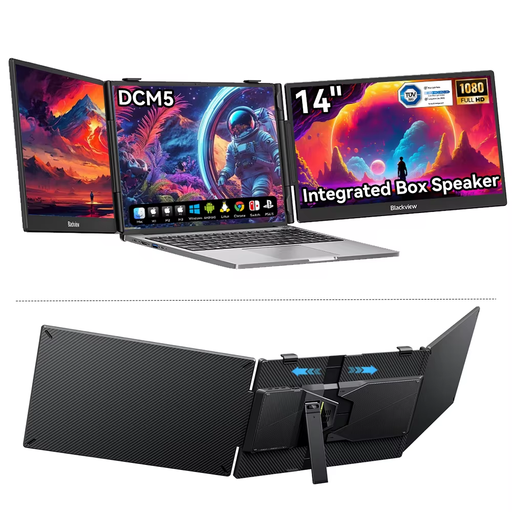
A 14-inch screen extender for use alongside your laptop; the product name states compatibility with laptops from 13 to 17.3 inches.
Full HD (1920 × 1080 pixels). The product name describes a portable extension with an extra screen.
No, not always: the National Archives viewer already lets you zoom in and out of scans. More pixels on a monitor can help you see more of an available scan at once, but they don’t add information to the original scan. Try your own material at a comfortable, readable screen scale.
Not necessarily. Check that your laptop’s USB-C port supports video and how the exact monitor model is powered. ASUS highlights video support as something to check for the MB16AHV. For the PRO MP165 E6, MSI lists USB-C with DP Alt Mode and an HDMI input.
Choose a portrait setup only if the model and stand support it, and use the viewer’s zoom function to view the scan at a suitable scale. The National Archives explains how to zoom in and out when viewing scans.
For an eligible distance sale from a business, the Dutch government says you generally have a 14-day cooling-off period; check the terms and exceptions for your specific purchase. The Netherlands has no fixed statutory guarantee period: if a product is faulty, you can ask the seller to provide a product that meets the required standard. A manufacturer’s guarantee does not replace your statutory rights.