
Chart comparer
You want to keep a tide chart on one screen and read handwritten references on a second, without writing on it.


If you want to read existing handwritten notes alongside a tide chart, a standard portable second screen may be all you need. Choose touch and pen input only if you also want to write directly on the screen. Compare the screen layout with your own documents, and before buying, check that your device can output video through the connection you’ve chosen and power the screen.
You want to keep a tide chart on one screen and read handwritten references on a second, without writing on it.
You want to add marks or notes directly to the portable screen while reading. Touch, pen support, and compatibility with your device and app are then important considerations. Lenovo lists touch and pen support for the ThinkVision M14t Gen 2.
You move between study locations and want to take the screen, stand, cables and power supply with you. A monitor with its own battery calls for different considerations from a screen powered by your laptop.
Choose this if: you only want to view existing scans or notes alongside a digital chart.
The trade-off: you can read on the screen, but will still need to write on paper or use your main device.
Choose this if: you want to mark up or write directly on the extra screen in a compatible app.
The trade-off: check compatibility with your device and app, and whether the supplied pen suits the way you work.
Choose this if: you want a chart, references and another work window visible at the same time.
The trade-off: check that your device supports the multi-screen setup you want and that it will work for your study space.
| Consideration | What should you check? | Who is this important for? |
|---|---|---|
| Reading charts and handwriting | Compare the diagonal size, resolution, aspect ratio and screen orientation with your documents and scaling settings. | If I want to compare a chart and a scan side by side, the text and lines in both windows need to remain legible with my chosen display settings. Around 31% of consumers say readability and window layout are their top buying priorities. |
| Annotating directly | Check touch support, compatible pen, box contents and compatibility with your device and app. | If I want to make new notes on the external screen while studying, the pen needs to suit the way I write. Around 25% of consumers give direct annotation top priority. |
| Video connection and power | Check that the port you’ve chosen supports video; with HDMI, also check what power supply and cable are needed. | If I study on different devices, I want to know in advance whether the monitor will display an image and receive power from my device. Around 25% of consumers put connectivity and power at the top of their list. |
| Portability and setup | Compare the weight of the exact variant and check which stand, cables and power supply you’ll need. | If I often change study locations, I want to know what else I need to take with the monitor and where I can connect it. Around 19% of consumers say portability and setup are their top buying priorities. |
USB-C describes the connection, but it doesn’t automatically mean the port supports video. ASUS advises checking the video capability of the source device. Philips states that the 16B1P3302D/00 requires DP Alt Mode for USB-C video on the device.
Check the port specifications for your own device. If you’re using an HDMI connection, also check the screen’s power requirements.
For the ThinkVision M14t Gen 2, Lenovo lists a passive pen in the box and also discusses active stylus support. That doesn’t necessarily mean the pen you want to use is included in the package.
Check the full model or part number, which pen is included, and whether it’s supported by your device and annotation app.
Features can vary between variants. Philips describes DisplayLink for the 16B1P3302/00, while the 16B1P3302D/00 has a different connection requirement. The ASUS MB16AHG is also a different model from the MB16AHV.
Compare the full model number and check the connections and features you need for each variant.
The ZenScreen models in this comparison range from a conventional second screen to a model with a battery and a dual-panel version.
The ThinkVision M14t Gen 2 is worth considering if you want to make digital annotations on the external screen as well as read from it.
The Business Monitor 16B1P3302D/00 is a portable Full HD model with two USB-C ports.
The E14 G4 is a 14-inch Full HD option for anyone looking for a conventional portable second screen with USB-C.
This selection includes portable second screens for viewing charts and references. One model is described as a touchscreen for anyone considering making on-screen annotations.
 No image available
An option for viewing charts and documents on a second screen.
2.5K IPS screen, 144 Hz, 16:10, two USB-C ports and mini-HDMI.
 No image available
An option for displaying a chart and reference material on a portable second screen.
16 inches, 2560 × 1600, QHD IPS, 16:10, built-in stand, USB-C and HDMI.
 No image available
A second screen for displaying charts and existing notes.
FHD IPS screen, 144 Hz, 16:10, two USB-C ports, mini-HDMI and built-in stand.
 No image available
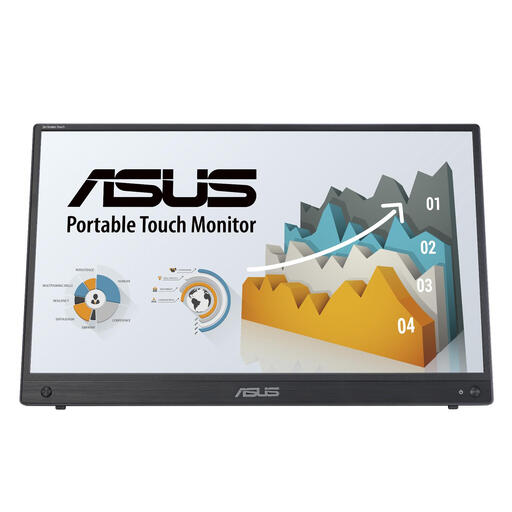
An option to consider if you want to annotate on a touchscreen as well as display documents.
15.6 inches, 1920 × 1080, Full HD and touchscreen.
 No image available
An option for viewing charts and reference material on a second screen.
15.6 inches, 1920 × 1080, Full HD and LED.
Yes, if you display scans or photos from your connected device on the second screen. If you want to write directly on that screen, check that touch, pen, device and annotation app are all compatible.
A USB-C connection doesn’t automatically guarantee a video signal. ASUS recommends checking whether the laptop port supports video; for USB-C video on the 16B1P3302D/00, Philips requires DP Alt Mode. Check your device’s port specifications.
Check which stand, case, video cable and power supply are included with the exact model variant. Dutch ASUS information for the MB16AHV lists, among other items, a USB-C cable, adapter, power adapter and case. This doesn’t tell you what’s in the box with other models.
For online purchases from a business, there is generally a 14-day cooling-off period in the Netherlands, with some exceptions. You’re also covered by the statutory guarantee if a product doesn’t perform as you could reasonably expect under normal use. ACM ConsuWijzer states that there is no single standard guarantee period for all monitors.
The European Commission states that electronic displays within the applicable scope are covered by ecodesign and energy labelling rules. Check the information for the specific model; an energy label alone doesn’t tell you whether it’s compatible with your device, pen or app.