
Teacher with a school laptop
You want to view sources alongside your lesson plan, but need to check which video connection, power supply and software are allowed on your managed laptop.


First, check whether your laptop can output video via USB-C and whether the monitor you choose gets enough power; a USB-C port alone doesn’t guarantee either. Then choose a size that suits your documents and the space available on the table. If your laptop doesn’t support video over USB-C, check what extra power, cables or software you’ll need for an HDMI or USB-A alternative.
You want to view sources alongside your lesson plan, but need to check which video connection, power supply and software are allowed on your managed laptop.
You compare sources with your lesson plan and consider text readability, aspect ratio and screen position.
You take your monitor with you regularly and want the screen, stand and cables to fit a small workspace.
| What to consider | What should you check? | Who is this important for? |
|---|---|---|
| Connection and power | Check the video mode supported by your laptop port, the cable and the power requirements of the exact monitor model. | If I use my laptop at school, I want to know in advance whether the screen will receive a video signal and how it will be powered. Around 36% of consumers say connection and power are their main concerns. |
| Space for reading documents | Compare the diagonal screen size, aspect ratio, resolution, text scaling, reflections and the stand’s viewing angle. | If I read lesson plans and sources side by side, I consider how text will appear in my setup. Around 29% of consumers prioritise readability and screen space. |
| Carrying and setting up | Compare the stated weight and dimensions, the stand’s adjustment range and the space taken up by the cables. | If I take the screen to the library, I want it to fit in my bag and on the table available. Around 21% of consumers prioritise portability and table space. |
| Total cost and aftercare | Check which cables and power supply you’ll need, and review the terms of any additional service cover. | If I choose a monitor for long-term use, I want to know what my setup needs and who I can contact if there’s a problem. Around 14% of consumers focus mainly on total cost and aftercare. |
USB-C ports can have different functions. For USB-C video, your laptop must support the video mode required by the monitor model you choose.
Check the specifications for both your laptop port and the monitor before choosing.
With the ASUS ZenScreen MB169CK, the HDMI connection also requires USB-C power.
Check in advance how you’ll power the whole setup where you plan to work.
Small text and reflections can affect readability, even on a high-resolution screen. Arboportaal highlights small text, insufficient contrast and glare as things to consider when working with a screen.
As well as resolution, compare text scaling, reflections, the stand and how the screen sits on the table.
An extra service package provides additional cover and is separate from the rights you have with the seller.
Before choosing a package, read what it covers and check its terms and conditions.
The ThinkVision M14d is a compact option to consider if you’re looking for a 14-inch screen with a 16:10 aspect ratio.
According to ASUS, the ZenScreen MB169CK has a 15.6-inch Full HD IPS screen, with USB-C video or an HDMI connection option.
The Business Monitor 16B1P3302/00 is worth looking into if you’re considering USB-C video or a possible DisplayLink connection via USB-A.
The PRO MP165 E6 is a 15.6-inch model with HDMI and USB-C video, worth comparing for laptop work.
The Series 5 Pro 514pn is an option to compare if you’re looking for a compact screen with a higher stated resolution.
These portable screens are designed to serve as an extra monitor for laptop work. Compare their stated size, aspect ratio and connections with your laptop and the space available on the library table.
 Image unavailable
A 14-inch screen to compare if you’re looking for a portable second monitor for laptop work.
The product listing specifies Full HD and compatibility with laptops from 13–17.3 inches.
 Image unavailable
Compare this 16-inch screen with a more compact model to see how much workspace will fit on your library table.
The product title specifies FHD, 16:10, 144Hz, IPS, two USB-C ports, Mini HDMI and a built-in stand.
 Image unavailable
This model is worth comparing if you’re considering a 16:10 screen for documents.
The product description specifies 2560 × 1600 and 16:10. The title lists 144Hz, IPS, two USB-C ports, Mini HDMI and a stand.
 Image unavailable
A 14-inch option to include in your comparison of screen sizes and connections for laptop work.
The product title specifies 1920 × 1200, IPS, 16:10, Type-C and Mini-HDMI.
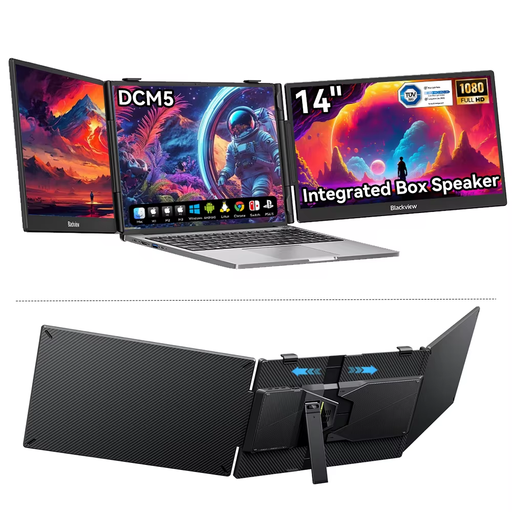 Image unavailable
This compact size is worth comparing if the space available on the table and in your bag is a consideration.
The product title specifies an IPS LCD screen with a 16:9 aspect ratio and compatibility with laptops from 13–17 inches.
Not necessarily. For USB-C video, your laptop must support the video mode required by the screen you choose, such as DP Alt Mode. Check the monitor’s power requirements separately too.
It depends on your laptop and the monitor model. The ASUS ZenScreen MB169CK offers an HDMI connection with a separate USB-C power supply. For the Philips 16B1P3302/00, you could look into the DisplayLink connection via USB-A; also check software compatibility and whether you have permission to install it.
Place the screen on a stable surface and consider text scaling, viewing angle and reflections. Arboportaal highlights small text, insufficient contrast and glare as factors that can affect readability, so don’t choose on resolution alone.
According to the Rijksoverheid, online purchases from a business usually come with a 14-day cooling-off period, although exceptions may apply. If the product is faulty, the seller is responsible for upholding your statutory rights. In the Netherlands, there is no fixed statutory warranty period of two years.