
Survey and map reader
You want to view questionnaires, tables and heatmaps side by side. Readability and the space available on your desk both help determine the screen size and set-up that will work for you.


Choose a portable monitor that is confirmed to receive a video signal from your laptop’s port. Then consider how much space you need for surveys, maps and text, and how you want to position the screen. A 16:10 screen or touch controls may suit certain documents, but check the screen size and connections of the exact model too. An extra monitor won’t block out conversations in the background: where you study calls for a separate solution.
You want to view questionnaires, tables and heatmaps side by side. Readability and the space available on your desk both help determine the screen size and set-up that will work for you.
You’re taking a second screen with you, but first want to know whether your laptop’s specific port can output video and whether the connection and power supply are suitable for your chosen monitor.
You’re reading research findings while other people are talking. A screen that’s comfortable to position and a way to deal with background noise are two separate needs.
| What to consider | What should you check? | Who should prioritise this? |
|---|---|---|
| Room for text and maps | Compare the screen size, aspect ratio, resolution and stand. Also consider text scaling and reflections in the space where you plan to work. | If I want to read surveys, maps and questions side by side, having enough screen space is my top priority; around 36% of consumers cite reading space as their main concern when buying. |
| Video and power connections | Check the video specifications of your laptop’s port, the monitor’s connections, the cable and the power requirements. USB-C alone doesn’t guarantee a video signal. | I want to know in advance whether my laptop and monitor will work together without needing an unexpected connection solution; around 29% of consumers cite connectivity as their main concern when buying. |
| Portability and positioning | Check the dimensions, weight and stand options of the exact model. | When I work in different study spaces, I want the screen to fit in my bag and stand securely; around 21% of consumers cite portability as their main concern when buying. |
| Reading with conversations in the background | Assess the monitor for visual readability, but treat the sound environment as a separate consideration. | If conversations interrupt my reading, I also look for a quieter spot or a separate way to deal with the noise; around 14% of consumers cite concentration when people are talking as their main concern when buying. |
The Philips 16B1P3302D/00 requires DP Alt Mode on the connected device for video over USB-C. ASUS specifies a DisplayLink driver for using the MB16ACE with USB-A.
Before ordering, check your laptop’s port, the connections on the exact monitor model, the cable and the power supply.
Resolution alone doesn’t tell you whether text will be comfortable to read from your usual viewing distance. Screen size, text scaling, reflections and positioning also play a part.
Compare the documents you want to view and check how readable they are in the space where you’ll use the monitor.
A monitor won’t change the noise in your study space. A meta-analysis by Vasilev, Kirkby and Angele on reading found a small but reliable negative effect of background noise and speech on reading performance; it wasn’t a test of any specific monitor.
Choose your screen set-up to suit your visual workspace, and treat conversations as a separate concentration issue.
ZenScreen models offer a range of connection and positioning options. Compare the exact model before you choose.
The ThinkVision M14t Gen 2 is worth comparing if you’re considering a 14-inch 16:10 touchscreen.
The Pro 14 Plus P1425 is an option to compare if you’re looking for a portable 14-inch 16:10 screen without a touchscreen.
The Business Monitor 16B1P3302D/00 combines a 15.6-inch screen with a tilt-adjustable stand.
These portable screens are designed as a second display for surveys, maps and text. Before buying, check that your laptop can provide video and the necessary power through the connection you’ve chosen. The Dutch government states that electronic devices placed on the market in the EU must have CE marking; check this for the specific item you’re buying.
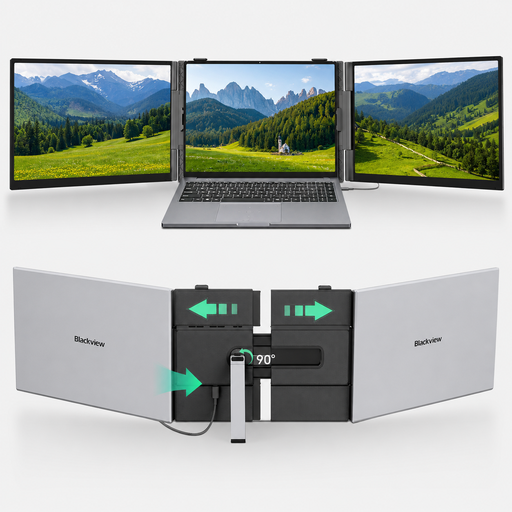 Image unavailable
The 16:10 aspect ratio may suit anyone who wants to view surveys and maps side by side. Check that the laptop extension described is compatible with your laptop size.
15.3 inches, 1920 × 1200, 16:10, IPS and two USB-C ports. The laptop extension described is designed for 14–17.3-inch laptops.
 Image unavailable
The built-in stand may be useful if you want to set up your second screen in different study spaces. Check that the connections are compatible with your laptop.
FHD IPS screen, 16:10, USB-C and Mini HDMI. The product description mentions a built-in stand.
 Image unavailable
The stated 16:10 aspect ratio and resolution may suit anyone who wants to view survey documents, tables and maps on a second screen.
2560 × 1600, 16:10 and IPS. The product name mentions a built-in stand, USB-C and Mini HDMI.
 Image unavailable
The 16:10 aspect ratio and 1920 × 1200 resolution are features to compare if you want to view survey data alongside a map.
IPS, 16:10, 1920 × 1200 and 60 Hz. The product name lists compatibility with Windows, Mac, Chrome OS and mobile devices.
 Image unavailable
The stated 16:10 aspect ratio may suit anyone who wants to view survey data and maps side by side. Also check which input your laptop supports.
QHD IPS screen, 16:10, 2560 × 1600, Mini HDMI and Type-C. The product name mentions VESA compatibility.
No. Philips states that the connected device must support DP Alt Mode for video over USB-C on the 16B1P3302D/00. Check your laptop’s port specifications and the connection requirements of your chosen monitor.
No, a second screen won’t change the noise in your study space. A meta-analysis by Vasilev, Kirkby and Angele on reading found a small but reliable negative effect of background noise and speech on reading performance; the analysis didn’t test any specific monitor.
Consider reflections, contrast and the position of the screen and light source. Arboportaal also sets out specific workplace requirements for employees who work at a screen for more than two hours a day; these don’t automatically apply to every student.
For eligible distance purchases from a business, you usually have a 14-day cooling-off period, according to the Dutch government. The Netherlands has no fixed statutory guarantee period; if a product is faulty, the seller must provide a product that works as it should and resolve the issue in line with the applicable rules.
The Dutch government lists electronic devices among the products that must have CE marking in the EU. Before buying, check the product information and marking on the specific item.