First, choose a portable monitor that can receive a video signal from your laptop. Then decide whether you need fine diagram details, more screen space or a lightweight setup. A second screen can show diagrams alongside study materials, but it won’t block out conversations. If background noise is your main problem, you’ll also need to consider your study space.
Who is a portable monitor suitable for?
Readers of detailed diagrams
If you want to view small labels and lines in rain garden diagrams alongside study materials, compare screen size and resolution together. Lenovo lists a 14-inch screen with 2240 × 1400 pixels for the ThinkVision M14t Gen 2.
Students who study in different places
If you’re taking a second screen with you, it’s worth considering its weight, stand and power requirements, as well as your laptop’s video output. HP lists the E14 G4 as weighing 640 g.
Students who study with conversations in the background
An extra screen can help you organise diagrams and notes, but it won’t change the noise in the room. Arboportaal identifies conversations as a possible source of noise disturbance; the information cited relates to employees.
What should you look for when choosing one?
First, check that your laptop can send a video signal to the screen you’ve chosen. Then decide how much detail, screen space and portability you need. A monitor won’t solve problems with background noise.
| What to consider |
What to look for |
Who is this important for? |
| How clearly diagram details can be seen |
Compare screen size and resolution together, and check whether small labels are readable at the size you want. |
If I want to study fine lines and small labels, I look at the combination of screen size and resolution. Around 28% of consumers prioritise diagram details. |
| Connection and power |
Check whether the specific laptop port supports video and what cables and power supply the monitor requires. |
If you want to know in advance whether your laptop and screen will work together, check that your laptop port supports video. Around 22% of consumers prioritise connection compatibility. |
| Viewing diagrams and taking notes at the same time |
Decide how many windows you need open at once and whether your workspace has room for the screen setup you want. |
If I want to keep diagrams, sources and my own notes side by side, I consider how many separate screens I need. Around 22% of consumers prioritise reading and writing at the same time. |
| Portability and setup |
Compare the stated screen weight with everything else you carry, and check the stand and power supply. |
If you often move between study spaces, you’ll want to know how the screen, cables and stand will fit in your bag and on your desk. Around 17% of consumers prioritise portability. |
| Concentration when people are talking |
Decide whether switching between windows or audible conversations is the bigger problem; a monitor won’t block out ambient noise. |
If conversations are what disrupt my concentration most, I need to consider whether an extra screen will address my main problem. Around 11% of consumers prioritise staying focused when people are talking in the background. |
Common buying mistakes
-
Assuming USB-C means video output
A USB-C port doesn’t automatically send a video signal to a monitor that uses DisplayPort Alt Mode.
Before you order, check the video specifications for the exact laptop port and monitor.
-
Assuming a larger Full HD screen will automatically look sharper
Screen size and pixel count describe different things; a larger screen won’t necessarily look sharper.
Compare resolution and screen size together, and check whether diagram text is readable at the size you want.
-
Choosing an extra screen to block out conversations
A monitor changes your screen layout, not the noise in the room.
First decide whether you mainly need more screen space or are being disturbed by conversations. Address these two problems separately.
-
Assuming a similar model code means it’s the same version
A related model name doesn’t prove that it’s the same monitor version.
Check the full model or part number and the key specifications of the version you want to buy.
Brands to consider
Lenovo
The ThinkVision M14t Gen 2 is a compact 14-inch option to consider if you’re looking for a higher resolution and touchscreen functionality.
- Lenovo lists 2240 × 1400 pixels and two USB-C connections for this model.
- Check that your laptop supports video and the required touchscreen functionality through the connection.
ASUS
The ZenScreen range includes single-panel portable monitors, models with a built-in battery and dual-panel screens.
- ASUS lists a 15.6-inch Full HD screen with USB-C and mini-HDMI for the MB16AHV. For the MB16AHP, ASUS specifies a built-in battery and up to four hours of use under the stated conditions.
- According to ASUS, the MB16AHV has no speaker. Check the exact version and the relevant usage conditions before making your choice.
MSI
The PRO MP165 E6 is a 15.6-inch Full HD model with USB-C and HDMI video connections.
- MSI specifies an anti-glare IPS panel, two USB-C ports with DP Alt Mode and an HDMI input for this model.
- MSI notes that specifications and availability may vary by country, so check the version you’re considering.
HP
The E14 G4 is a 14-inch Full HD option to consider if weight is an important factor.
- HP lists the screen as weighing 640 g.
- A single USB-C cable connection will only work if your computer’s port supports video.
Acer
The PM161QB1 is an option to consider if you’re looking for a portable 15.6-inch Full HD screen with HDMI and USB-C.
- The Acer Store Netherlands lists an IPS panel with 1920 × 1080 pixels and HDMI and USB-C connections for part number UM.ZP1EE.101.
- Check the full part number for the version you’re considering; specifications don’t automatically apply to other versions.
Portable monitors at Joybuy
This selection includes portable extra screens and laptop screen extenders for viewing diagrams alongside study materials. Before use, check your laptop’s video connection and how much space the setup will take up.
 No image available
TECLAST V16H 16-inch portable monitor
An extra screen for viewing a diagram and study materials on a larger display.
16 inches, Full HD, IPS, 16:10, 144 Hz, two USB-C ports, mini-HDMI and built-in stand.
Check whether your laptop’s USB-C port supports video output.
View at Joybuy
 No image available
UPERFECT 16-inch 2K portable monitor
A portable extra screen for viewing diagram details and study materials on a larger display.
16 inches, 2560 × 1600 pixels, 16:10, 144 Hz, QLED, USB-C and mini-HDMI.
Check that your laptop’s video output is compatible with the connection you’ve chosen.
View at Joybuy
 No image available
ARZOPA Z1RC 16-inch 2.5K portable monitor
A portable extra screen for viewing diagrams and study materials on a separate display.
16 inches, 2560 × 1600 pixels, IPS, USB-C, HDMI and built-in stand.
Check that your laptop supports the video connection you’ve chosen.
View at Joybuy
 No image available
Blackview DCM6 Pro 14-inch laptop screen extender
A screen extension for adding an extra display to your laptop.
14 inches, Full HD; the product name states that it’s suitable for 13–17.3-inch laptops.
Before ordering, check your laptop size and the connections on the exact version.
View at Joybuy
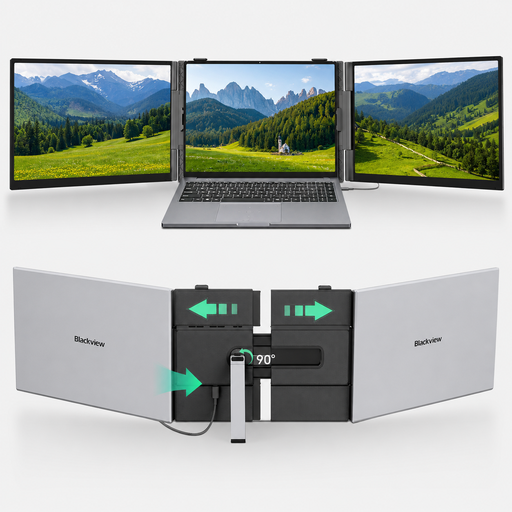 No image available
Blackview DCM8 Pro 15.3-inch FHD screen
A portable screen for viewing study materials on an extra display.
15.3 inches, FHD, USB-C and a stated weight of 1.2 kg.
Check whether your laptop’s USB-C port supports video.
View at Joybuy
Frequently asked questions
Will every USB-C port on my laptop work with a portable monitor?
No. Check whether the specific laptop port supports video output and whether the monitor supports that connection. ASUS distinguishes between USB-C ports with and without video functionality; the shape of the connector alone doesn’t tell you whether it will work.
Do I need to install software to use a second screen?
It depends on the connection and model. ASUS describes a direct, driver-free connection when using a compatible USB-C connection with DP Alt Mode, while some USB display solutions may require a driver. Check the manual and select ‘extend display’ on your computer if you want to show your diagram and notes separately.
Can a portable monitor filter out background conversations?
No. An extra display changes your screen layout, not the ambient noise. If conversations are distracting you, consider your study space too. Arboportaal identifies conversations as a possible source of noise disturbance, but the information cited doesn’t measure the effect of portable monitors on students.
How do I clean a portable screen?
Follow the instructions for the exact model and don’t spray liquid directly onto the screen. The product instructions consulted for the specific ASUS model recommend using a dry, soft microfibre cloth; this advice doesn’t automatically apply to other models.


