For small legends and colour-coded layers, a compact screen with a high pixel density and a stated colour gamut is a sensible option. A larger screen may be more comfortable if extra workspace for diagrams and notes matters more. Lenovo and ASUS publish specifications for their screens, but these are not independent measurements of legibility or colour accuracy. Also check whether your laptop’s USB-C port supports video and how the screen is powered.
Who is a portable monitor suitable for?
Reader of detailed diagrams
Wants to compare small labels and colour-coded layers, so looks at resolution, aspect ratio and stated colour gamut. These specifications alone do not guarantee accurate colour reproduction; Lenovo, for example, states 100% sRGB for the ThinkVision M14d.
Student who often changes location
Carries a laptop and screen between lectures and pays particular attention to size, stated weight and a stable set-up. Lenovo states that the ThinkVision M14d weighs 600 g; ASUS gives the ZenScreen MB16FC a weight of 0.90 kg.
Student using different connections
May use different laptops or workspaces, so checks whether the laptop supports video through the chosen port, which cable is needed and how the screen is powered.
What should you look for when buying?
Start with what you need to make out in your diagrams, then weigh up your preferred screen size, portability and connection.
| What to consider |
What to look for |
Who is this most important for? |
| Details and colours in diagrams |
Compare resolution, aspect ratio and stated colour gamut. Lenovo states that the ThinkVision M14d has a resolution of 2240 × 1400 and 100% sRGB; this is not an independent measurement of colour accuracy. |
I want to be able to distinguish small legends and colour areas clearly. Around 36% of consumers put detailed image quality first. |
| Carrying and setting it up |
Check the dimensions, weight and how the screen sits on a table. Lenovo states that the ThinkVision M14d weighs 600 g, while ASUS gives the ZenScreen MB16FC a weight of 0.90 kg. |
If I’m often carrying the screen between lectures, size, weight and a stable set-up matter a lot. Around 29% of consumers put portability first. |
| Video connection and power |
Check whether the laptop port supports video, which cable is needed and how the screen is powered. ASUS distinguishes between USB-C ports with and without video functionality. |
I want to know in advance whether my laptop can output video through the chosen port and how the screen is powered. Around 21% of consumers prioritise connection compatibility. |
| Extra workspace |
Decide whether you mainly need space for a second window or want to view small details. Then compare size, resolution and the features you’ll actually use. |
I want enough room for an extra PDF or notes window, without features I don’t need. Around 14% of consumers prioritise this kind of simple extra workspace. |
Common buying pitfalls
-
Assuming USB-C guarantees video through a single cable
Not every USB-C port outputs a video signal. ASUS points out that a DisplayLink connection may require a driver.
Before buying, check the video and power capabilities of your laptop port, the screen and the cable you plan to use.
-
Assuming a larger screen is automatically sharper
According to ASUS, the ASUS ZenScreen MB16FC has 1920 × 1200 pixels on a 16-inch screen; Lenovo states that the 14-inch ThinkVision M14d has 2240 × 1400. Screen size and pixel count are different things.
Decide separately how much physical workspace you want and how much detail you need to see in small labels.
-
Confusing stated colour gamut with proven colour accuracy
Lenovo states 100% sRGB for the ThinkVision M14d, but this manufacturer specification is not an independent measurement of colour deviation at your settings.
Use colour gamut as a selection criterion when map layers rely on colour. If colour accuracy is essential, look for a relevant independent measurement.
-
Assuming the manufacturer’s warranty is the full extent of your legal protection
According to ACM ConsuWijzer, your statutory guarantee applies alongside any commercial warranty. What you can reasonably expect from a product depends, among other things, on normal use.
Keep your proof of purchase and model details, and contact the seller if you think a product is faulty.
Relevant brands to consider
Lenovo
The ThinkVision M14d is a compact option for anyone weighing up resolution and stated colour gamut; the ThinkVision M14t Gen 2 is designed for those who need touch and stylus support.
- For the M14d, Lenovo states 2240 × 1400, 100% sRGB and 600 g. For the M14t Gen 2, Lenovo states 2240 × 1400, touch support and 700 g.
- The stated colour gamut is not proof of independent colour calibration. For the M14t Gen 2, also check that your laptop and software support the touch and stylus features you want.
ASUS
According to ASUS specifications, the ZenScreen MB16FC combines a 16-inch 16:10 screen with USB-C video and mini-HDMI.
- ASUS states a resolution of 1920 × 1200, typical brightness of 350 cd/m² and a weight of 0.90 kg.
- The larger screen has fewer pixels than the ThinkVision M14d reviewed here. The stated brightness is not a measurement of outdoor legibility.
MSI
According to MSI, the PRO MP165 E6 is a 15.6-inch Full HD screen with USB-C video and HDMI.
- MSI states a resolution of 1920 × 1080 and DP Alt Mode over USB-C.
- USB-C video only works if the laptop port you’re using supports this feature. Also check the connections, cables and power requirements of the version you choose.
Dell
According to Dell Netherlands specifications, the Dell Pro 14 Plus P1425 is a compact 14-inch alternative without touch functionality.
- Dell Netherlands states that the P1425 has a resolution of 1920 × 1200 and IPS technology.
- The specifications provided do not allow for a comparison of measured colour quality.
Portable monitors at Joybuy
These portable monitors offer extra workspace for study sessions, with both larger 16-inch screens and more compact 14-inch models.
 Image unavailable
TECLAST V16Q 16-inch 2.5K Portable Monitor
A larger workspace for viewing diagrams and notes side by side; check in advance that your laptop supports video through the connection you intend to use.
The product name lists 16:10, 144Hz, 100% sRGB, two USB-C ports, Mini HDMI and a built-in kickstand.
View at Joybuy
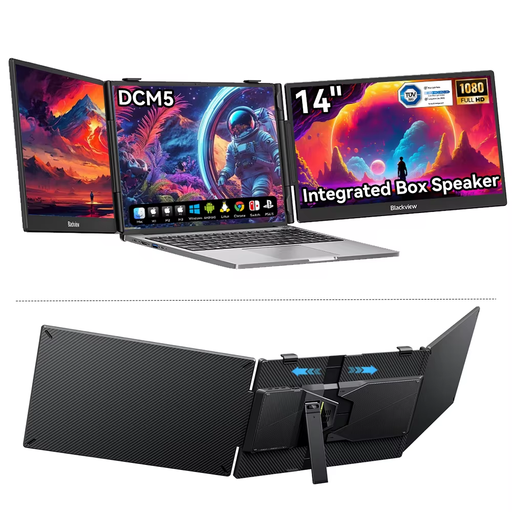 Image unavailable
Blackview DCM5 14-inch 16:9 Portable Monitor
A more compact second screen for anyone who wants to carry a monitor between lectures; check that its size and connection suit your laptop set-up.
The product name lists an IPS LCD screen and compatibility with laptops from 13 to 17 inches.
View at Joybuy
 Image unavailable
UPERFECT 16-inch 2K 144Hz Portable Monitor
A 16-inch screen for anyone looking for more room for diagrams and notes; before buying, check that your laptop supports the video connection you intend to use.
The product name lists 2560 × 1600, 16:10, 450 Nits, QLED, Mini HDMI and Type-C.
View at Joybuy
 Image unavailable
ARZOPA Z1RC 16-inch 2.5K Portable Monitor
A larger second screen for anyone who wants more room alongside their laptop; the stated colour gamut is not an independent measurement of colour accuracy.
The product name lists 2560 × 1600, IPS, 123% sRGB, a built-in stand, USB-C and HDMI.
View at Joybuy
 Image unavailable
Blackview DCM6 PRO 14-inch Full HD Portable Monitor
A compact extra screen for anyone who mainly wants a second window alongside their laptop; check whether your laptop’s USB-C port supports video.
The product name lists Full HD and compatibility with laptops from 13 to 17.3 inches.
View at Joybuy
Frequently asked questions
Will a portable monitor work with any USB-C port on my laptop?
No. Check whether the specific laptop port supports video, for example through DisplayPort Alt Mode, and whether the monitor and cable are compatible with that connection. ASUS distinguishes between USB-C ports with and without video functionality; a DisplayLink connection may require a driver.
How do I set up the screen for a short study session?
Place the monitor on a stable table and connect the appropriate video and power cables. Follow the instructions for the exact model, then choose on your laptop whether to extend or duplicate the display. A single USB-C cable will only be enough if the devices involved support the video and power required.
Do I have a cooling-off period when buying online in the Netherlands?
Yes. For a standard online purchase, there is generally a statutory cooling-off period that ends 14 days after delivery. ACM ConsuWijzer also explains the applicable exceptions and rules for trying out and returning items.
Is a manufacturer’s warranty the same as a statutory guarantee?
No. According to ACM ConsuWijzer, your statutory guarantee applies alongside any seller’s or manufacturer’s warranty. If a product proves faulty during normal use, the seller is responsible for providing an appropriate remedy free of charge; in the Netherlands, there is no single fixed two-year period that applies to every product.
What should I do with a discarded monitor in the Netherlands?
Dispose of the monitor separately as electrical equipment. According to the Dutch Government, when buying a new, similar appliance, individuals can hand in their old one to the seller free of charge under the conditions described, including when buying online. A local council recycling centre is another option.


