Start by checking whether your laptop’s video output is compatible with the monitor’s input, and whether you have enough power and space to set it up. For sorting photos, a stable stand and a clear overview are useful. If you’ll also be assessing colour, you can factor colour gamut into your choice, but that specification alone doesn’t prove colour accuracy. Before buying, check that the version on offer has a CE marking.
Who is a portable monitor suitable for?
Photo selector on the go
You want to compare folders and photo thumbnails side by side, so a compact setup with a compatible display connection is useful. ASUS and Lenovo describe USB-C connections for specific portable models; check whether your laptop’s port supports video output.
Traveller without reliable access to power
You want to be able to sort photos even when there’s no usable power socket. NS says that facilities can vary from one train to another; ASUS lists a built-in battery for the ZenScreen MB16AHP.
Colour-conscious photo organiser
You want to do more than sort photos: you also want to assess their colour. Lenovo lists 100% sRGB for the ThinkVision M14t Gen 2; Adobe describes calibration as a way to set up a monitor profile.
What should you look for when choosing?
First check the video connection and power requirements, then consider whether the size, stand and display suit your space and the way you sort photos.
| What to consider |
What to look for |
Who should pay particular attention? |
| Display connection |
Check that your laptop’s port supports DisplayPort Alt Mode and matches the monitor’s input; also check which cable you’ll need. |
If I want to view photos and folders side by side, my laptop must actually output video through the port I’ve chosen. Around 24% of consumers give a working display connection top priority. |
| Power during your journey |
Check the power requirements or battery of the exact model, and find out what facilities are available on your train journey. |
If there’s no power socket on my journey, I want to know whether my laptop can power the monitor or whether it has its own battery. Around 24% of consumers put power supply at the top of their list. |
| Space to set it up and portability |
Compare the dimensions, including the stand, and the weight of the version on offer; bear in mind the space available at your seat. |
When using a laptop and monitor on a train table, I want to be able to set up and carry my kit within the space available to me. Around 19% of consumers start by looking for a compact, portable setup. |
| Viewing photos at a glance |
Compare screen size, resolution and aspect ratio; check that text and thumbnails are clear at the size you want to view them. |
When selecting photos, I want to see thumbnails and folders at the same time without the screen taking up too much space. Around 19% of consumers give an at-a-glance view of photos top priority. |
| Assessing colour |
Check the model-specific colour gamut, and consider using a suitable profile and calibration for colour-critical work. |
If I’m assessing colour on the go, I want to know which colour gamut is specified and whether my screen is set up correctly. Around 14% of consumers put colour assessment at the top of their list. |
Pitfalls to avoid when choosing a portable monitor
-
Assuming a USB-C port guarantees video output
A USB-C connection on your laptop doesn’t necessarily mean that the port can send video to a monitor. The laptop must support DisplayPort Alt Mode.
Before relying on a single cable, check your laptop’s specifications, the input on the exact monitor you’re considering, and which cable you’ll need.
You may need to carry extra cables or power equipment.
-
Assuming the maximum battery life will last for your whole journey
ASUS quotes a maximum of four hours for the MB16AHP under its stated conditions. NS says that power sockets on Sprinter trains can vary by train type and route.
Plan around your laptop, monitor settings and journey; don’t rely solely on a maximum battery-life figure or the availability of a power socket.
You’ll need to charge a monitor with its own battery; a screen powered by your laptop will drain the laptop’s battery.
-
Confusing colour gamut with colour accuracy
A stated colour gamut, such as 100% sRGB, isn’t an independent measurement of your screen’s accuracy.
Use colour gamut as a selection criterion, and set up a suitably calibrated profile for colour-critical work.
Calibration takes extra setup before you can assess colours critically.
-
Choosing a larger or dual screen without checking your setup
A larger screen or a second panel needs more space next to your laptop. According to NS’s house rules, hand luggage must not take up a seat that another passenger could use.
Check that the screen, stand and laptop will all fit within the space available to you.
Brands to compare
ASUS
The ZenScreen range offers a choice of setups: a single monitor with several connection options, a model with a battery, or two fold-out screens.
- ASUS specifies USB-C and mini-HDMI for the MB16AHV; according to ASUS, the MB16AHP has a built-in battery. The MB14FCD has two 14-inch panels.
- ASUS quotes a maximum of four hours for the MB16AHP’s battery under stated conditions; this doesn’t guarantee that it will last for every journey.
Lenovo
The ThinkVision M14t Gen 2 is designed for detail and colour reproduction, while the L16 offers a larger screen for more workspace.
- Lenovo specifies a 14-inch screen with 2240 × 1400 pixels and 100% sRGB for the M14t Gen 2.
- According to its product specifications, the Lenovo L16 has a 16-inch screen, a 16:10 aspect ratio and 45% NTSC. The colour specification for one model doesn’t automatically apply to the other.
HP
The E14 G4 is a 14-inch portable monitor with USB-C and a case for a compact work setup.
- HP lists 400 nits and a weight of 0.64 kg for this model; these are the stated specifications.
- When comparing products, check the version on offer and the latest product information.
Dell
The P1424H is a compact 14-inch Full HD monitor with two USB-C ports.
- In the P1424H manual, Dell confirms support for DisplayPort Alt Mode and pass-through.
- The stated 72% NTSC doesn’t prove calibrated colour accuracy.
ARZOPA
The A1S is a 14-inch Full HD option; according to ARZOPA, the Z1C is a larger model with a stated sRGB coverage.
- ARZOPA lists a 16.1-inch screen and 100% sRGB for the Z1C.
- According to the product specifications, the A1S has 45% NTSC; the Z1C’s colour specification doesn’t apply to the A1S.
Portable monitors at Joybuy
This selection includes compact 14-inch portable monitors and larger single screens, giving you more room to view photos and folders alongside your laptop.
 Image unavailable
Blackview SCM5 14-inch monitor
A compact extra display for sorting photos alongside folders.
14-inch FHD IPS screen with adjustable stand; the product information lists compatibility with laptops from 13 to 17.3 inches.
View at Joybuy
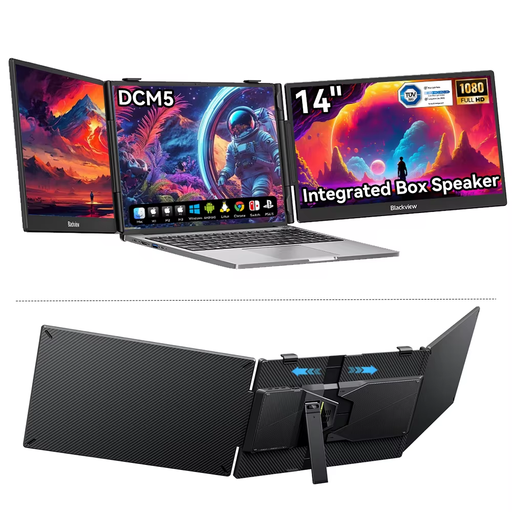 Image unavailable
Blackview DCM5 14-inch monitor
A portable second screen for anyone looking for a compact display alongside their laptop.
14-inch IPS screen with a 16:9 aspect ratio; the product information lists compatibility with laptops from 13 to 17 inches and mobile devices.
View at Joybuy
 Image unavailable
TECLAST V16H 16-inch monitor
A larger single screen for anyone who wants more workspace while sorting photos and has enough room to set it up.
IPS screen with a 16:10 aspect ratio and FHD resolution; the product name lists two USB-C ports, mini-HDMI and a built-in stand. Check that your laptop outputs video through the connection you plan to use.
View at Joybuy
 Image unavailable
TECLAST V16Q 16-inch 2.5K monitor
A larger screen for anyone who wants more workspace and is also interested in the stated colour gamut.
16-inch IPS screen with a 16:10 aspect ratio and 2560 × 1600 pixels. The product information lists 100% sRGB, two USB-C ports, mini-HDMI and a stand; the colour gamut isn’t an independent measure of accuracy.
View at Joybuy
 Image unavailable
Blackview TABLE 9 16-inch monitor
A larger screen for anyone who wants more vertical space and has room for the monitor and stand.
16-inch IPS screen with a 16:10 aspect ratio and 1920 × 1200 pixels. The product information lists USB-C, mini-HDMI and an adjustable rotating stand; check your laptop’s video output.
View at Joybuy
Frequently asked questions
Can every USB-C port on my laptop power a portable monitor?
No. If the monitor uses DisplayPort Alt Mode, your laptop’s port must support that video function. Check your laptop’s specifications, the monitor’s input and the cable before ordering.
Can I count on having a power socket on every train journey?
No. NS says that facilities on Sprinter trains can vary by train type and route. Check what’s available on your journey, and don’t assume that a USB charging port will be suitable for powering your entire laptop and monitor setup.
Does 100% sRGB mean I can assess colours accurately on the go?
No. Stated sRGB coverage isn’t an independent measurement of your screen’s accuracy. For colour-critical work, Adobe describes how to set up a suitable monitor profile through calibration.
Does an electronic monitor sold in the Netherlands need a CE marking?
Yes. The Dutch government states that electronic devices placed on the market in the EU must have a CE marking. Check the marking on the specific version on offer.
How can I protect my photo archive when sorting files on the go?
Back up your files before moving or deleting anything substantial. An extra monitor is just a screen and doesn’t back up your files.


