Choose a portable monitor based on what you want to assess first in your photos: colour, fine detail or a lightweight set-up. ASUS lists factory calibration for the PA148CTV, while the Lenovo ThinkVision M14d and ASUS ProArt PA16USV differ in stated resolution and screen size, among other things. These specifications alone do not determine how accurately your screen displays colour. Also check that your laptop can output video through the connection you choose, and that the power supply suits your set-up.
Who is a portable monitor useful for?
Careful colour assessor
You select and edit photos based on colour, and don’t want to rely on a screen that simply looks vivid. Compare the stated colour gamut and calibration, and pay attention to your own display settings. ASUS Netherlands and ViewSonic Netherlands describe colour features for specific models.
Detail-focused photo selector
You compare sharpness and fine feather details, and want enough pixels and workspace alongside your photo-editing software. Lenovo Netherlands specifies a resolution of 2240 × 1400 pixels for the ThinkVision M14d; ASUS Netherlands lists 3840 × 2160 pixels for the PA16USV.
Photographer travelling light
You take a second screen with you and want its size, weight and connection to suit your laptop and bag. Lenovo Netherlands lists the ThinkVision M14d at 600 g; also check what else you’ll need to carry for your set-up.
What should you look for when choosing?
Start with your main task: assessing colour or viewing fine detail. Then check that the size, portability and connection suit your laptop and the place where you work in the evening.
| What to consider |
What to look for |
Who is it most important for? |
| Colour assessment |
Compare the stated colour gamut and calibration for the exact model. Assess photos using a suitable colour profile and stable ambient lighting. |
If you want to assess colours in feathers, sky and water without relying solely on a saturated-looking image, colour performance may be your top priority. Around 40% of consumers put colour first. |
| Fine detail |
Compare resolution, aspect ratio and screen size, and take your laptop’s scaling settings into account. |
If you want to inspect fine feather details while making room for your photo-editing panels, more pixels and workspace may be important. Around 30% of consumers prioritise detail inspection and workspace. |
| Carrying and setting up |
Compare the monitor’s weight and any stand or other components you’ll need; check that the screen will fit in your workspace. |
If you take the screen with you regularly, you’ll want the complete set-up to fit in your bag and work on the table space available. Around 20% of consumers put portability first. |
| Connection and power |
Check your laptop’s video output, the required port mode and the power requirements of the exact monitor model. |
If you want to get started without connection surprises, check that your laptop can provide the required video signal and power. Around 10% of consumers make compatibility their top priority. |
Common buying mistakes
-
Assuming a stated colour gamut proves colour accuracy
Colour gamut and accuracy are different things. A manufacturer’s stated figures also don’t automatically tell you how your particular unit will look in your evening set-up.
Compare the colour gamut and calibration data for the exact model, and check the selected colour mode for your photo work.
-
Looking only at the shape of the USB-C connector
The connection must also support the required video signal and provide enough power to the monitor.
Compare your laptop’s port specifications with the monitor’s before you order.
Depending on your set-up, you may need a suitable additional cable or a separate power supply.
-
Assuming a larger screen makes for a more practical travel set-up
The screen size and resolution need to work with the weight, stand and space available when you’re travelling.
Compare the complete set-up you’ll be carrying, not just the panel. Stands and set-up features vary by model.
Brands to consider
ASUS
The ProArt PA148CTV is a compact option with stated sRGB specifications; the PA16USV is a separate 15.6-inch model for those who are also considering resolution.
- ASUS lists 100% sRGB and factory calibration with ΔE < 2 for the PA148CTV. For the PA16USV, ASUS specifies a resolution of 3840 × 2160 pixels.
- Calibration is a manufacturer’s stated figure, not a measurement of your individual unit. Also consider whether the screen size and connections suit your workspace.
Lenovo
The ThinkVision M14d is a 14-inch second screen for those weighing up its weight and the workspace available alongside a laptop.
- Lenovo Netherlands specifies a resolution of 2240 × 1400 pixels, 100% sRGB and a weight of 600 g for this model.
- A stated colour gamut coverage is not the same as proven accuracy on an individual screen. Also check the video connection required.
ViewSonic
The VP16-OLED is worth considering if a hood and its stated colour gamut suit your photo work.
- ViewSonic lists a hood, 100% DCI-P3 and ΔE < 2 for this model.
- These are manufacturer’s stated figures. Compare the stated colour profile with your output, and check the connections and power requirements for your device.
LG
The gram +view 16MQ70 is a 16-inch 16:10 model whose specifications can be used for comparison.
- LG Netherlands lists a resolution of 2560 × 1600 and a typical 99% DCI-P3 for the 16MQ70.
- LG Netherlands marks this model as discontinued; its specifications don’t mean it is currently widely available new.
Portable monitors at Joybuy
These models are portable extra screens for use with a laptop, with differences in size, resolution and stated panel features. Check the colour information and connections for each model to see how well they suit your photo work.
 No image available
TECLAST V16Q portable monitor, 16 inches, 2560 × 1600, 144 Hz
A portable second screen for viewing photos and fine details alongside your laptop.
IPS panel, 16:10 aspect ratio, 10-bit colour support and built-in stand. Its stated sRGB coverage alone doesn’t prove colour accuracy.
Joybuy
 No image available
UPERFECT 16-inch QLED monitor, 2560 × 1600, 144 Hz
A portable second monitor for viewing photos on a 16-inch screen alongside your laptop.
16:10 aspect ratio, 1200:1 contrast ratio and stated brightness of 450 nits. The title lists Type-C and Mini-HDMI connections; check compatibility with your own device.
Joybuy
 No image available
ARZOPA Z1RC portable IPS monitor, 16 inches, 2560 × 1600
A portable screen for viewing photos and editing panels alongside your laptop.
16:10 aspect ratio and built-in stand; the stated weight is 810 g. Its stated sRGB coverage alone doesn’t prove colour accuracy.
Joybuy
 No image available
ASUS ProArt PA16USV monitor, 15.6 inches, 3840 × 2160
A larger 4K screen to consider if fine detail is your priority.
ASUS specifies a 15.6-inch screen and a resolution of 3840 × 2160. Your source device must also support 4K output to display content in full 4K.
Joybuy
 No image available
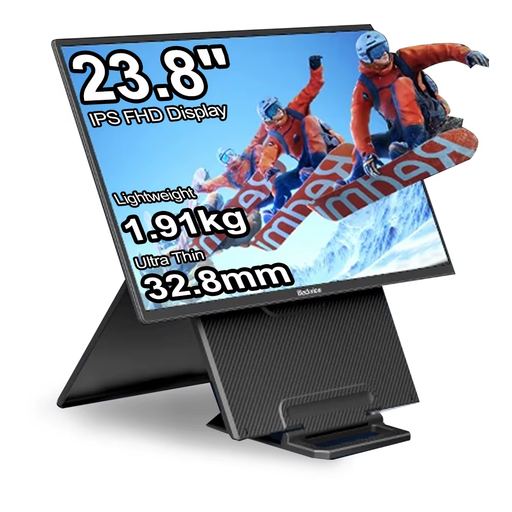
Blackview 23.8-inch HDR LCD monitor, 100 Hz
A larger second screen to consider if you want space for editing panels as well as your photos.
The description lists an IPS panel, 100% sRGB coverage and a weight of 1.91 kg. Stated colour coverage alone doesn’t prove colour accuracy; the weight is worth considering if you take the monitor with you often.
Joybuy
Frequently asked questions
Will one USB-C cable always carry both video and power?
No, don’t assume it will. The Lenovo ThinkVision M14d specifies USB-C with DisplayPort Alt Mode. Check your laptop’s video output, power delivery and compatible cable, and follow the connection instructions for the exact monitor model.
How can I use a portable monitor in the evening for a fair comparison?
Keep the ambient lighting as consistent as possible and check the selected colour mode before comparing the same photos. ViewSonic describes the VP16-OLED as having a shielding hood; this doesn’t replace checking the colour profile or calibration.
Do I have a cooling-off period when buying online in the Netherlands?
For a standard online consumer purchase, ACM ConsuWijzer says you generally have a statutory cooling-off period of up to 14 days after delivery. Check whether a legal exception applies to your purchase.
Is the manufacturer’s warranty my only right if the monitor breaks too soon?
No. ACM ConsuWijzer distinguishes between a commercial guarantee and the statutory guarantee: you can expect your purchase to work properly for a reasonable time for that product. There isn’t one fixed statutory guarantee period for every monitor.


