First, decide how the monitor and your image source will be powered: a monitor with a built-in battery relies less on your camera, phone or laptop battery, while a screen without one needs a suitable power source or a separate power supply. Then compare the colour specifications and check that your device can actually send video to the input you’ve chosen; a USB-C port alone doesn’t guarantee this.
Who is this for?
Photographers visiting clients
You want to show your portfolio without a mains socket and need to know in advance how long the complete setup will last. A monitor with a built-in battery and one powered by a laptop require different preparations. ASUS quotes up to four hours of battery life for the ZenScreen Go MB16AHP under its stated test conditions.
Photographers who want to discuss colour
You use the screen to view photos with a client and want to know which colour gamut the model specifies. These details are useful for comparing models, but they don’t measure the colour accuracy of the individual unit you buy.
Photographers using a camera or phone as the image source
You may want to present without a laptop. So first check your camera or phone’s video output and make sure it matches an input on the monitor.
What should you look for?
For a presentation without mains power, the power setup is the first thing to consider. Then check the video connection, colour specifications and how you’ll position the screen at your location.
| What to consider |
What should you check? |
Who is this important for? |
| Power for your presentation |
Compare a built-in battery with power from your laptop or a suitable external supply. Check the stated battery life and test the complete setup in advance. |
If I’m presenting without a mains socket, I want to know whether the monitor and image source will stay powered throughout the appointment. Around 31% of consumers prioritise reliable power. |
| Colour reproduction |
Compare the stated colour gamut and any accuracy claims for the exact model; don’t treat them as a measurement of your individual unit. |
When I discuss photos with a client, I want to know what colour specifications the screen quotes. Around 25% of consumers give colour assessment top priority. |
| Connecting to your image source |
Check the video output on your camera, phone or laptop, the input on the monitor and the cable you’ll need. For USB-C, specifically check that the source supports the required video mode. |
If I want to present without a laptop, my camera or phone needs to provide a compatible video signal. Around 25% of consumers prioritise source compatibility. |
| Visibility and positioning |
Consider the stated brightness alongside features such as anti-glare coating, a hood, a stand or a tripod mount. Brightness alone doesn’t guarantee a clear picture in direct sunlight. |
When I’m on location, I want to position the screen so my client can view the portfolio clearly. Around 19% of consumers give visibility and positioning top priority. |
Common mistakes
-
Assuming ‘portable’ means ‘works without a power source’
A portable monitor may need power from a laptop or an external supply. That’s a different setup from a monitor with a built-in battery.
Before buying, check how the exact model is powered and test the complete setup without a mains socket.
If the model needs an external supply, you’ll also need to bring a suitable power source.
-
Assuming every USB-C port carries video
For USB-C video, the image source also needs to support the required video mode. ASUS specifies DisplayPort Alt Mode as a requirement for USB-C video on the ZenScreen MB16AHP.
Before choosing your setup, check the exact video outputs on your source, the monitor input and the cable you’ll need.
-
Treating a stated colour gamut as a guarantee of colour accuracy
Colour coverage and a colour-accuracy claim are different specifications. A spec sheet doesn’t prove how accurately the unit you buy will display your photos.
Compare the stated specifications with your presentation needs and consider how much you value colour assessment on location.
Brands worth considering
ASUS
The ZenScreen range includes models with different connections and power setups, including the MB16AHP and MB16AHV.
- ASUS quotes up to four hours of battery life for the MB16AHP when using DisplayPort Alt Mode at 100% brightness; actual battery life depends on the setup.
- According to ASUS, the MB16AHV has USB-C ports and mini-HDMI, as well as a kickstand and tripod socket.
- Don’t assume that the MB16AHP’s specifications also apply to the MB16AHV. The stated brightness of the MB16AHV doesn’t guarantee that it will be easy to see in every outdoor setting.
Lenovo
The ThinkVision M14t Gen 2 is a compact option for a laptop with a compatible USB-C video output.
- Lenovo specifies a 14-inch screen, 2240 × 1400 pixels, 100% sRGB and a weight of 700 g for this model.
- USB-C power pass-through doesn’t mean the monitor has a built-in battery. Check how your laptop and monitor will be powered in your setup.
ViewSonic
According to ViewSonic, the ColorPro VP16-OLED is designed for creators who want to view images on location, including with a camera that has a suitable HDMI output.
- ViewSonic quotes 100% DCI-P3 and Delta E < 2 for this model, and says it comes with a monitor hood.
- These are ViewSonic’s specifications and claims, not independent measurements of the unit you buy. Check the power supply if you plan to use it without a mains socket.
HP
The E14 G4 is a portable USB-C monitor that you can use as an extra screen with a compatible computer.
- HP specifies a 400-nit anti-glare screen and connection via a single USB-C cable.
- HP’s claim about visibility in direct sunlight comes from the manufacturer. Before using it without a mains socket, check how both the monitor and computer will be powered.
Portable monitors at Joybuy
These models are portable screens for use with a compatible laptop or other image source. Check the video connection for each model and how you’ll power the monitor without a mains socket.
 No image available
Blackview DCM6 PRO 14-inch portable monitor
Could suit a portfolio setup with a compatible laptop.
The product title describes a 14-inch Full HD monitor. The product description mentions compatibility with laptops from 13 to 17.3 inches.
View at Joybuy
 No image available
TECLAST V16H 16-inch portable monitor
Could be an option if you want to connect a compatible image source and use a built-in kickstand.
The product title describes a 16-inch Full HD IPS screen, 144 Hz, two USB-C ports, Mini HDMI and a built-in kickstand.
View at Joybuy
 No image available
TECLAST V16Q portable monitor
Could be worth considering if you want to show photos from a compatible source and compare the stated colour coverage.
The product description lists 2.5K, 144 Hz, IPS, 100% sRGB, 10-bit colour, two USB-C ports, Mini HDMI and a kickstand.
View at Joybuy
 No image available
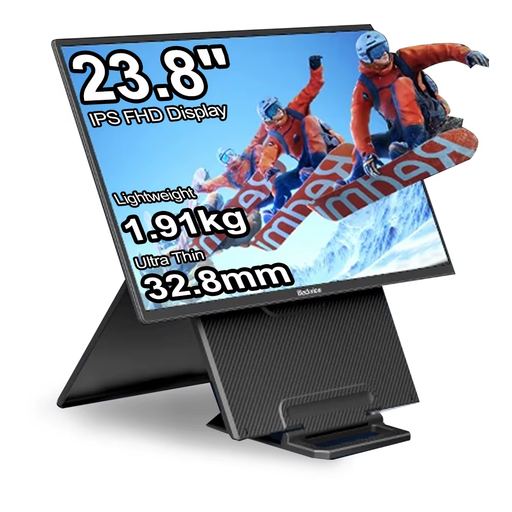
Blackview 23.8-inch portable HDR LCD monitor
Could work if you want to show your portfolio from a compatible PC, smartphone or tablet.
The product description lists 1920 × 1200 pixels, 100% sRGB, 300 nits and USB-C and Mini HDMI connections. It also gives a weight of 1.91 kg and says there is no stand.
View at Joybuy
 No image available
Lenovo L16 16-inch portable monitor
Could suit use with a laptop that supports USB-C video via DisplayPort Alt Mode.
The product description lists a WUXGA IPS screen, USB-C with DisplayPort Alt Mode and up to 65 W Power Delivery. It also mentions a weight under 1 kg and a protective case.
View at Joybuy
Frequently asked questions
Can every USB-C phone or laptop be used as an image source?
No. The source needs to support the video mode required by the monitor. ASUS specifies DisplayPort Alt Mode for USB-C video on the MB16AHP. Check the video specifications of your exact device and the monitor’s connection.
Can I connect a camera directly and present without a mains socket?
Only if the camera and monitor have a suitable video connection and the monitor is powered. ViewSonic specifies micro-HDMI for the VP16-OLED; also check your camera’s output, the cable you’ll need and the power setup.
How should I prepare a monitor with a built-in battery for a presentation?
Charge the monitor in advance and test the complete setup, including the source, cable and screen, at the brightness you plan to use. ASUS quotes up to four hours for the MB16AHP when using DisplayPort Alt Mode at 100% brightness; those stated conditions don’t guarantee the same result for every setup.
What are my rights when shopping online in the Netherlands?
According to the Netherlands government, when you buy online from a business you usually have 14 days to change your mind, although exceptions may apply. If a product is faulty, the seller is responsible for providing a solution. The Netherlands Authority for Consumers and Markets (ACM) states that there is no fixed term for the statutory guarantee in the Netherlands, and that it is separate from any manufacturer’s warranty.


