Start with a monitor that can receive a video signal from your laptop, tablet or phone, and can be positioned securely so the person you’re talking to can see it. For reviewing photos, the stated colour gamut is useful if it suits your photography workflow, but it doesn’t prove how accurately the colours are displayed on your individual monitor. You should also consider the space available on the table and how the monitor is powered.
Who is a portable monitor suitable for?
Photographers discussing colour
Show photos to a client or collaborator and want to assess the colour display without mistaking a stated colour gamut for measured colour accuracy. Lenovo and ASUS provide colour specifications for the models mentioned.
Presenters at a small table
Want to look through a portfolio together while keeping space for the source device and the conversation. The screen size, stand and viewing angle all affect how you arrange the table; Lenovo and Arzopa offer different screen sizes and stand designs.
Presenters using different devices
Use a laptop, tablet or phone, for example, and check beforehand that the device can output video through the chosen input. ASUS describes different connection options for the ZenScreen models mentioned.
What should you look for?
First, check that your source device can output video through one of the monitor’s connections. Then compare the colour information with your photography workflow, and make sure the screen, stand and power supply are right for your kitchen table.
| What to consider |
What should you check? |
Who should consider this? |
| Colour display |
Does the stated colour gamut suit your photo files and chosen colour mode? Treat colour coverage and colour accuracy as separate properties. |
If I’m discussing photos in an sRGB workflow, I want to know whether the stated coverage is suitable; around 33% of consumers make colour display their top priority. |
| Video connection |
Check the video output on your source device, the monitor’s connection and the cable you’ll need. USB-C doesn’t automatically support video input. |
When I switch between devices, I want to be sure my own laptop, tablet or phone can output video to the monitor; around 27% of consumers put a working connection first. |
| Table space |
Compare the screen and stand dimensions with the space left for your source device. Also check that the screen stays stable at the viewing angle you want. |
If I’m sharing the screen with someone at a small table, I want to leave enough room for the conversation; around 20% of consumers prioritise space for their setup. |
| Power |
Check whether the monitor needs power from the source device, has a battery, and the conditions under which its stated battery life applies. |
When there isn’t necessarily a mains socket near the table, I want to know how to power the screen; around 20% of consumers make independent power their top priority. |
Pitfalls to avoid when buying a portable monitor
-
Assuming every USB-C port supports video
For video over USB-C DisplayPort Alternate Mode, the source device must also support this feature. ASUS specifies this requirement for the ZenScreen Go MB16AHP.
Before choosing a monitor, check the video output on your device and the cable you’ll need.
You may need a different cable, adapter or connection method if your devices don’t use the same connection.
-
Assuming a wide colour gamut guarantees accurate colours in photos
Colour coverage and colour accuracy aren’t the same thing. A stated colour coverage figure doesn’t, on its own, tell you how accurately an individual screen has been calibrated.
Compare the stated colour gamut with your photography workflow, and consider coverage and accuracy separately.
-
Planning a presentation around the stated battery life
ASUS states the maximum operating time for the MB16AHP under specific usage conditions, so battery life will vary depending on the settings.
Test the monitor beforehand at your preferred brightness and arrange a suitable power supply if needed.
If the battery doesn’t last for the whole conversation, you’ll still need a power source.
Brands to consider
ASUS
The ZenScreen models cater for different needs: the MB16AHV offers a choice of connections, the MB16AHP has a built-in battery, and the MQ16AH has a stated wide OLED colour gamut.
- ASUS lists USB-C with DP Alt Mode and mini-HDMI for the MB16AHV, and USB-C and micro-HDMI for the MB16AHP.
- The stated battery life for the MB16AHP applies under specific usage conditions. The MQ16AH has no built-in height adjustment.
Lenovo
According to Lenovo, the ThinkVision M14t Gen 2 is a 14-inch 16:10 screen with stated 100% sRGB coverage and touch control.
- The 14-inch size may suit a small table; Lenovo also lists a tilting stand.
- The colour coverage is a manufacturer’s claim, not an independent measurement of colour accuracy. Touch control is only useful if your source device and controls support it.
Arzopa
According to Arzopa, the Z1C is a 16.1-inch Full HD IPS monitor with stated 100% sRGB coverage and a built-in stand.
- The larger screen gives you more physical viewing space than a more compact model.
- A larger screen takes up more table space. The stated colour coverage doesn’t, on its own, tell you how accurately an individual screen has been calibrated.
Dell
The P1424H is a documented 14-inch portable IPS model with an anti-glare coating.
- Dell lists two USB-C ports with DisplayPort Alt Mode.
- Check that the connections suit your source device and that the setup is stable enough on the table.
HP
HP lists an anti-glare screen and 400 nits of brightness for the E14 G4.
- The stated brightness and anti-glare finish may be worth considering when setting up at the table.
- HP’s stated brightness doesn’t, on its own, confirm that the screen is suitable for colour-critical photo reviews.
Portable monitors at Joybuy
These Joybuy products are portable monitors designed to work as a second screen when showing photos. For each model, check that the connections, dimensions and power supply suit your device and table setup.
 No image available
Blackview DCM6 PRO 14-inch Dual-Screen Laptop Extender, Full HD
A portable second screen for showing photos from a laptop at the table.
14 inches; Full HD; compatible with 13–17.3-inch laptops according to the product name.
Before buying, check that your laptop and preferred setup match the stated compatibility.
View at Joybuy
 No image available
TECLAST V16H 16-inch IPS monitor
A larger screen with a built-in stand for viewing photos together and connecting multiple devices.
16 inches; IPS; 16:10; Full HD; two USB-C ports and mini-HDMI; built-in stand.
Check which input can receive video from your source device and whether the stand is stable on your table.
View at Joybuy
 No image available
TECLAST V16Q 16-inch 2.5K IPS monitor
An option for anyone looking for a portable screen with stated sRGB coverage for a photo portfolio.
16 inches; 2.5K; IPS; stated 100% sRGB; 16:10; two USB-C ports, mini-HDMI and a built-in stand.
The stated coverage isn’t an independent measurement of colour accuracy. Also check that your device can output video through one of the inputs.
View at Joybuy
 No image available
PM14R 14-inch IPS monitor
A portable second screen for anyone looking for a more compact size and multiple connection options.
14 inches; IPS; 1920 × 1200; 16:10; Type-C and mini-HDMI.
Check which input matches your device’s video output and which cable you’ll need.
View at Joybuy
 No image available
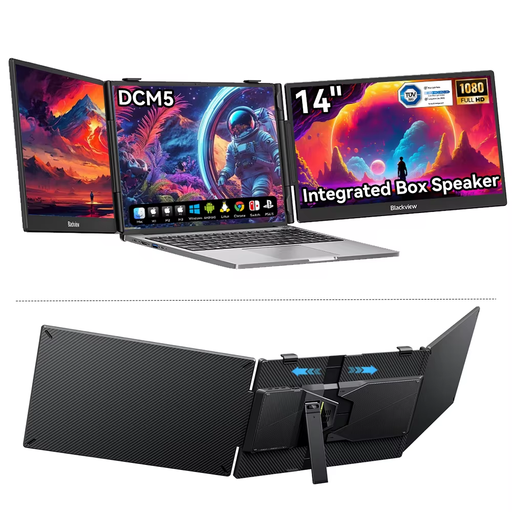
Blackview DCM5 14-inch IPS monitor
A portable second screen for a laptop setup at the table.
14 inches; IPS LCD; 16:9; suitable for 13–17-inch laptops according to the product name.
Check that your specific laptop and preferred connections will work with the monitor.
View at Joybuy
Frequently asked questions
Does every USB-C port work as a video connection straight away?
No. Check whether the USB-C port on your source device can output video. ASUS states that the MB16AHP requires DisplayPort Alternate Mode support on the source device too, so check your device and cable.
How should I position the monitor for a conversation at the table?
Set up the screen and stand securely, then check the viewing angle before opening your portfolio. Lenovo lists a tilting stand for the ThinkVision M14t Gen 2; the position that works best will depend on your table setup.
Should I choose an OLED monitor with DCI-P3 for showing photos?
Not necessarily. Choose a colour gamut that suits your photos and preferred colour mode. ASUS states 100% DCI-P3 and ΔE < 2 for the MQ16AH; Lenovo lists 100% sRGB for the M14t Gen 2. These are manufacturer claims, not independent measurements of your individual monitor.
What can I do if a monitor I bought online isn’t suitable or develops a fault?
For many online purchases from a business, the Dutch government says you have a 14-day cooling-off period; check whether it applies to your purchase. If a product is faulty, the seller must handle the statutory guarantee. In the Netherlands, there is no fixed statutory guarantee period.


