
Colour-critical photo reviewer
You compare colours across measurement photos and want to know what colour data is specified for the screen. Picture settings and the light at your workstation also play a part, as Adobe and EIZO explain.


When reviewing polder photos in the evening, start by checking substantiated colour data if colour comparison matters to you. If you want to view small details alongside revision notes, consider resolution and screen space. ASUS lists 100% sRGB and ΔE < 2 for the ProArt PA148CTV; Lenovo gives the ThinkVision M14t Gen 2 a resolution of 2240 × 1400. These are manufacturer specifications, not a guarantee of how the display will look in your working environment. Also check the picture settings, ambient light and whether your laptop can provide the required video signal and power through your chosen connection.
You compare colours across measurement photos and want to know what colour data is specified for the screen. Picture settings and the light at your workstation also play a part, as Adobe and EIZO explain.
You want to inspect small features in photos while keeping your notes open. Lenovo and Verbatim describe models with different screen sizes and resolutions for you to consider.
You move between workspaces and want to check in advance whether your laptop can provide video and enough power via USB-C, or whether you’ll need HDMI and a separate power supply. ASUS and Verbatim list connection requirements for specific models.
Choose colour data, detail and connectivity based on what you actually need during photo reviews. A stated colour gamut alone doesn’t prove colour accuracy.
| What to consider | What should you look for? | Who should pay particular attention? |
|---|---|---|
| Colour reproduction | Check the stated colour coverage and any accuracy data for the exact model. Also see whether you can set the picture mode to suit your needs. | If I compare colours across measurement photos, I want to know what colour data is specified and how I can set up the screen for my workstation. Around 33% of consumers put colour reproduction at the top of their list. |
| Photo detail and notes | Compare the resolution with the screen size and the space you have to view photos alongside revision notes. | I want to assess small features without losing sight of my notes. Around 27% of consumers give photo detail and workspace the highest priority. |
| Video and power | Check whether USB-C supports video and supplies enough power, or find out which HDMI and power connections the screen requires. | I want to use my existing laptop setup without discovering too late that the connection isn’t suitable. That’s why around 20% of consumers start by checking compatibility. |
| Portability and setup | Weigh the screen size and stated weight against where you’ll be using the screen in the evening. Also check the stand and space for cables. | I work in different places and want a screen I can take with me and set up wherever I go. Around 20% of consumers prioritise portability and setup. |
The USB-C connection needs to support the required video function and power. For a single-cable connection to the PA148CTV, ASUS specifies DisplayPort Alt Mode and at least 10 W from the connected device.
Check the specifications for both your laptop and the exact monitor model before choosing how to connect them.
Perceived colour is also affected by picture settings, calibration status and ambient light. So stated colour coverage alone doesn’t tell you how the screen will display your photos.
Check the colour data listed for the exact model, then adjust the screen to suit the lighting at your workstation.
For the Verbatim #32239, Verbatim specifies a separate power supply when using HDMI. According to Verbatim, touch functionality via HDMI also requires an additional USB cable.
Before buying, check which connections you plan to use and which cables are included with the version on offer.
The ProArt PA148CTV is worth considering if you want to compare colour data for a compact monitor. The ZenScreen MB16AHV is designed for general use, with USB-C and mini-HDMI.
The ThinkVision M14t Gen 2 is a compact option to compare if resolution and touch functionality matter when viewing details.
The portable 4K monitor #32239 is a larger screen with USB-C and HDMI to compare if screen space or available connections are important to you.
The E14 G4 is a 14-inch second screen to consider if you’re looking for a portable business setup via USB-C.
These Joybuy products are portable screens to compare by photo detail, size, connectivity and the colour data listed for each specific model.
 No image available
The stated resolution may be worth considering if you want to view small photo details; resolution alone says nothing about colour accuracy.
The product title lists 2560 × 1600 pixels, a 16:10 aspect ratio, a QLED screen, 450 nits, USB-C and Mini HDMI.
 No image available
This model could suit anyone looking for a portable screen with a high stated resolution and a built-in stand.
The product information lists 2560 × 1600 pixels, IPS, 123% sRGB, USB-C and HDMI. Stated colour coverage alone doesn’t prove calibrated colour accuracy; settings and ambient light also play a part.
 No image available
The 4K resolution may be useful if you want to view fine details on a portable screen; check that your source device supports 4K output.
The product title lists 3840 × 2160 pixels, 4K UHD and an LCD screen.
 No image available
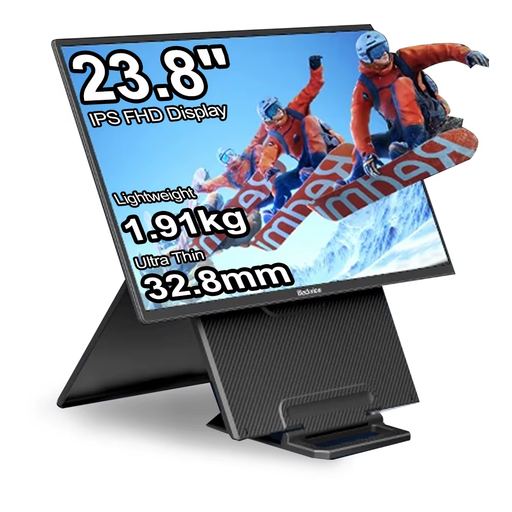
The larger stated screen size could suit you if you want to view photos alongside revision notes; bear in mind the space available at your workstation.
The product title lists an HDR LCD screen and a 100 Hz refresh rate.
 No image available
The stated resolution is worth considering if you want to view small photo details.
The product title lists an IPS screen, 2560 × 1600 pixels, 100% sRGB, 10-bit, 16:10, two USB-C ports and Mini HDMI. The stated colour coverage isn’t an independent measurement of colour accuracy.
No, the shape of the connection alone isn’t enough. For a single-cable connection to the PA148CTV, ASUS requires DisplayPort Alt Mode and at least 10 W from the connected device. Check the specifications for your laptop and chosen screen.
Adjust the screen to suit the lighting at your workstation and take ambient light into account. Adobe lists screen differences, calibration status and ambient light among the factors that affect perceived colour. EIZO explains that the calibration target depends on the lighting at your workstation.
That depends on the model and the features you want to use. For the Verbatim #32239, Verbatim specifies a separate power supply when using HDMI and an additional USB cable for touch functionality. Also check which cables are included with the version on offer.
Report the problem to the retailer. According to the Government of the Netherlands, the retailer must provide a solution if a product develops a problem; any manufacturer’s guarantee is in addition to this.
For a distance purchase from a business, consumers generally have a 14-day cooling-off period, according to the Government of the Netherlands. This doesn’t necessarily apply to a business purchase or a purchase from a private individual; check which terms and conditions apply to your purchase.