
Photographer organising images on the go
You want to organise photos, folders and metadata across two screens between appointments. A portable extra workspace is your priority.


When organising folders, selections and metadata between client visits, a portable monitor is mainly an extra workspace. Look at its size and weight, and check that the connection to your laptop can provide both a video signal and enough power. If you also assess colour for client work, compare the specifications for the exact model and don’t treat manufacturer claims as proof of colour accuracy in your own setup.
You want to organise photos, folders and metadata across two screens between appointments. A portable extra workspace is your priority.
You select images and assess colour for client work. Look at the specified colour gamut and settings for the exact display model.
You work in different locations and want to know in advance whether your laptop can provide both a video signal and enough power for the display.
Choose this if: you mainly want to see folders, keywords and selections side by side.
Bear in mind: a smaller screen may leave less room for multiple windows, and colour specifications may not be provided.
Choose this if: you want to see more windows or have more vertical workspace while selecting images. Lenovo specifies a 14-inch 16:10 screen with 2240 × 1400 pixels for the ThinkVision M14t Gen 2.
Bear in mind: more workspace doesn’t automatically mean better colour assessment. Check the connection too, along with any support for touch controls.
Choose this if: you assess client photos and the stated colour gamut suits your workflow.
Bear in mind: ASUS and ViewSonic list colour specifications as product details; these alone don’t show how the display will perform in your setup. ASUS also specifies connection requirements for using a single USB-C cable.
| What to consider | What should you look for? | Who is this important for? |
|---|---|---|
| Workspace for sorting | Compare the screen size, resolution and aspect ratio with the space in your bag and at your workstation. | If I want to see photos and management information at the same time, workspace comes first; around 36% of consumers give this need top priority. |
| Colour for client photos | Decide which colour gamut your workflow uses, and distinguish stated coverage from a measurement taken in your own setup. | If you also assess colour in client photos, you’ll want to compare the specifications for the exact model; around 29% of consumers prioritise colour assessment. |
| Video connection and power | Check your laptop port, video support and the power requirements of your chosen display. | When working in different locations, I want to know in advance whether my laptop and monitor can handle both video and power; around 21% of consumers give connection reliability top priority. |
| Weight and protection | Check the weight of the complete setup you’ll carry, and see what’s included in the way of a case, stand and cables. | If I take the monitor with me between client visits, weight and protection matter; around 14% of consumers prioritise portability. |
To use a single USB-C cable with the ASUS ProArt PA148CTV, the connected device needs DisplayPort Alt Mode and at least 10 W output power.
Check your laptop’s port specifications and the connection requirements for the exact display model before choosing a cable setup.
A colour gamut or colour deviation specification applies to the named model. It doesn’t replace an assessment of your own workflow and setup.
First decide which colour gamut you need. Treat manufacturer specifications as product details, not as an independent measurement taken after installation.
A case and other accessories can change the weight of what you actually carry. On a French product page, LG lists separate weights for the 16MR70 with and without its case; this doesn’t confirm what’s included with the Dutch version.
Check what’s included with the version you’re considering and factor in the weight of the complete setup.
The statutory cooling-off period for an online consumer purchase doesn’t automatically apply when you buy as a business.
For a business order, agree the return and service terms in advance, especially if you want to test the monitor with a specific laptop.
The ZenScreen MB166C and ProArt PA148CTV are portable displays designed for different working needs.
According to Lenovo, the ThinkVision M14t Gen 2 combines a 14-inch 16:10 screen with high vertical resolution and touch controls.
The VP16-OLED is aimed at mobile creators who want to assess images on location too.
The gram +view 16MR70 is a portable 16-inch 16:10 option for anyone looking for more screen space.
The E14 G4 is a compact Full HD option with USB-C for a second workspace.
These portable monitors can give you extra workspace alongside your laptop for organising photos and management information. Compare their size, aspect ratio and connections with your mobile setup.
 No image available
This model is designed as a second screen for a laptop and may suit you if you’re looking for a compact extra workspace.
The product name specifies a 14-inch Full HD screen and compatibility with 13–17.3-inch laptops.
 No image available
The 16:10 aspect ratio may suit you if you want more vertical space for windows alongside your laptop.
The product name specifies Full HD, an IPS screen, 144 Hz, two USB-C ports, Mini HDMI and a built-in stand.
 No image available
This model may be worth considering if you’re looking for a second workspace with the stated high resolution and colour gamut.
The product name specifies 2.5K, 16:10 and 100% sRGB, as well as USB-C and Mini HDMI connections and a stand.
 No image available
A 14-inch screen with an adjustable stand may suit a compact, temporary workspace.
The product name specifies Full HD, IPS and compatibility with 13–17.3-inch laptops.
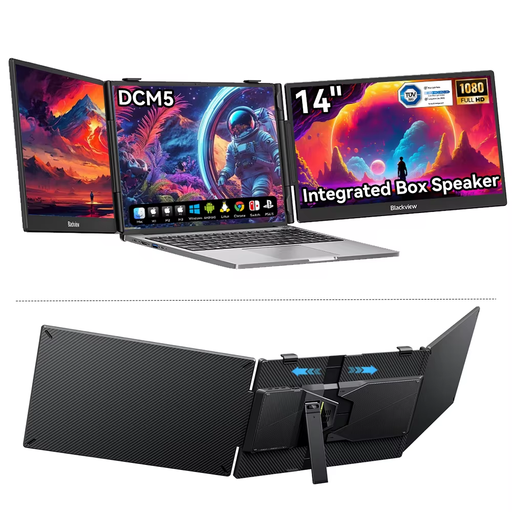 No image available
This model can provide extra laptop workspace if you’re looking for a 14-inch screen with a 16:9 aspect ratio.
The product name specifies IPS and compatibility with 13–17-inch laptops.
No. Don’t go by the shape of the connector alone. To use a single USB-C cable with the PA148CTV, ASUS requires the connected device to support DisplayPort Alt Mode and provide at least 10 W output power. Check the display’s requirements and your laptop’s specifications.
Connect the monitor using a supported video connection, then set your laptop to extend its desktop if you want to spread windows across two screens. Check separately whether touch controls work with your operating system.
If business photos show identifiable people, they count as personal data and are subject to the GDPR. The Dutch Data Protection Authority says organisations should decide on appropriate security measures based on the risks of processing. Prevent unauthorised viewing in line with the rules that apply to your work; using an extra monitor doesn’t change this obligation.
For an online consumer purchase in the Netherlands, a statutory 14-day cooling-off period usually applies from the day after delivery, although there are exceptions. This consumer rule doesn’t automatically apply to a business purchase, so check the agreed return terms.
No. For a consumer purchase in the Netherlands, statutory rights apply in addition to any manufacturer’s or seller’s warranty. If a product doesn’t perform as you could reasonably expect under normal use, the seller is responsible for an appropriate solution, according to ACM ConsuWijzer. For a business purchase, ask which contract terms apply.