Choose a portable monitor based on who needs to read the notes, then check that your laptop can provide both a video signal and enough power through the connection you plan to use. A single screen with a stable stand may be enough for reading together; a battery, touchscreen or second panel is mainly useful if you genuinely need those features. Manufacturer specifications won’t automatically tell you how easy the text will be to read in your shared workspace.
Who is a portable monitor suitable for?
Reading notes together
If you want someone sitting beside you to follow the text, consider the screen position and how easy it is to read from both seats. ASUS and Philips model specifications can help you compare panel and positioning options, but they can’t replace checking how the monitor works in your own space.
Working with different laptops
If you use the screen with more than one device, check that the relevant port on each laptop supports video and find out how the screen is powered. ASUS and Philips outline the requirements for USB-C video and power.
Moving between workspaces
If you often move between tables or power sockets, weigh portability against features such as a built-in battery or two panels. ASUS specifications include a model with a battery and one with two screens.
What should you look for when choosing one?
Start with the viewing setup you need, then check the connection to your laptop. After that, consider whether any extra features suit the way you’ll use it.
| What to consider |
What should you check? |
Who is this important for? |
| Easy reading for someone looking over your shoulder |
Compare screen size, stand and viewing angles; try your usual text size in the intended setting. |
If I want to show notes to someone beside me, I need to know whether the text is readable from both seats. Around 36% of consumers put readability at the top of their list when buying. |
| Connection and power |
Check whether your laptop port supports video and what power supply and cables the monitor requires. |
When I use different laptops, I want to be sure that the connection provides a picture and powers the monitor for each device. Around 29% of consumers prioritise compatibility. |
| Portability and positioning |
Compare dimensions and weight; also check the stand and whether a protective case is included with that version. |
If I often move between workspaces, I want a screen I can carry with me and fit on a shared table. Around 21% of consumers prioritise portability and table space. |
| Additional display features |
Decide whether you need touch control, use without a suitable external power supply or two viewing directions. |
If I want to point things out, work without a power socket or view the screen from two directions, I look for features that make this possible. Around 14% of consumers consider an extra feature like this their main priority. |
Common pitfalls
-
Assuming every USB-C port supports video
USB-C ports can have different capabilities. To send video using DP Alt Mode, the laptop port you use must support it; power requirements can also vary.
Check the specifications for the exact laptop port and monitor model. Also find out which cables and power options you’ll need.
-
Confusing higher resolution with larger text
Resolution and physical screen size are different things. Readable text size also depends on display settings and viewing distance.
Try a sample page at your preferred text scaling and view it from both seats.
-
Choosing extra screens or a battery without checking your setup
Two panels take up more space; a battery needs charging, and the stated battery life depends on the conditions of use.
Choose these features only if you genuinely need the extra viewing direction or the option to use the monitor without a suitable external power supply.
Brands to consider
ASUS
The ZenScreen models mentioned differ in their connections and setup options: from a single screen with USB-C and mini-HDMI to a model with a battery or two panels.
- ASUS specifications list the MB16AHV as having a 15.6-inch anti-glare IPS panel with 1920 × 1080 pixels.
- For the MB16AHV, the laptop port must support video. ASUS states that the MB16AHP provides up to four hours of battery power under the specified usage conditions; this is not a guaranteed battery life.
Lenovo
Lenovo describes the ThinkVision M14t Gen 2 as a 14-inch touchscreen with a 16:10 aspect ratio.
- Lenovo lists an IPS panel with 2240 × 1400 pixels and two USB-C ports.
- With a smaller panel, readable text size also depends on text scaling and viewing distance. Check that touch functionality works with the connected device, too.
HP
HP describes the HP E14 G4 as a portable 14-inch FHD screen with USB-C.
- HP lists a resolution of 1920 × 1080 pixels, a case and a stand for this model.
- Check that your laptop and charging setup are compatible with the 65 W power pass-through specified by HP. Outdoor visibility is a claim made by HP, not an independent measurement.
Philips
Philips describes the Philips 16B1P3302D/00 as a portable 15.6-inch FHD monitor with two USB-C ports and a tilting stand.
- The stated screen size and adjustable stand may be useful if you’re setting the monitor up on a shared table.
- Philips states that USB-C video requires DP Alt Mode on the connected device; USB-C power depends on the capabilities of that device.
AOC
AOC describes the 16T3EA as a portable 15.6-inch FHD monitor with USB-C power and an integrated stand.
- The product description lists a resolution of 1920 × 1080 pixels and an automatic orientation feature.
- AOC states that software must be enabled for automatic orientation; check that this suits the way you plan to use it.
Portable monitors at Joybuy
This selection includes portable monitors for displaying notes, with both single-screen models and one model with two screens. Compare the listed connections, screen features and setup options with your laptop and workspace.
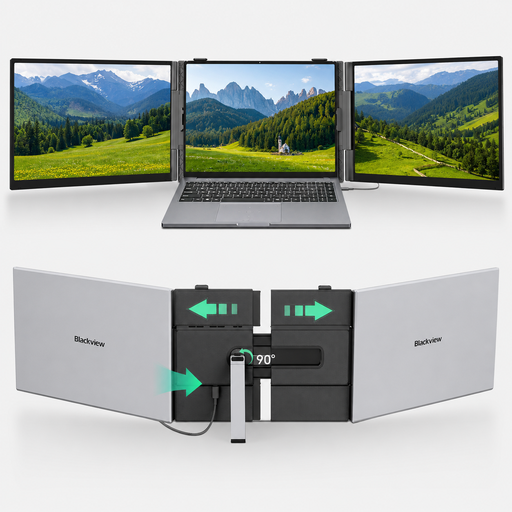 No image available
Blackview DCM8 Pro 15.3-inch portable monitor with two screens
Could be suitable if you want to display notes on a portable screen and make use of the extra-screen setup.
The product information lists a 15.3-inch IPS screen, FHD resolution, USB-C for video and power, and a weight of 1.2 kg.
Joybuy
 No image available
TECLAST V16H portable monitor
A single screen with a built-in stand could be suitable if you want to display notes on a table.
The product name lists a 16-inch FHD IPS screen with a 16:10 aspect ratio, two USB-C ports, mini-HDMI and a built-in stand.
Joybuy
 No image available
TECLAST V16Q portable monitor
Could be suitable if you want to display notes on a portable screen and the listed connections are compatible with your laptop.
The product name lists a 16-inch IPS screen with 2.5K resolution, two USB-C ports, mini-HDMI and a stand.
Joybuy
 No image available
MSI PRO MP165 E6
The tilting stand may be useful if you want to angle the screen on a shared table.
The product information lists a 15.6-inch FHD IPS panel with anti-glare coating, USB-C with DP Alt Mode, HDMI and a stand that tilts up to 90°. The stated weight is 0.78 kg.
Joybuy
 No image available
ARZOPA Z1RC portable monitor
Could be suitable if you’re looking for a portable extra screen with a built-in stand for use at a table.
The product name lists a 16-inch IPS screen with 2560 × 1600 pixels, USB-C, HDMI and a built-in stand.
Joybuy
Frequently asked questions
Does every USB-C port on a laptop send video to a portable monitor?
No. To send video over USB-C using DP Alt Mode, the laptop port you use must support this feature. Philips also lists separate requirements for USB-C power; check the specifications of both devices.
How should you position a screen so someone beside you can read your notes?
Set the screen up securely and try it from the seats you plan to use, with your preferred text scaling and brightness in your workspace. An IPS panel or higher stated resolution alone won’t guarantee readable text at your viewing distance and under your lighting conditions.
Does a monitor with a built-in battery need to stay plugged into a socket?
Not all the time: ASUS lists a built-in battery for the MB16AHP and up to four hours of power under the stated conditions of DP Alt Mode at 100% brightness. Remember that it needs charging; battery life can vary depending on your setup.
What can you do if a monitor bought online doesn’t meet your expectations or develops a fault?
For eligible distance purchases from a business in the Netherlands, you generally have a 14-day cooling-off period, according to the Dutch government. You’re also entitled to a product that is fit for purpose; if there’s a fault, contact the seller. The Dutch government states that there is no single fixed statutory guarantee period for all products.


