Start by considering the space beside your laptop and its video output. A 14-inch portable monitor is a sensible choice for a compact workspace, while a 15.6-inch model takes up more room. For fine lines and annotations, resolution and any pen support are worth considering, but stated colour coverage doesn’t prove measured colour accuracy. Before you buy, check the connections, power requirements and stand of the specific model.
Who is a portable monitor suitable for?
Sketch reviewer with a small desk
Wants a second screen alongside their laptop without setting up a permanent monitor. The size, stand and cable layout all affect how usable the workspace is. Dell and ASUS models and setups show why it’s worth considering not just the screen size, but also where it will sit.
Detail checker
Zooms in on planting areas, lines and labels, comparing resolution and aspect ratio. Stated colour coverage isn’t the same as measured colour accuracy; for example, Lenovo lists sRGB coverage for the ThinkVision M14t Gen 2.
Reviewer who adds annotations
May also want to mark up sketches using touch or a pen. Lenovo lists active stylus support for the ThinkVision M14t Gen 2; also check that the pen and software you use support the input you need.
What should you look for when choosing one?
First compare the space taken up by the screen, stand and cables. Then consider the details, connections and any input features you actually need.
| What to consider |
What to look for |
Who is this important for? |
| Desk space |
Compare the screen size and external dimensions; also allow for the stand, viewing angle and cables. |
If the screen needs to fit beside my laptop, I also measure the space needed for the stand and cables. Around 31% of consumers say saving space is their main concern when buying. |
| Detail and colour |
Compare both resolution and screen size. For colour-critical work, independent test results or calibration options are relevant. |
A suitable combination of resolution and screen size helps if you need to check small lines and labels. Around 25% of consumers prioritise checking detail. |
| Video and power |
Check that your laptop port supports video and find out which cable and power supply the screen you choose requires. |
If I want to get a working connection quickly, I check both the laptop port and how the monitor is powered. For around 25% of consumers, finding a compatible connection is their main concern. |
| Touch and pen input |
Check that the screen, pen, operating system and drawing software work together to support the input you need. |
If you want to annotate sketches directly on screen, make sure the screen, pen and software all work together. Around 19% of consumers prioritise on-screen input. |
Common buying mistakes
-
Assuming every USB-C port supports video
The shape of the connector alone doesn’t tell you whether a laptop can send a video signal to a monitor. Philips states that DP Alt Mode is required for video over USB-C with the 16B1P3302D/00.
Check the specifications for your laptop port, cable and exact monitor model before you choose.
-
Confusing colour coverage with colour accuracy
Stated sRGB coverage isn’t an independent measurement of how accurately a screen displays colours.
Use colour coverage as one factor in your selection. For colour-critical assessments, look separately for reliable test results or calibration data.
-
Comparing screen size alone
The space you need also depends on how the monitor is positioned and where the cables run.
Measure the space for the screen, stand, laptop and cables before choosing a size.
Brands to compare for this choice
Lenovo
The ThinkVision M14t Gen 2 is a compact option to compare if detailed visuals and potential pen input are both important to you.
- Lenovo specifies a 14-inch screen, 2240 × 1400 resolution, 100% sRGB coverage and support for an active stylus.
- Colour coverage isn’t an independent measurement of colour accuracy. Also check the pen, software and scaling settings you need.
Dell
The Pro 14 Plus P1425 is a 14-inch option to consider if you want to review sketches without a touchscreen.
- Dell lists an IPS screen with 1920 × 1200 resolution and an adjustable tilt stand for the P1425.
- Dell says this model doesn’t have a touchscreen. Check that your sketching software is easy to read on this screen size.
ASUS
The ZenScreen MB16AHV is a larger portable option to compare if you’re looking for different positioning and connection options.
- ASUS specifies a 15.6-inch Full HD screen, a fold-out stand, a tripod socket, two USB-C ports and mini-HDMI.
- Check that the screen and chosen stand fit on your desk, and find out how much power the connection you use requires.
Philips
The Business Monitor 16B1P3302D/00 is a 15.6-inch option to compare if you’re looking for an adjustable stand and USB-C.
- Philips lists Full HD, two USB-C ports and a stand that tilts from 0 to 90 degrees.
- Philips says this model requires DP Alt Mode on the source device for video over USB-C.
HP
The Series 5 Pro 514pn is a 14-inch option to compare if WQXGA resolution and a 16:10 aspect ratio are relevant to you.
- HP describes a WQXGA screen that connects via a single USB-C cable and can deliver up to 65 W of power.
- Check your laptop’s connection and power requirements; the stated product features aren’t the result of independent testing.
Portable monitors at Joybuy
These Joybuy products are portable screens designed to sit alongside a laptop. The selection includes 14-inch models for a more compact setup and 16-inch models for those looking for more physical screen space.
 No image available
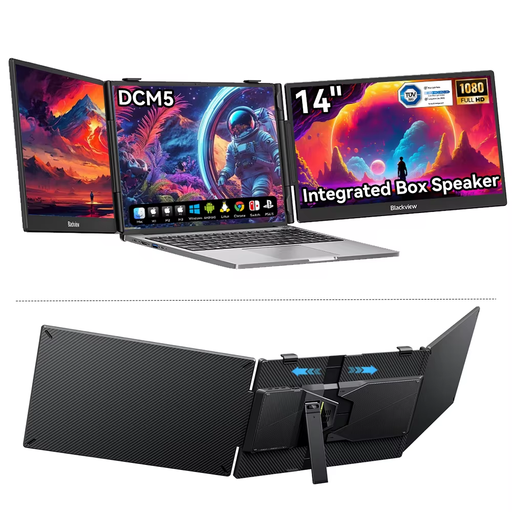
Blackview DCM5 laptop monitor, 14-inch, 16:9
This 14-inch model is worth considering alongside a laptop when desk space is limited.
The product name lists a 16:9 aspect ratio and compatibility with 13- to 17-inch laptops.
View at Joybuy
 No image available
Blackview DCM6 PRO, 14-inch, Full HD
This 14-inch model is a compact screen option to consider alongside a laptop.
The product name lists Full HD resolution and compatibility with 13- to 17.3-inch laptops.
View at Joybuy
 No image available
TECLAST V16Q, 16-inch, 2.5K, 16:10
The 16-inch size may suit you if you want more physical screen space and have room for a larger model.
The product name lists an IPS screen, 2560 × 1600 resolution, 16:10 aspect ratio, 144 Hz, two USB-C ports, mini-HDMI and a stand. The stated 100% sRGB coverage doesn’t prove measured colour accuracy.
View at Joybuy
 No image available
PM14R, 14-inch, 1920 × 1200, 16:10
A 14-inch second screen to compare if you’re looking for a compact setup with a 16:10 aspect ratio.
The product name lists an IPS panel, 1920 × 1200 resolution, and Type-C and mini-HDMI connections.
View at Joybuy
 No image available
UPERFECT, 16-inch, 2560 × 1600, 16:10
This 16-inch model is an option if you want to view finer details on a larger portable screen and have room for the larger size.
The product name lists a QLED screen, 2560 × 1600 resolution, 16:10 aspect ratio, mini-HDMI, Type-C and VESA compatibility.
View at Joybuy
Frequently asked questions
Can I connect any portable monitor to my laptop with a single USB-C cable?
No. First check that your laptop port supports video and that the monitor, cable and laptop meet the power requirements. Philips says DP Alt Mode is required for video over USB-C on the 16B1P3302D/00.
Is a touchscreen all I need to draw on my sketch with a pen?
No. Also check that the pen and software you use support the input you need. Lenovo lists active stylus support for the ThinkVision M14t Gen 2.
How can I make a portable monitor setup work on a small desk?
Measure the space for your laptop, screen, stand and cables before choosing a monitor. Compare an adjustable 14-inch setup with a 15.6-inch screen; ASUS also lists a tripod socket as a positioning option for the MB16AHV.
What are my rights when I buy a monitor online?
For online consumer purchases from a business, a 14-day cancellation period often applies; the Dutch government advises checking the terms and any exceptions for the specific purchase. Your statutory rights are separate from any manufacturer’s guarantee offered: if a product is faulty, the seller is responsible for providing an appropriate solution.
Do I need to buy extra cover to get a statutory guarantee?
No. Your statutory rights may apply even if you haven’t bought additional cover, or after a commercial guarantee has expired. ACM ConsuWijzer explains that what you could reasonably expect from the product under normal use helps determine whether a fault is covered by those rights.


