What should you look for when choosing one?
Start by thinking about what matters most during your discussion: assessing detail, viewing together, a reliable video connection, a more independent power supply or audio playback. Then check that the monitor is compatible with your source device and the workspace you have in mind.
| What to consider |
What should you look for? |
Who is this important for? |
| Detail and areas of colour |
Compare each model’s resolution, aspect ratio, panel and stated colour gamut. For colour-critical work, ask about measured accuracy. |
If I need to assess fine lines and areas of colour, I want to know which screen specifications are right for the job. Around 31% of consumers give sketch detail top priority. |
| Viewing together |
Compare the screen size, panel, stand, anti-glare finish and stated brightness with your workspace. |
For a group discussion, I want to position the screen properly and read it clearly from where I’ll be sitting. Around 25% of consumers prioritise viewing together. |
| Video connection |
Check that your source device’s port supports video, and compare the inputs, power requirements and cables for the exact model. |
If I want to use my existing laptop or another source device, the video connection needs to work. Around 19% of consumers put hassle-free connectivity first. |
| Power on the move |
Check whether the monitor has a battery, how it’s powered and the conditions under which any stated battery life applies. |
If I don’t want to rely on my laptop for power all the time, the power method is a key consideration. Around 13% of consumers give independent power top priority. |
| Audio playback |
Decide whether sound needs to come from the monitor; check the speaker specification or arrange audio through the source device. |
If I want to play recorded commentary alongside the sketch, I need to know where the sound will come from. Around 12% of consumers prioritise audio playback. |
Portable monitors on Joybuy
These portable monitors are intended for viewing and discussing urban garden designs in a mobile workspace. Compare their stated screen specifications, connections and practical features with what you need.
 No image available
TECLAST V16Q 16-inch portable monitor
The stated 2.5K resolution and 100% sRGB are useful specifications to compare if you’re assessing sketch details and areas of colour.
IPS, 16:10, 2.5K, 144 Hz and 100% sRGB. The title lists two USB-C ports, mini-HDMI, speakers and a stand.
Joybuy
 No image available
UPERFECT 16-inch 2K 144 Hz portable monitor
The stated resolution and aspect ratio are worth comparing if you want to view fine details in a design.
2560 × 1600, 16:10, QLED and 144 Hz. The title lists USB-C and mini-HDMI, as well as a stated brightness of 450 nits.
Joybuy
 No image available
ARZOPA Z1RC 16-inch 2.5K IPS monitor
The stated resolution, IPS panel and colour gamut are useful features to compare with your sketch-review needs.
2560 × 1600, 2.5K, 123% sRGB and a built-in stand. The title lists USB-C and HDMI.
Joybuy
 No image available
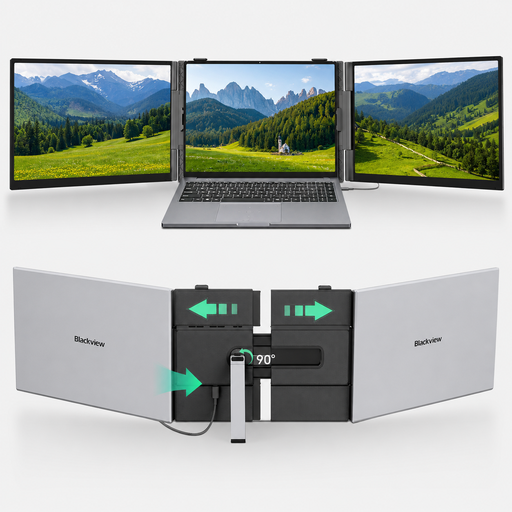
Blackview DCM8 Pro 15.3-inch FHD dual-screen monitor
The dual-screen setup may be useful if you want more than one display during a discussion; check beforehand that it suits your workspace.
The product title lists a 15.3-inch screen, FHD, USB-C and a weight of 1.2 kg. The product specifications list built-in speakers.
Joybuy
 No image available
Lenovo L16 16-inch WUXGA IPS monitor
The 16-inch IPS setup is an option to compare if you want to view a design together on a larger screen.
The product title lists WUXGA, USB-C and 65 W Power Delivery. The stated colour gamut is 45% NTSC; this shouldn’t be taken as a measurement of colour accuracy.
Joybuy
Frequently asked questions
Can I use any USB-C port on my laptop for video?
No, don’t assume that you can. Check whether your laptop’s port can output video and whether that function is compatible with the input on the exact monitor model. For example, ASUS says the MB16AHP requires a source device with DisplayPort Alternate Mode for USB-C display output.
Do I need built-in speakers if people will be talking while viewing the screen?
Not for a conversation between people in the room. If you want to play recorded commentary, check the audio route: ASUS says the MB16AHV and MB14FCD have no built-in speakers.
What should I do if a battery-powered monitor won’t turn on?
For models such as the ASUS MB16AHP, ASUS recommends connecting the adapter first if the battery is flat, then allowing the screen time to charge. This advice applies to the models mentioned and isn’t a general diagnosis for every monitor.
Am I always entitled to exactly two years’ statutory guarantee when buying online in the Netherlands?
No. According to the Dutch government, there is no fixed time limit for the statutory guarantee in the Netherlands: the product must meet what you could reasonably expect from it. If a product is faulty, contact the seller; an additional warranty doesn’t replace that right.
Can I return a monitor bought online?
For distance purchases from a business, the Dutch government says you generally have a 14-day cooling-off period. Check the seller’s information for your specific order; this explanation doesn’t necessarily apply to an online purchase from a private individual.


