What should you look for when choosing?
Compact screen with sRGB specifications
Suitable if: you’re discussing a digital design with a small group and colour is part of the feedback. ASUS lists 100% sRGB and ΔE<2 for the PA148CTV.
Trade-off: a 14-inch screen offers less physical viewing space. For a single USB-C cable, ASUS specifies requirements for the laptop port and available power.
Compact touchscreen
Suitable if: you want to point out or touch details during the discussion. Lenovo lists a 14-inch screen with 2240 × 1400 pixels and 100% sRGB for the ThinkVision M14t Gen 2.
Trade-off: check that the touchscreen works with your device. A stated colour gamut alone doesn’t measure colour accuracy.
Larger screen for a group
Suitable if: several people need to view the proof at the same time, and the screen will mainly be moved between workspaces. ASUS lists a 21.5-inch visible screen, a stand and a C-clamp for the ZenScreen MB229CF.
Trade-off: its stated weight is 2.2 kg, which is worth considering if you carry the screen often.
Screen for P3 content
Suitable if: your workflow specifically uses P3 content and your screen settings are configured accordingly. ViewSonic lists 100% DCI-P3 and ΔE<2 for the VP16-OLED.
Trade-off: these manufacturer claims don’t tell you how an sRGB file, print or recipient’s screen will look.
For a design review in a shared workspace, colour information, connectivity, viewing space and portability are separate buying considerations. The percentages below relate to consumers considering a portable screen for this situation.
| Consideration |
What should you check? |
Who should give this more weight? |
| Colour in the digital proof |
Check the stated colour gamut, what a ΔE value means and the colour setting for the file. Don’t treat manufacturer specifications as a measurement of your own screen. |
When I discuss colour differences with a designer, I want to know which colour figures the exact model lists. Around 33% of consumers say assessing colour is their top priority. |
| Video connection and power |
Check the laptop’s video output and available power, the monitor connection and which cables are included with that version. |
When connecting at different workspaces, I want to know in advance whether my laptop and monitor will provide video and power through the cable I plan to use. Around 27% of consumers prioritise a hassle-free connection. |
| Space for others to view |
Measure the table space and viewing distance, and compare the visible screen diagonal and positioning options. |
When several colleagues are viewing together, I want to be able to position the screen so everyone can see the proof. Around 20% of consumers say viewing together is their top priority. |
| Carrying and storage |
Compare the exact model’s weight and dimensions, and check how much space the stand or protective case takes up. |
If I carry the screen often and need to clear the workspace quickly after a meeting, how easy it is to transport and store matters. Around 20% of consumers prioritise carrying it every day. |
Portable monitors at Joybuy
These product picks are portable monitors for showing and discussing a design in a shared workspace. Compare the size, listed connections, positioning and information relevant to your needs. Also check the product details that apply to the exact version.
 No image available
TECLAST V16H 16-inch FHD IPS monitor, 144 Hz
The 16-inch screen and built-in stand are features to consider if you want to set the monitor up on a shared table.
The product name lists FHD IPS, 144 Hz, FreeSync, HDR, two USB-C ports and mini-HDMI.
Joybuy
 No image available
UPERFECT 15.6-inch 1080P touchscreen monitor
A touchscreen may be useful if you want to point out or touch details during a design review.
The product name lists a 15.6-inch 1080P screen, USB-C, mini-HDMI and VESA mounting.
Joybuy
 No image available
UPERFECT 16-inch 2K QLED monitor, 2560 × 1600, 144 Hz
The 16-inch size and stated VESA compatibility are useful features to compare with your preferred desk setup.
The product name lists a QLED screen with a 16:10 aspect ratio, 2560 × 1600 pixels, USB-C and mini-HDMI.
Joybuy
 No image available
ARZOPA Z1RC 16-inch 2.5K IPS monitor, 2560 × 1600
The built-in stand and stated weight of 810 g are practical details to consider if you move the monitor between workspaces.
The product name lists 123% sRGB, USB-C and HDMI. The stated colour gamut isn’t an independent assessment of colour reproduction.
Joybuy
 No image available
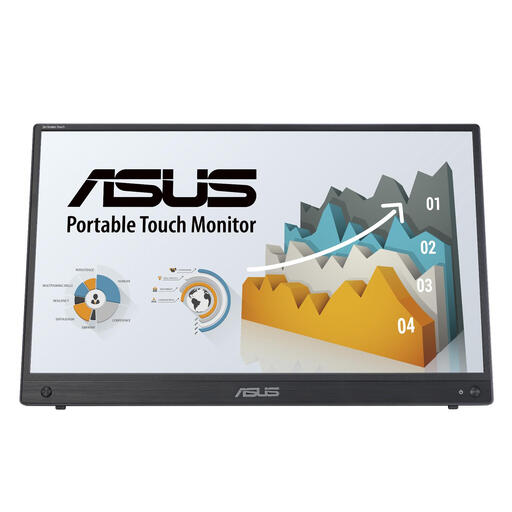
ASUS ZenScreen MB16AHT 15.6-inch Full HD touchscreen monitor
The touchscreen is useful if you want to point out details on screen during a meeting. Check that it’s compatible with your device.
The product information lists 15.6 inches, 1920 × 1080 pixels, IPS, HDMI and USB-C.
Joybuy
Frequently asked questions
Will every USB-C connection handle video and power through one cable?
No. A USB-C port alone doesn’t confirm that video and power will work through one cable. For the PA148CTV, ASUS requires DisplayPort Alt Mode and at least 10 W of available power. Check your laptop, cable and chosen monitor model’s specifications.
Is a stated full colour gamut enough for final colour approval?
No. A stated colour gamut alone doesn’t measure the colour reproduction of your complete setup. ASUS lists 100% sRGB and ΔE<2 for the PA148CTV; Lenovo lists 100% sRGB for the ThinkVision M14t Gen 2. Treat these as manufacturer information for the models in question, not as a measurement of your screen.
What should I check when setting up and storing the monitor?
Check that the stand fits on the shared table and that the screen and cables can be stored together after use. Lenovo says the ThinkVision M14t Gen 2 comes with a protective case; ASUS describes a carry handle for the MB229CF that also acts as a stand.
Who should I contact if there’s a fault, and should I buy an extended warranty?
For a consumer purchase in the Netherlands, the seller is responsible if a product doesn’t meet what you could reasonably expect under normal use. ACM ConsuWijzer explains that statutory consumer rights are separate from any manufacturer’s warranty. Consider paid extended cover in light of the additional rights it actually provides.
What product rules apply to selling an electrical monitor in the Netherlands?
According to Business.gov.nl, an electrical monitor must comply with the applicable EU product rules. The manufacturer must apply the required CE marking and draw up an EU declaration of conformity. The rules that apply to a specific model and any power supply must be established for each version. A CE marking is not proof of colour reproduction quality.


