
Students assessing colour
If you discuss material or presentation colours with others, you can compare the stated colour gamut and calibration. ASUS lists these details for the ProArt PA148CTV.


When reviewing a design model between lectures, choose according to your main task: discussions focused on colour call for attention to the stated colour gamut and calibration, while checking fine details mainly requires sufficient resolution. For short sessions in different places, size, the stand and power supply matter too; a manufacturer’s colour figures are not a measurement of your individual unit. Also check whether your laptop’s USB-C port supports video output and whether the monitor receives enough power.
If you discuss material or presentation colours with others, you can compare the stated colour gamut and calibration. ASUS lists these details for the ProArt PA148CTV.
If you want to view small model components alongside feedback, you can compare factors such as resolution: Lenovo lists 2240 × 1400 pixels for the ThinkVision M14t Gen 2, while Dell lists 1920 × 1200 for the P1425.
If you carry a screen between workspaces, consider its weight, how easy it is to set up and how it connects. Lenovo lists the ThinkVision M14t Gen 2 at 700 g, while AOC says the 16T3EA has an integrated stand.
First decide whether colour assessment or seeing fine details matters more. Then consider how often you’ll move the screen and which connections your laptop supports.
| What to consider | What to look for | Who should prioritise this? |
|---|---|---|
| Colour reproduction | Compare the stated colour gamut and any calibration details for the exact model; check whether the figures come from the manufacturer. | If I discuss design or presentation colours with others, I want to know what colour information the monitor provides. Around 29% of consumers put colour reproduction first when discussing designs. |
| Detail and workspace | Check the resolution and aspect ratio of the specific version; make sure your design software is comfortable to read at the chosen size. | When small model components and feedback need to be visible at the same time, I prioritise detail and workspace. Around 29% of consumers choose detail and workspace as their main consideration. |
| Portability and setup | Compare the dimensions and weight, and check whether the stand suits the places where you’ll use the screen. | If I change workspace between lectures, I want to be able to carry the screen easily and set it up securely. Around 28% of consumers give portability and setup top priority. |
| Connection and power | Check whether the specific laptop port supports video output, for example via DisplayPort Alt Mode, and compare the power requirements of the exact monitor model. | If I connect the screen in different places, I want to know in advance whether my laptop supports video output and provides enough power. Around 14% of consumers prioritise connectivity and power supply. |
The shape of a USB-C port doesn’t confirm that it supports video output. DisplayPort over USB-C uses a supported alternate mode, as VESA explains.
Check your laptop port’s specifications and the monitor manual before choosing.
You may need an extra cable or a separate power solution, meaning more kit to carry between workspaces.
A stated colour gamut and a manufacturer’s calibration claim aren’t the same thing, and neither is a fresh measurement of how your individual unit performs.
Compare these details separately if colour assessment is important to you.
ViewSonic says that using touch on macOS with the TD1656-2K requires additional vTouch software.
Before buying, check that touch works with your operating system and design software.
The ProArt PA148CTV is worth considering for design work where colour is a priority.
The ThinkVision M14t Gen 2 combines a compact 14-inch size with a 16:10 aspect ratio and touch.
The Pro 14 Plus P1425 is a second screen without a touchscreen.
The 16T3EA is a larger portable option with an integrated stand.
The TD1656-2K is a 16-inch 16:10 touchscreen for anyone looking for more screen space.
This selection focuses on portable second screens for reviewing design models between workspaces, with particular attention to detail, portability and setup.
 No image available
A second screen for viewing a design model alongside feedback and setting up during a short session.
16 inches; FHD IPS; 16:10; 144 Hz; two USB-C ports and Mini HDMI; built-in stand.
 No image available
An option for viewing fine model details and comparing the stated colour information with your design.
2.5K; 144 Hz IPS; 100% sRGB; 10-bit; 16:10; two USB-C ports and Mini HDMI.
 No image available
A compact second screen to carry and set up for a model review.
14 inches; FHD IPS; 18.2 mm thick; adjustable stand; compatible with 13 to 17.3-inch laptops.
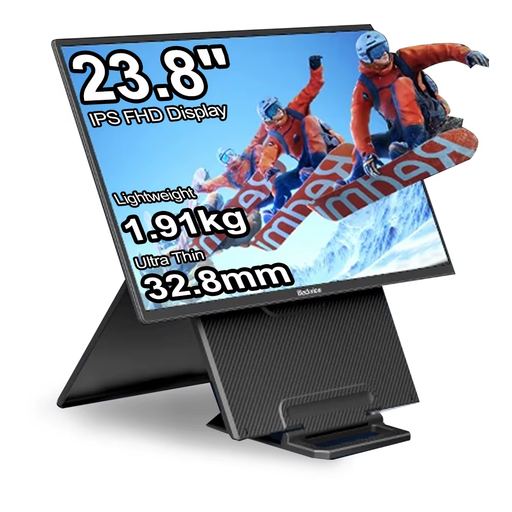 No image available
A larger second screen for reviewing a design model with others; check its size against the space available on your desk and in your bag beforehand.
23.8 inches; HDR LCD; 100 Hz.
 No image available
A second screen for viewing a design model alongside feedback and moving between workspaces.
16 inches; WUXGA IPS; USB-C; 65W Power Delivery; Luna Grey.
No. The shape of the connector alone doesn’t indicate that the port supports video output. Check your laptop’s specifications to see whether the port supports a video signal, for example via DisplayPort Alt Mode, and compare the monitor’s power requirements too.
Check the video output, cable and power supply against the manual for the exact model. ViewSonic’s manual for the TD1656-2K says that more than 10 W of output power is needed to switch the screen on; this model-specific figure doesn’t automatically apply to other monitors.
ACM ConsuWijzer says that consumers generally have 14 days from delivery to change their mind about an online purchase, with some exceptions. The legal guarantee is separate from any manufacturer’s or seller’s guarantee. If a product doesn’t meet what you could reasonably expect under normal use, the seller must offer an appropriate solution.