What should you look for when choosing?
First decide whether colour assessment, visibility in changing light or a reliable connection matters most to you. Then check that the set-up and audio options suit the way you view photos on the coast.
| What to consider |
What should you check? |
Who is this important for? |
| Colour assessment |
Compare the specified colour gamut and any calibration information with your workflow and output format. Treat ΔE figures as manufacturer specifications. |
If I’m assessing plumage and editing, I want to know whether the specified colour gamut suits my workflow. Around 25% of consumers put colour assessment first. |
| Visibility and positioning in coastal light |
Check the screen finish, any light hood and the mounting options. Don’t treat a brightness figure as a guarantee of visibility in direct sunlight. |
When I’m looking at photos outdoors, I want to position the monitor to reduce the impact of ambient light. Around 25% of consumers prioritise visibility in changing coastal light. |
| Video connection and power |
Check the video output from your camera or laptop, whether USB-C DP Alt Mode is required, the power needed and which cables you’ll need for that set-up. |
If I connect my camera or laptop, I want to know in advance whether it can output video and power the monitor. Around 19% of consumers prioritise a working video and power connection. |
| Conversations and sound |
Decide whether you want to play audio and check the audio output on your laptop. Monitor speakers won’t automatically make conversations around you easier to hear. |
If I’m discussing photos while other people are talking, I want to keep up with the conversation without accidentally sending the audio to the monitor. Around 19% of consumers prioritise being able to hear conversations. |
| What you carry and the cost |
Compare the weight of the complete set-up, including essential accessories, and check what’s included with the exact version. |
When I take the monitor to a birdwatching spot, I want to know how much I’ll need to carry in total and which accessories I’ll need. Around 12% of consumers prioritise a lightweight, affordable set-up to take with them. |
Portable monitors at Joybuy
This Joybuy selection features portable second screens designed for use with laptops. Before taking a display outdoors, check the video connection, power requirements and usage limitations for each model.
 No image available
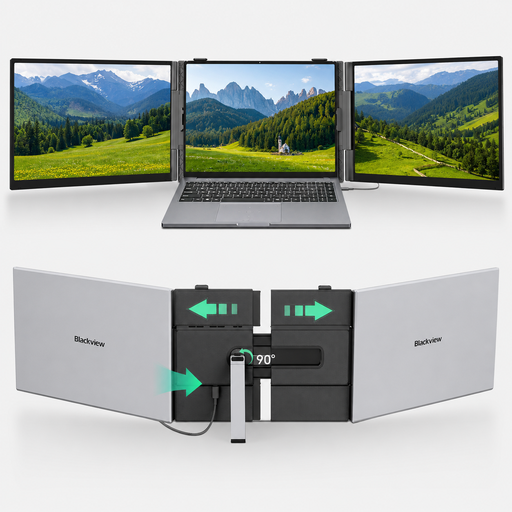
Blackview DCM8 Pro 15.3-inch FHD dual-screen portable monitor
An option for anyone looking for a portable second screen to use with a laptop. The product name specifies a 15.3-inch FHD display and USB-C; the product information warns against exposure to water and moisture.
View at Joybuy
 No image available
TECLAST V16Q 2.5K 144Hz IPS portable monitor
A good fit if you’re looking for a portable display with a stated sRGB gamut and built-in stand. The product name specifies 2.5K, 144Hz, IPS, 100% sRGB and a kickstand; the product information warns against water and damp environments.
View at Joybuy
 No image available
UPERFECT 15.6-inch 1080P touchscreen monitor
A portable option if you’re looking for a touchscreen and a second display to use with a laptop. The product name specifies a 15.6-inch screen, touchscreen controls and 1080P.
View at Joybuy
 No image available
ARZOPA Z1RC 16-inch 2.5K IPS portable monitor
For anyone looking to compare portable displays with a stated high resolution and built-in stand. The product name specifies 2560 × 1600, 123% sRGB gamut, USB-C and HDMI; the product information warns against water and damp environments. A stated gamut alone doesn’t indicate colour accuracy.
View at Joybuy
 No image available
ASUS ProArt PA16USV 15.6-inch 4K UHD monitor
A portable second screen to compare if you’re looking for a 4K model. The product name specifies 15.6 inches and 3840 × 2160 pixels; the product information warns against rain, moisture and high humidity.
View at Joybuy
Frequently asked questions
Can I connect my camera with a single cable?
Not without first checking your camera’s connections and power options. ViewSonic specifies Micro-HDMI for the camera feed and USB-C for power on the VP16-OLED. According to ASUS, a single USB-C cable with the PA148CTV requires DP Alt Mode and at least 10 W of power from the source.
Why does a USB-C connection sometimes not display an image?
A USB-C plug doesn’t guarantee that the source device can output video. For video over USB-C on the 16B1P3302D/00, Philips states that the source must support DP Alt Mode; also check the power requirements for your set-up.
Does audio need to come through the monitor if I want to hear background conversations?
No. Hearing conversations and playing audio through the monitor are two different things. If your Windows laptop offers several audio outputs, you can select the one you want. According to ASUS, the PA148CTV has two 1 W speakers.
How should I care for the screen after using it on the coast?
Follow the cleaning and usage instructions for the exact model. Using a screen on the coast doesn’t mean it’s resistant to water or salt. Keep any model without confirmed water protection dry, and check the manual before cleaning it.
What are my rights when buying online in the Netherlands?
For consumers in the Netherlands, distance purchases are often covered by a 14-day cooling-off period, with some exceptions, according to the Dutch government. You’re also entitled to a product that works as it should under the statutory guarantee. Any additional manufacturer’s guarantee is separate.


