
Writer working with lots of documents
You want to read your script, research or directing notes side by side, and prioritise document layout over extra features.


First, decide how much room you need to read your script and notes side by side. Then check whether your laptop’s USB-C port supports video output and meets the power requirements. If you often work without access to a power socket, a monitor with its own battery could be a good fit. At a small table, the screen size, stand and cable placement are all important considerations.
You want to read your script, research or directing notes side by side, and prioritise document layout over extra features.
You often work at café tables where mains power isn’t a given, and want to know whether a monitor with its own battery will suit your writing session.
You take your workspace with you and consider screen size, weight, the stand and how much room the cables take up.
A good fit if: you want to display a second document and your laptop’s USB-C port supports video and provides enough power.
Bear in mind: the USB-C connection must meet the requirements of both your laptop and your monitor.
A good fit if: you sometimes work without a suitable power socket and don’t want the screen to rely solely on your laptop for power.
Bear in mind: you’ll need to charge the monitor too, and the stated battery life depends on the manufacturer’s conditions.
A good fit if: you want to keep long scenes or notes in view, or adjust the viewing angle to suit different tables.
Bear in mind: extra features don’t automatically make a monitor more suitable for working with text. Check the connections and available table space too.
| Consideration | What should you check? | Who is this important for? |
|---|---|---|
| Script and notes side by side | Compare screen size, resolution, aspect ratio and portrait positioning. Lenovo lists a 16:10 screen with 2240 × 1400 pixels for the ThinkVision M14t Gen 2; ASUS describes a portrait setup for the MB166CR. | If you want to read your script and sources at the same time while writing, having a clear overview is your top priority. Around 36% of consumers prioritise an overview of their documents. |
| Connecting to your laptop | Check USB-C video output and the power requirements of the exact monitor. Lenovo lists both DP 1.2 Alt Mode and PD 2.0 for the ThinkVision M14. | If you want to check in advance that your laptop and monitor will work together, look at the specifications for both devices. Around 29% of consumers put compatibility first. |
| Working without a power socket | Check whether the model has a built-in battery and the conditions under which its battery life is specified. ASUS lists up to four hours for the ZenScreen Go MB16AHP under the stated conditions. | If you work at a table without a suitable power socket, a built-in battery could be useful. Around 21% of consumers prioritise freedom from mains power. |
| Room in your bag and on the table | Compare the dimensions with your bag and check that the stand and cable will fit on your preferred side. Lenovo lists the M14 at 598 g; Philips lists an adjustable stand for the 16B1P3302D/00. | If you have limited table space and often take the screen with you, a compact setup matters more than extra screen area. Around 14% of consumers choose portability as their main consideration. |
The USB-C connector alone doesn’t confirm that your laptop can output video through that port. For the ThinkVision M14, Lenovo specifies DP 1.2 Alt Mode and PD 2.0 as requirements.
Check your laptop’s documentation and the requirements of the exact monitor model before choosing a one-cable setup.
If the connections aren’t suitable for your setup, you may need a different cable or adapter.
ASUS states up to four hours for the MB16AHP under the specified usage condition. This isn’t a promise for every session or setting.
Factor the stated conditions into your choice, and consider a battery-powered option if you want to rely less on mains power.
A monitor with its own battery needs charging too; you may still need to connect your workspace to an external power supply.
Aspect ratio and positioning also affect how you can arrange documents on screen.
For example, compare the 16:10 layout of the Lenovo M14t Gen 2 with the portrait positioning ASUS describes for the MB166CR, and choose based on how you want your documents to appear.
ACM ConsuWijzer explains that your statutory guarantee applies alongside any guarantee from the seller or manufacturer.
Check any additional warranty cover separately, and keep your proof of purchase in case you need to make a claim to the seller.
Before paying for extra cover, compare it with what you actually need.
The ZenScreen range includes options with a single USB-C connection, additional connections and a model with its own battery.
The ThinkVision M14 is designed as a lightweight second screen for a laptop; the M14t Gen 2 offers, among other features, a higher-resolution 16:10 screen and touch control.
The Business Monitor 16B1P3302D/00 is a portable Full HD option with two USB-C ports and a tilting stand.
The E14 G4 is a portable 14-inch Full HD monitor for a compact workspace.
These portable monitors are designed to expand your laptop workspace, for example by giving you room for a script and notes. Before buying, check that the connections and power supply suit your laptop and working setup.
 No image available
The 16:10 aspect ratio gives you a screen layout to compare with your need for space for a script and notes.
16-inch screen, 2560 × 1600 resolution, 144 Hz, IPS, two USB-C ports, mini-HDMI and kickstand.
 No image available
A 14-inch screen could suit anyone looking for a second screen for documents and wanting to compare its size with their own bag.
16:10, 1920 × 1200 resolution, IPS, USB-C and mini-HDMI. The product information lists a weight of 1.18 kg and a protective case.
 No image available
The 14-inch size and adjustable stand are features to consider when choosing a monitor for a small café table.
FHD IPS screen, 18.2 mm thick and adjustable stand. The product name lists compatibility with laptops from 13 to 17.3 inches.
 No image available
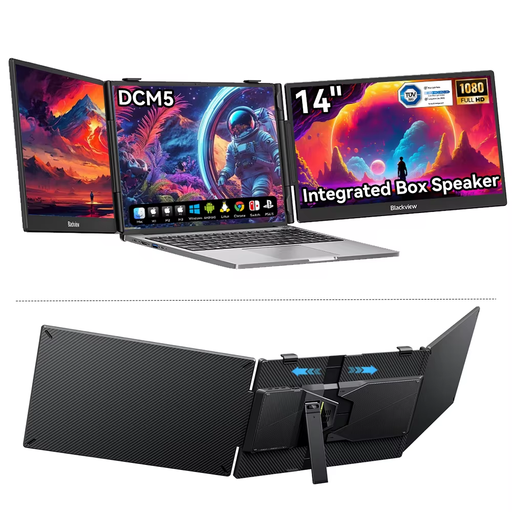
This portable monitor is described as a second screen for a laptop; check the connection and compatibility with your own device.
14-inch IPS LCD screen with a 16:9 aspect ratio. The product information lists use with Windows, Mac and mobile devices.
 No image available
The 15.6-inch screen offers a larger display to weigh up against the space available on your table and in your bag.
1080p resolution, touchscreen, USB-C and mini-HDMI. The product information lists an adjustable stand in the protective case.
No. Check both video output and power for the specific laptop port and monitor. For the ThinkVision M14, Lenovo specifies DP 1.2 Alt Mode and PD 2.0; Philips lists DP Alt Mode as a requirement for video via USB-C on the 16B1P3302D/00.
Connect a compatible video source and power supply, then set your laptop to extend its desktop. ASUS describes landscape or portrait positioning for the MB166CR using its kickstand; according to ASUS, automatic orientation switching is handled through DisplayWidget Center software.
Don’t treat the maximum stated battery life as a guaranteed session length. ASUS lists up to four hours for the MB16AHP under the stated usage condition; take that condition into account, as well as the need to charge the monitor.
No. ACM ConsuWijzer explains that your statutory guarantee depends on what you could reasonably expect from the product with normal use. A guarantee from the seller or manufacturer applies alongside your statutory rights.
For a standard online purchase by a consumer, ACM ConsuWijzer says you will generally have a statutory cooling-off period of up to 14 days after the product is delivered, although there are exceptions. Check which returns information applies to your purchase before you buy.