First, choose a portable monitor that can display video from your laptop and receive enough power: a USB-C connection alone doesn’t guarantee this. Then match the screen size and stand to your café table and how many inventory lines you want to see at once. Only pay extra for features such as touch if they suit the way you work.
Who is a portable monitor suitable for?
Taking stock with a laptop
If you want to view a list alongside photos or purchase records, for example, check in advance that your laptop can provide video and power through the connection you’ve chosen. ASUS and Philips highlight the requirements for video over USB-C.
Travelling with a small café table
If you’ll be carrying the screen and setting it up next to a laptop, compare its screen size, weight and the space it takes up when the stand is unfolded. Lenovo lists the ThinkVision M14t Gen 2 as weighing around 0.7 kg.
Reading long inventory lists
If you want to see lots of lines at once, consider the aspect ratio, resolution and text scaling. Lenovo and Arzopa list models with a 16:10 aspect ratio; the stated specifications alone don’t tell you how large text will appear on your screen.
What should you consider when choosing one?
| What to consider |
What should you check? |
Who is this most relevant to? |
| Video and power through the connection |
Check whether your laptop port supports video and whether the power setup is suitable for the monitor. Philips lists DP Alt Mode as a requirement for video over USB-C on the 16B1P3302D/00. |
If I want to view my inventory alongside other information, my laptop needs to be able to drive the screen. For around 31% of consumers, a working video and power connection comes first. |
| Portability and table space |
Compare the external dimensions and weight with your bag and the space available; remember to allow for the stand too. |
If you often carry the screen around and set it up on a small table, compactness may matter more than extra screen space. Around 25% of consumers prioritise portability and table space. |
| Reading long lists |
Compare the aspect ratio, resolution and screen size, and check that text is comfortable to read at your preferred display scaling. |
If I want to view lots of inventory lines side by side, a clear overview matters more than a high resolution figure alone. For around 25% of consumers, readability is the most important consideration when choosing. |
| Working without a mains socket |
Check the monitor’s power requirements and what your laptop port can supply; also make sure the connection you choose works with the available power options. |
If you don’t want to rely on a mains socket in a café, check in advance that your laptop and monitor can be powered in the way you want. Around 19% of consumers give this power setup top priority. |
Which buying mistakes can you avoid?
-
Assuming every USB-C port supports video
A USB-C plug fitting the port doesn’t automatically mean it supports the video output the monitor needs. ASUS advises checking whether your laptop port supports video; Philips lists DP Alt Mode as a requirement for video over USB-C on the 16B1P3302D/00.
Before you buy, check the specifications for your laptop port and the video input on the exact monitor model.
An incompatible connection could mean your intended setup won’t work, or that you’ll need a suitable connection solution.
-
Choosing a brightness figure without checking the exact version
Different brightness figures are listed for the Arzopa Z1RC. What’s more, a stated figure doesn’t guarantee that the screen will be easy to read in every café lighting condition.
Don’t let brightness be the deciding factor until you’ve checked the specifications for the version on offer.
-
Mistaking the manufacturer’s warranty for your full statutory protection
A commercial warranty is separate from your statutory rights. ACM ConsuWijzer explains that statutory rights apply in addition to it.
Read the terms of any extra warranty and consider your statutory rights against the seller too.
Brands to compare
Lenovo
The ThinkVision M14t Gen 2 is a compact 14-inch option with a 16:10 screen.
- Lenovo lists a resolution of 2240 × 1400 pixels, a weight of around 0.7 kg, two USB-C ports and touch functionality.
- Touch adds little if you’re only reading lists; check that the connection and power setup will work with your laptop.
ASUS
The ZenScreen MB166CR is a 15.6-inch Full HD monitor with a stand.
- ASUS lists an anti-glare IPS panel, with video and power over a single USB-C connection.
- Your laptop’s USB-C port must support video output; check this for your device.
Philips
The Business Monitor 16B1P3302D/00 is a 15.6-inch model with two USB-C ports.
- Philips lists a tilt-adjustable stand and dual USB-C.
- For video over USB-C, Philips says the source device must support DP Alt Mode.
HP
The E14 G4 is a 14-inch option with an anti-glare screen and a stated brightness of 400 nits.
- HP lists a Full HD screen and 400 nits.
- The brightness figure is the manufacturer’s stated specification, not a measured guarantee of readability in a café.
Arzopa
The Z1RC is a 16-inch 16:10 option with a stated resolution of 2560 × 1600 pixels.
- Arzopa lists two USB-C ports and a resolution of 2560 × 1600 pixels.
- Arzopa lists different brightness figures for the Z1RC; check the specifications for the version on offer before choosing it for its brightness.
Portable monitors at Joybuy
These models are suited to using a portable second screen with a laptop, from compact 14-inch options to larger screens with extra resolution.
 No image available
Blackview DCM6 PRO 14-inch Full HD monitor
A compact second-screen option for use alongside a laptop.
14 inch, Full HD and, according to the product information, suitable for laptops from 13 to 17.3 inch. The product information lists a USB-C connection for video and power; check that your laptop supports this.
View at Joybuy
 No image available
TECLAST V16H 16-inch Full HD IPS monitor
A larger second-screen option with a built-in stand for use on a table.
16 inch, Full HD, IPS and 16:10. The product information lists two USB-C ports, Mini HDMI and a built-in stand; check which connection supports video from your laptop.
View at Joybuy
 No image available
TECLAST V16Q 2.5K monitor
An option to compare if you want more pixels and screen space for long inventory lists.
The product information lists 2560 × 1600 pixels, 16:10, two USB-C ports, Mini HDMI and a built-in stand. Check your laptop’s connection requirements.
View at Joybuy
 No image available
Blackview SCM5 14-inch Full HD IPS monitor
A compact option with an adjustable stand for setting up beside a laptop.
14 inch, Full HD, IPS and a stated thickness of 18.2 mm. The product description recommends keeping it at least 15 cm away from medical implants.
View at Joybuy
 No image available
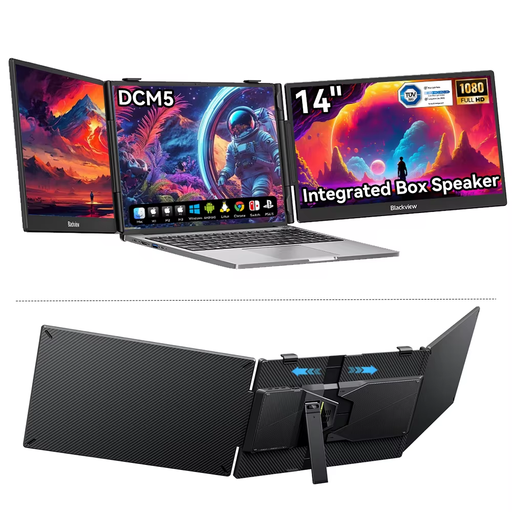
Blackview DCM5 14-inch IPS monitor
A portable second-screen option for viewing documents alongside a laptop.
14 inch, IPS and 16:9. Before you buy, check that the connections and compatibility of the version on offer suit your laptop.
View at Joybuy
Frequently asked questions
Does every USB-C port support video to a portable monitor?
No. Your laptop’s USB-C port must support video output. Philips lists DP Alt Mode as a requirement for video over USB-C on the 16B1P3302D/00; check the specifications for both your laptop and the exact screen.
How can you set up a small café table?
Measure the space beside your laptop and compare it with the screen’s external dimensions and the room the stand needs. An adjustable or tilt-adjustable stand can help you find a suitable viewing angle at the table.
What should you do if the monitor doesn’t display an image after you connect it?
First, check that the laptop port you’re using supports video and that the monitor is receiving enough power. Check the requirements for the exact devices before trying another cable or adapter.
What are your rights when buying online in the Netherlands?
According to ACM ConsuWijzer, online consumer purchases generally come with a 14-day cooling-off period after delivery, subject to applicable exceptions. You also have statutory rights: if a product doesn’t meet reasonable expectations when used normally, the seller is responsible for providing an appropriate solution.


