
People who use different laptops
You want to open a second desktop quickly at a client’s office or between appointments. Whether that works depends on the video output from your laptop’s port and using the right cable.


First, choose a portable monitor that can receive a video signal through a port and video mode supported by your laptop; USB-C alone is no guarantee. Then consider the screen size and power supply. A built-in battery can be useful when there’s no socket nearby, but it also needs charging and adds something else to carry.
You want to open a second desktop quickly at a client’s office or between appointments. Whether that works depends on the video output from your laptop’s port and using the right cable.
If you pack and unpack several times a day, compare the screen size, weight, case and stand before choosing extra workspace.
You often work away from a socket and want to know whether the monitor runs on power from your laptop, an adapter or its own battery.
First, check whether your laptop can output video through the connection you plan to use. Then choose a screen size and power supply to suit how often you travel and where you work.
| What to consider | What should you check? | Who is this important for? |
|---|---|---|
| Working video connection | Check the exact laptop port, the video mode required, the monitor’s input and the cable. Then set your operating system to extend the display. | If I connect different laptops between client visits, I want to know in advance whether video works through the port I plan to use. Around 36% of consumers rank connection reliability as their top priority. |
| Carrying and setting it up | Compare the weight and size of the exact model, and check whether a case and stand are included. | If I’m often packing and unpacking, bag space and a quick set-up matter. Consumers who prioritise portability make up around 29% of the group. |
| Workspace for documents | Compare the screen diagonal, resolution and aspect ratio of the models you’re considering. | If I want to keep documents open alongside my laptop work, I weigh up the extra screen space against the size I’ll need to carry. Around 21% of consumers prioritise visible workspace. |
| Power supply | Check whether the model runs on power from your laptop, a charger or its own battery, and whether that suits where you work. | If I often work without a socket nearby, I want to know whether I’ll need a built-in battery and when I can charge it. Around 14% of consumers make independent power their main priority. |
Having a USB-C connection on both your laptop and monitor doesn’t, by itself, guarantee a working video connection. ASUS states that the connected device must support the required DisplayPort Alternate Mode for the ZenScreen Go MB16AHP.
Check the specifications for the exact laptop port and monitor model before choosing.
According to HP, the E14 G4 uses its own charger for the power pass-through described. This is a different power solution from the built-in battery in the ASUS ZenScreen Go MB16AHP.
Choose a power source you can actually use between appointments.
The ASUS ZenScreen Duo MB14FCD has two panels and several display modes, making it different from a single compact screen.
Decide how many separate workspaces you need, and check that your preferred screen layout will work with your laptop and workspace.
The ZenScreen models available in the Netherlands include a single 15.6-inch screen, a model with a battery and a foldable dual-screen option.
The ThinkVision M14t Gen 2 is a 14-inch screen with a 16:10 aspect ratio and touch functionality.
The E14 G4 is a 14-inch Full HD option for anyone looking for one portable work screen.
The Dell Pro 14 Plus P1425 is a 14-inch screen with a 16:10 aspect ratio.
These product picks are designed to give you extra laptop workspace on the go. Before buying, check that the connection, video mode and power supply suit your laptop and how you work.
 No image available
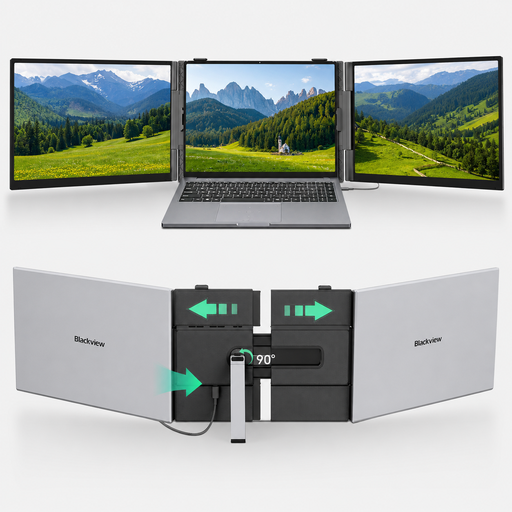
The product title describes this version as a dual-screen laptop extension for laptops measuring 13–17.3 inches; check that the set-up will fit your laptop.
The title lists Full HD resolution of 1920 × 1080 and a USB-C connection.
 No image available
An option for anyone looking for a portable set-up with extra screen space. Check that your laptop’s USB-C connection supports the video and power connections required.
The product description lists a 15.3-inch IPS panel, 1920 × 1200 resolution, USB-C for video and power, a protective case and a weight of 1.2 kg.
 No image available
An option if you’re looking for a portable 16-inch screen with several video inputs; check which connection is available on your laptop.
The product title lists Full HD, IPS, 144 Hz, 16:10, two USB-C ports, mini-HDMI and a built-in stand.
 No image available
For anyone looking for a portable screen with a 16:10 aspect ratio and several video inputs; check which connection you need on your laptop.
The product title lists a 2.5K IPS screen, 144 Hz, 16:10, two USB-C ports, mini-HDMI and a stand.
 No image available
A portable 16-inch option for a laptop with USB-C DisplayPort Alt Mode; check that your laptop supports this video mode through the port you plan to use.
The product description lists 1920 × 1200, 16:10, two USB-C ports with DP Alt Mode, an adjustable stand, a protective case and a weight under 1 kg.
In Windows, choose Extend in the multiple display settings, then arrange the screens to match how they’re positioned on your desk. Microsoft Support recommends testing the screen layout; you’ll need a working video connection first.
No, not necessarily. ASUS states that the connected device must support the required DisplayPort Alternate Mode for the ZenScreen Go MB16AHP. Check the specifications for your laptop port and the connection requirements for the monitor model you’ve chosen.
At home, test the laptop port, cable, power supply, extended display and stand together as one set-up. Also check which cable and case are included with the exact version; both are listed for the Lenovo version reviewed.
For a consumer purchase in the Netherlands, contact the seller if a product is faulty; the Dutch government states that there is no fixed statutory warranty period. For a standard online purchase, consumers generally have a statutory 14-day cooling-off period, as explained by Ondernemersplein. Business purchases aren’t automatically covered by the same consumer rules, so check the terms that apply to your purchase.
When buying a new, similar appliance, individuals can use the Dutch government’s old-for-new scheme; the shop will then take the old appliance free of charge. The same source states that this scheme doesn’t apply to equipment from businesses.