For small labels and structural details, it’s worth considering screen size and resolution together, and checking in advance that your laptop can send video to the monitor. A lighter model may be more convenient if you regularly change where you study; two display panels can give you room to view a drawing alongside its notes. A monitor won’t block out conversations in the background, so treat noise distractions as a separate issue.
Who is a portable monitor suitable for?
People reading fine drawing details
If you work with small labels, lines and dimensions, choose a screen size and resolution that give you the readability you need. Lenovo and ASUS list a range of screen sizes and resolutions for their different models.
Students who move between study spaces
If you regularly take the extra screen with you, its weight and power requirements matter, as does your laptop’s video output. Check the connections on both your laptop and the exact monitor model.
People who want to view a drawing and its notes together
If you want to keep a drawing alongside calculations, notes or a document, extra screen space may be useful. ASUS describes the ZenScreen Duo MB14FCD as a model with two panels.
What should you look for when choosing one?
Start by considering what you need to read on the drawing, then check the connection to your laptop. Next, weigh portability against extra workspace. If background conversations are a concern, look for a separate solution.
| What to consider |
What should you look for? |
Who is this important for? |
| Fine details and drawing area |
Compare the resolution with the screen size, and think about the scale at which you’ll view the drawing. |
I want to assess small labels and dimensions without relying on screen size alone. Around 36% of consumers put drawing detail first. |
| Video connection and power |
Check that your laptop port supports video, and find out which connection and power supply the monitor needs. |
If I want to connect the monitor to my laptop, I need to know in advance whether the port outputs video and how the screen is powered. Around 29% of consumers give connection reliability top priority. |
| Portability or extra workspace |
Check the stated weight, the stand and how much room your chosen setup will take up. |
When I move between study spaces, I weigh portability against having room to show a drawing and its notes at the same time. Around 21% of consumers give mobile workspace top priority. |
| Background conversations |
Assess the monitor for its display; consider separately how you want to deal with ambient noise. |
If conversations distract me, I don’t want to assume a screen will change the noise in the room. Around 14% of consumers put managing background conversations first. |
Common buying mistakes
-
Assuming every USB-C port carries video
A compatible plug doesn’t guarantee a video signal. ASUS states that the source device must support DisplayPort Alternate Mode for the ZenScreen Go MB16AHP.
Before buying, check your laptop’s video output and the input on the exact monitor model.
You may need a different cable or connection setup.
-
Confusing more screen panels with sharper detail
According to ASUS, the ZenScreen Duo MB14FCD has two panels, each with a resolution of 1920 × 1200 pixels. Extra room for windows won’t automatically make details within a single drawing sharper.
First decide whether you want more detail within one drawing or the ability to view several documents side by side.
-
Buying a monitor to block out conversations
A screen won’t change the noise in the room. A study of reading with background speech published in PLOS ONE found effects on the reading process under the conditions tested; it did not specifically examine bridge drawings or monitors.
Choose a monitor for the visual task, and decide separately whether you need a quieter place or another way to manage noise.
You may need a separate solution to manage distractions in your study environment.
-
Comparing weight or battery life without considering the conditions
ASUS lists the ZenScreen MB16AHV’s net weight as 0.9 kg, while MediaMarkt Magazine gives it as 780 g. ASUS states that the MB16AHP’s maximum battery life applies under a specific usage condition.
Compare specifications for the exact model, and don’t treat the stated maximum battery life as a guarantee for your setup.
Brands to compare
Lenovo
According to Lenovo, the ThinkVision M14d and M14t Gen 2 are compact 14-inch models with a resolution of 2240 × 1400 pixels.
- Lenovo lists the M14d’s weight as 600 g.
- The M14t Gen 2 adds touch controls; choose this version only if you need touchscreen input. These features apply to the models listed.
ASUS
The ZenScreen models in this comparison offer a range of features, including a larger screen, a built-in battery and two panels.
- According to ASUS, the MB16QHG has a 16-inch screen with a resolution of 2560 × 1600 pixels; the MB14FCD has two 14-inch panels.
- According to ASUS, the MB16AHV has no speaker. The stated maximum battery life of the MB16AHP applies under a specific condition.
Dell
According to Dell, the Dell Pro 14 Plus P1425 is a portable monitor with a 14-inch screen and a resolution of 1920 × 1200 pixels.
- Dell lists an anti-glare finish and an adjustable stand.
- According to Dell, this model has no touchscreen; these are product specifications, not the results of an independent user test.
HP
According to HP, the HP E14 G4 is a portable 14-inch monitor with Full HD resolution and USB-C.
- HP describes a one-cable USB-C connection for a compatible setup.
- Check that your laptop’s video output works with the connection you want to use.
Portable monitors at Joybuy
This selection includes portable monitors for viewing fine detail, as well as a model with two display panels for anyone who wants to view documents side by side.
 No image available
TECLAST V16Q portable monitor
A good option if you’re looking for a single portable screen for viewing drawing details.
The product title lists an IPS screen, 2.5K, 144 Hz, a 16:10 aspect ratio, two USB-C ports and mini-HDMI.
View at Joybuy
 No image available
UPERFECT 16" 2K 144Hz portable monitor
A good option if you’re looking for a portable 16-inch screen with a higher stated resolution for viewing drawings.
The product title lists 2560 × 1600 pixels, a 16:10 aspect ratio, a QLED screen, Type-C and mini-HDMI.
View at Joybuy
 No image available
ARZOPA Z1RC 16" 2.5K portable monitor
A good option if you’re looking for a single portable screen for viewing details on a drawing.
The product title lists a 16-inch IPS screen with a resolution of 2560 × 1600 pixels, USB-C, HDMI and a built-in stand.
View at Joybuy
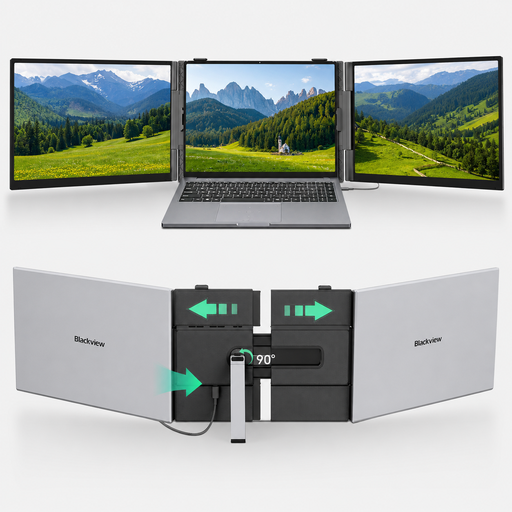 No image available
Blackview DCM8 Pro 15.3" dual-screen monitor
A good option if you want to display a drawing and its notes on separate screens.
The product title lists a dual-screen setup, FHD, USB-C and a weight of 1.2 kg.
View at Joybuy
 No image available
Arzopa A1S 14.0" FHD portable monitor
A good option if you’re looking for a portable 14-inch second screen to use in different study spaces.
The product title lists FHD 1080P and a built-in stand.
View at Joybuy
Frequently asked questions
Will every USB-C port on a laptop work with a portable monitor?
No, don’t assume it will. For the USB-C video connection described, the source device must support the required video function; ASUS specifically lists DisplayPort Alternate Mode for the MB16AHP. Check the port specifications for your laptop.
How can I set up a monitor to show a drawing and its notes?
If your laptop supports extended display mode, you can put the drawing and its notes on separate screens. According to ASUS, the ZenScreen Duo MB14FCD has two panels; also check the stand and the available desk space for the model you choose.
Do I need a monitor with speakers to deal with background conversations?
No, speakers in a monitor won’t block out conversations in the room. Consider noise distractions separately from your choice of screen; research into reading tasks with background speech isn’t a test of monitors or bridge drawings.
What costs and rights should I consider after buying online in the Netherlands?
Check in advance what comes with the monitor and whether you’ll need a compatible cable or power supply for the connection. According to the Dutch government, in many cases you have 14 days to change your mind when buying from a business online as a consumer. The Netherlands has no fixed statutory warranty period; you’re entitled to a product that works as it should, and the retailer is your point of contact if there’s a fault.


