
Researcher at a small archive table
This researcher wants to set up a laptop, archive materials and a second screen at the same time. Measure the whole setup, including the stand and cables, rather than comparing screen size alone.


First, choose a portable monitor that fits alongside your laptop and archive materials, including its stand and cables. Then check that your laptop supports the required video output and power supply. A compact 14-inch screen with a 16:10 aspect ratio can be useful for documents, while a 15.6-inch model needs more desk space. Touchscreen controls or two panels are worth considering only if you’ll actually use them.
This researcher wants to set up a laptop, archive materials and a second screen at the same time. Measure the whole setup, including the stand and cables, rather than comparing screen size alone.
This reader compares digital documents with notes and looks at aspect ratio, resolution and a useful viewing angle. Lenovo and Dell offer examples of compact 14-inch screens with a 16:10 aspect ratio.
This laptop user checks in advance whether the USB-C port supports video, whether an HDMI connection is available and how the monitor is powered.
First, measure the available desk space with your laptop, documents and cables in place. Then check the video connection and power supply; only after that should you choose the aspect ratio and extra features.
| What to consider | What to look for | Who is this most relevant to? |
|---|---|---|
| Desk space | Measure the available width and depth next to your laptop and papers, with the stand and cables in position. | If I need my laptop, scans and notes on the desk at the same time, I want to know whether the whole setup will fit. Around 31% of consumers prioritise having enough desk space. |
| Document readability | Compare the aspect ratio and resolution, then adjust the text size on your laptop to a comfortable reading size. | When reading scans and transcripts side by side, I want enough room for the documents and text that remains easy to read. Around 31% of consumers prioritise document readability. |
| Video connection | Check whether USB-C supports video over DisplayPort Alt Mode; if you’re using HDMI, also check how the monitor is powered. | I want to connect my laptop without discovering afterwards that the chosen port doesn’t transmit a picture. Around 23% of consumers start by checking the video connection. |
| Power and accessories | Check which cables and power supply you’ll need, and whether there’s a power socket available where you’ll be working. | When working in different locations, I want to know in advance how the screen is powered and what I need to bring. Around 15% of consumers prioritise power and accessories. |
A USB-C plug that fits doesn’t guarantee that your laptop can output a video signal through that port. HDMI may also require a separate power supply.
Before choosing, check your laptop and monitor specifications, the cables included and the power requirements.
The stand, cables and space for documents also affect whether a monitor will fit on a small archive table.
Measure the setup next to your laptop with the stand unfolded; don’t rely only on the dimensions of the folded screen.
Touch controls or a second panel won’t automatically make a monitor more suitable for reading a scan alongside your notes. A multi-panel setup also needs enough desk space.
Choose touch controls only if touching or drawing suits the way you work, and a dual-screen setup only if you’ll actually use the extra screen space.
The ThinkVision M14d is a compact 14-inch, 16:10 screen; the M14t Gen 2 is an option if you want touchscreen controls in that size.
The Pro 14 Plus P1425 is a compact 14-inch screen with a 16:10 aspect ratio.
The ZenScreen MB16AHV is a single 15.6-inch screen; the ZenScreen Duo MB14FCD has two foldable panels.
The PRO MP165 E6 is a 15.6-inch FHD option with USB-C and HDMI.
The E14 G4 is a 14-inch USB-C model you can compare as a compact second screen.
These product picks are portable second screens for laptop and document work, including compact models and a larger 16-inch option.
 No image available
A compact option for viewing documents alongside a laptop, provided the connections are compatible.
14 inch, 1920 × 1200, IPS, 16:10, USB-C and Mini-HDMI.
 No image available
The adjustable stand can be useful if you need to position the screen on a small table.
14 inch, FHD, IPS and adjustable stand. The product title states compatibility with laptops from 13 to 17.3 inch.
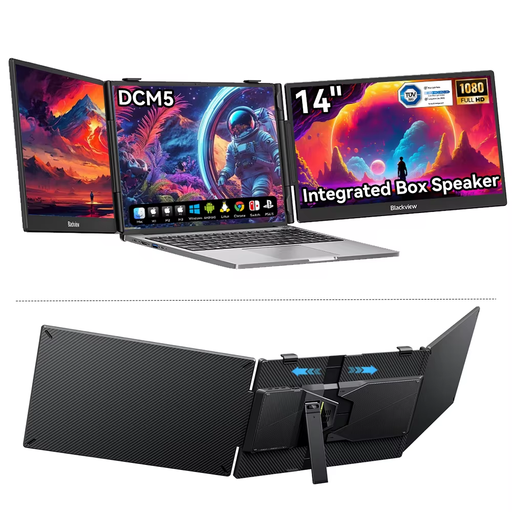 No image available
A 14-inch second screen for use alongside a laptop; bear the aspect ratio in mind when working with documents.
IPS panel and 16:9 aspect ratio. Check the connections and compatibility with your own laptop.
 No image available
A portable screen with a built-in stand; measure the complete setup next to your laptop.
14 inch, 1920 × 1080, 16:9, USB-C and HDMI.
 No image available
The larger screen may suit you if you want more screen space and have enough room on your desk.
16 inch, 2560 × 1600, 16:10, Mini-HDMI and USB-C.
No. Check whether your laptop port supports video over DisplayPort Alt Mode and provides enough power. Lenovo lists DP 1.2 Alt Mode and PD 2.0 as requirements for the ThinkVision M14; don’t assume that the same model-specific requirements apply to other monitors.
Measure the space needed for the screen, stand, laptop, cables and papers together. Position the screen and adjust the text for comfortable viewing, and take breaks from prolonged screen work. The Dutch workplace health and safety rules discussed by Arboportaal apply to the relevant working context for employees and employers.
Not automatically. According to the Dutch government, statutory rights apply alongside any manufacturer’s warranty. There is no fixed statutory warranty period in the Netherlands, and the retailer is your point of contact if a product is faulty. Compare what additional rights a paid warranty actually provides.
For many eligible distance purchases from a business, you have a 14-day cooling-off period, according to the Dutch government. Check the terms and conditions of the specific seller; this is not a general returns promise for purchases from private individuals.
No. A monitor doesn’t change the archive’s access conditions. According to the Dutch Data Protection Authority, access to transferred public archives may be restricted because they contain personal data; ask the relevant archive about the conditions for the specific item.