What should you look for?
Start by checking device compatibility and key layout. Then compare how compact it is to carry, how much table space it needs and the typing feel that suits your note-taking.
| What to consider |
What to look for |
Who is this important for? |
| Packed size and table space |
Compare the dimensions when folded and unfolded, and check that the keyboard fits your usual workspace. |
At a small café table, I want to write up my notes without the keyboard taking over my workspace. Around 31% of consumers say packed size and table space are their main purchasing concerns. |
| Key noise |
Consider the key mechanism and, if possible, try the typing feel for yourself. A manufacturer’s claim that a keyboard is quiet isn’t the same as a comparable sound measurement. |
At a shared table, I want to type without making unnecessarily noticeable noise. Around 25% of consumers prioritise quiet typing. |
| Typing longer texts |
Look at the key size, positioning and layout, and consider whether you have enough space to work comfortably. |
When writing longer field notes, I want a layout that suits the way I type, even if the keyboard is less compact to store. Around 25% of consumers say extended typing is their main purchasing concern. |
| Connecting devices |
Check the operating system, your preferred connection method and how many devices the model can pair with. |
If I switch between my phone, tablet and laptop, I want to know whether the keyboard works with my devices and is easy to switch between. Around 19% of consumers prioritise switching between devices. |
Joybuy products
This selection includes folding Bluetooth keyboards and compact 75% models for anyone who wants to take a keyboard with them or use less table space.
 Image unavailable
NAXSIR Foldable Bluetooth Keyboard with Magnetic Stand, Grey
A folding model for anyone who wants to take their keyboard with them and prop up a phone or tablet on the magnetic stand.
Rechargeable; the product name mentions an aluminium casing and compatibility with mobile phones and tablets.
View at Joybuy
 Image unavailable
AJAZZ AK820 MAX 75% Wireless Mechanical Keyboard, US QWERTY
The compact 75% layout may suit you if you want to use less table space; check that the US QWERTY layout works for the way you type.
82 keys; Bluetooth, 2,4 GHz and USB-C connectivity.
View at Joybuy
 Image unavailable
AJAZZ AK820 Pro 75% Mechanical Keyboard, US QWERTY
A 75% model for anyone looking for a more compact layout; the US QWERTY version listed won’t suit every preferred keyboard layout.
82 keys; Bluetooth 5.1, 2,4 GHz and USB-C connectivity.
View at Joybuy
 Image unavailable
Voxis B033 Tri-Fold Bluetooth Keyboard with Touchpad
A folding keyboard with a touchpad for anyone who wants to navigate while typing.
63 keys; 152 × 97 × 12 mm when folded. The product information lists Bluetooth and support for iOS, Android and Windows.
View at Joybuy
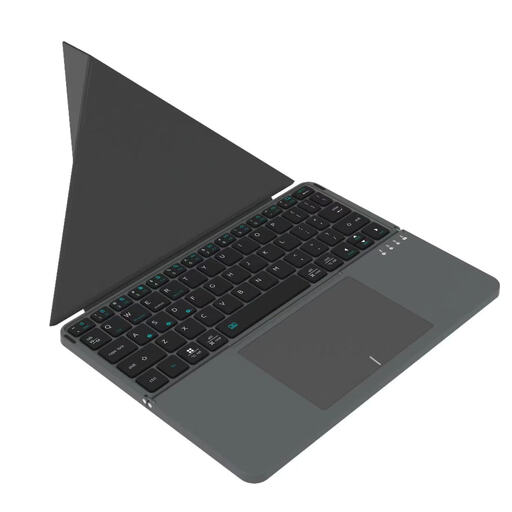 Image unavailable
Voxis HL-BOX1 Foldable Bluetooth Keyboard with Touchpad
A folding keyboard with a touchpad for anyone who wants a compact model to take along, combining typing and navigation in one device.
64 keys; 157,5 × 98 × 15,8 mm when folded. The product information lists Bluetooth and support for computers, mobile phones and tablets.
View at Joybuy
Frequently asked questions
Does my tablet need to support a specific type of keyboard?
Check whether your device supports Bluetooth keyboards and whether the version you choose works with its operating system. Also check the key layout: Bluetooth support alone doesn’t confirm that the layout suits the way you type.
How do I pair the Samsung Smart Keyboard Trio 500?
According to Samsung’s instructions, switch on the keyboard, press and hold the Bluetooth button, then select the keyboard on your device. Next, enter the six-digit code shown on the device.
What can I do if a keyboard I bought online develops a fault too soon?
In the Netherlands, contact the seller: according to the Dutch government, you’re entitled to a product that works as it should, and the seller is your point of contact. There’s no fixed statutory warranty period; the appropriate solution depends, among other things, on the fault and what you could reasonably expect from the product.
Can I include identifiable people in my café observations?
Without knowing the purpose and use of the notes, this can’t be answered with a general yes or no. According to the Dutch Data Protection Authority, information that can indirectly identify someone may also count as personal data; if the GDPR applies to the processing, you must assess whether it is permitted. The exception for purely personal or household activities may be relevant, but professional use isn’t automatically covered.


