
The letter writer with short stops between visits
You carry a phone or tablet and want to quickly set up a separate typing space without giving up too much room in your bag.


For quick writing stops with a phone or tablet, you could start with a slim keyboard with a protective cover; Logitech describes its universal Keys-To-Go 2 as having one. For longer letters, a compact model with scissor keys is also worth considering. A foldable model can save space in your bag, but check the keyboard layout, how much room it needs when open and how you’ll prop up your screen.
You carry a phone or tablet and want to quickly set up a separate typing space without giving up too much room in your bag.
You type and edit longer passages at a table, prioritising the keyboard layout and feel over the smallest possible packed size.
You might start on a phone and continue later on a tablet or laptop, and want to know in advance how the keyboard switches between devices.
Choose this if: you type during short stops and often put the keyboard away in your bag.
Bear in mind: Logitech says the cover protects the keys, but the universal Keys-To-Go 2 doesn’t have a built-in stand.
Choose this if: you regularly type or revise a whole letter and have space to set down a separate keyboard.
Bear in mind: these models retain their full length when you carry them; Trust says the Trust Lyra combines two Bluetooth connections with a USB receiver.
Choose this if: saving space in your bag matters and you’ll have a flat surface to unfold the keyboard on when you arrive.
Bear in mind: ProtoArc lists the XK01 as having 105 keys, including a number pad, so also consider how much space it takes up when unfolded.
| What to consider | What should you check? | Who is this important for? |
|---|---|---|
| Packed size and set-up | Compare the packed shape and protection, and think about where you can prop up your phone or tablet. | If I only have a short break between appointments, I need to be able to get the keyboard out of my bag quickly and use it with my phone or tablet. Around 36% of this group prioritise quick carrying and set-up. |
| Keyboard layout and feel | Check which QWERTY layout is available and where the punctuation and navigation keys are; try the keys if possible. | For a longer letter, I want to be able to type, reread and edit comfortably. Around 29% of this group prioritise comfortable writing and editing. |
| Switching between devices | Check compatibility with your operating system, the number of connections and how to switch between them. | If I edit my letter on more than one device, I want to know whether pairing and switching suit the way I work. Around 21% of this group prioritise switching between devices. |
| Typing noise | Consider the key mechanism and, if possible, assess the sound in a similar environment. | In a waiting room or shared workspace, I don’t want to disturb others unnecessarily. Around 14% of this group prioritise quiet typing. |
According to ProtoArc, the XK01 has a 105-key layout, including a number pad, when unfolded.
Compare both the shape it takes up in your bag and the space it needs while you’re typing.
A product description won’t necessarily tell you how the keyboard sounds or feels on your surface.
Use the listed features to compare models, and assess the sound and key feel for yourself if possible.
Logitech describes both the slim, universal Keys-To-Go 2 with a key cover and the compact Pebble Keys 2 K380s for use with multiple devices.
Trust describes the Lyra as having Bluetooth and a USB receiver, and the Nado II as a compact Bluetooth model for multiple devices.
According to the manufacturer, the CHERRY KW 7100 MINI BT is designed for mobile working, with three Bluetooth channels and a carry case included.
ProtoArc describes the foldable XK01 as an option for anyone who wants to carry a full keyboard layout in a foldable design.
These Joybuy products range from foldable keyboards to compact and full-size models for writing between appointments.
 No image available
Suitable for quick writing stops with a phone or tablet if you want a foldable keyboard and a magnetic stand.
The product name specifies a rechargeable model with an aluminium body.
 No image available
An option if you also want to take a mouse with you when you write.
The product name specifies a wireless RF and Bluetooth connection, with a QWERTY US English layout.
 No image available
Suitable for short stops if you’re looking for a foldable keyboard with an integrated touchpad.
The product name specifies use with tablets, smartphones and computers.
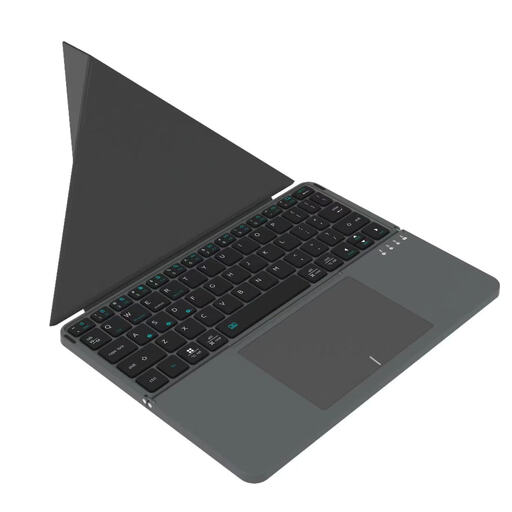 No image available
An option if you want a foldable keyboard with a touchpad.
The product name describes a keyboard with a leather case.
 No image available
Suitable for longer letters and lots of editing if you want a full keyboard layout with a number pad; bear in mind how much space it’ll take up in your bag.
The product name specifies scissor keys and support for multiple devices.
Check both for the exact version. Logitech lists Android, ChromeOS, Windows, iPadOS, iOS and macOS as compatible with the Keys-To-Go 2 Universal; a separate version of the Keys-To-Go 2 is designed for Apple devices. Also check the physical keyboard layout for letters and punctuation.
Make sure you have a stable place for your screen and keyboard. Arboportaal recommends using an additional keyboard and mouse with a laptop, and possibly an external screen or laptop stand, so the screen and keyboard can be positioned separately. What works best depends on your workspace.
Check how many devices the exact model supports and which connection each device uses. For the Trust Lyra, Trust describes two Bluetooth connections alongside a USB receiver, so that’s not three Bluetooth connections.
Check the battery before you leave and take the right charging cable for your model if needed. Trust describes the Lyra as rechargeable and says it can be used while charging; don’t assume every keyboard has the same power supply.
For online consumer purchases in the Netherlands, ACM ConsuWijzer says you generally have a statutory cooling-off period of up to 14 days after the product is delivered, with some exceptions. If a purchase develops a fault sooner than you could reasonably expect under normal use, ACM ConsuWijzer says the seller must offer an appropriate free solution, such as a repair, replacement or refund.