Choose a keyboard that connects to the device you’ll use to plan your essay, and has a layout that feels comfortable to you. Then weigh up how much space it takes in your bag against how it feels to type on. Keys described as quiet by the manufacturer may suit a peaceful study space, but that doesn’t mean typing will be inaudible. Check the power source too, along with your library’s rules.
Who is this for?
Student with a tablet or phone
You want to take a separate keyboard with you so you can work on your essay plan without a laptop. Check that your device supports Bluetooth and can stand securely on its own. The Consumentenbond describes separate tablet keyboards as Bluetooth keyboards.
Student in a quiet study space
You want to type without making unnecessary noise and are mindful of your library’s rules. Logitech and Trust describe certain models as quiet, but library rules vary by location. Utrecht University Library and the University of Amsterdam Library both emphasise avoiding disruption and keeping noise to a minimum.
Student who switches between devices
You work on the same essay plan across, for example, a tablet and a laptop, and want to switch easily between devices. Logitech, Trust and CHERRY describe models with options for switching between devices or connections.
What should you look for?
First, check that the keyboard connects to your device and that its layout works for you. Then compare its size, keys and power source.
| What to consider |
What should you check? |
Who should pay particular attention? |
| Size and portability |
Compare the dimensions, layout and any protective cover for travelling. Also consider whether the size feels comfortable to type on. |
If space in my bag or on the table is limited, I want to work compactly without choosing a layout that feels awkward to type on. Around 25% of consumers prioritise portability. |
| Key noise |
Look for keys described as quiet and, if possible, try them out. Always follow the venue’s rules. |
In a shared study space, I want to disturb others as little as possible, but a manufacturer’s claim doesn’t tell me how audible the typing will be there. Around 25% of consumers prioritise quiet typing. |
| Device connectivity |
Check Bluetooth and operating system support. If the keyboard uses a USB receiver, check that your device has a suitable port too. |
Before I start, I want to be sure the keyboard works with the device my essay plan is on. Around 33% of consumers put compatibility first. |
| Layout and power |
Check the keyboard layout and whether the model is rechargeable or uses disposable batteries. |
If I use lots of punctuation or keyboard shortcuts, I want a familiar layout and to know how the keyboard is powered. Around 17% of consumers prioritise ease of use and power. |
How to avoid common buying mistakes
-
Assuming versions with the same product family name are interchangeable
Whether a keyboard is suitable depends on the exact version and the device you’ll be typing on. A different layout or connection may make it harder to use.
Before buying, check the keyboard layout and compatibility of the specific version, not just the product family name.
Choosing the wrong version could mean extra hassle when arranging a return.
-
Assuming a manufacturer’s ‘quiet’ claim means it’s allowed in every quiet study area
A description of the keys isn’t an independent sound measurement, nor does it determine what your library allows. Utrecht University Library may speak to visitors who are causing a disturbance.
Check the rules at your library and choose a space where typing is allowed and won’t disturb others.
-
Assuming there’s a fixed two-year warranty period
According to ACM ConsuWijzer, the statutory guarantee in the Netherlands depends on what you could reasonably expect from the product. This doesn’t mean there’s one fixed period for every keyboard.
Keep your proof of purchase and contact the seller if a product doesn’t meet reasonable expectations.
Brands to compare
These brands are worth considering for specific keyboard models. The features mentioned apply to those product ranges and aren’t a recommendation for the brand as a whole.
Logitech
The Keys-To-Go 2 Universal is designed for portability, with a protective key cover. The Pebble Keys 2 K380s is a compact option for switching between devices.
- Logitech says the Keys-To-Go 2 has a built-in cover, while the K380s can switch between three devices using Easy-Switch.
- Logitech describes the K380s keys as low-profile and quiet, but this isn’t an independent comparison of key noise. Check the layout of the version you choose too.
Trust
The Nado II and Lyra are compact models designed for use with multiple devices.
- Trust describes the Nado II as having low-profile scissor keys and a rechargeable battery. For the Lyra, Trust lists a USB receiver and Bluetooth connectivity for up to three devices.
- Descriptions of quiet typing and battery life aren’t based on directly comparable measurements. Check the layout and power source of the version you choose.
CHERRY
The KW 9200 MINI is a compact option if you want several ways to connect.
- CHERRY lists two Bluetooth channels, a 2.4GHz connection with a receiver and a wired connection for this model. The manufacturer also says it comes with a carry case.
- A receiver or cable will only work if your device has the right port. CHERRY’s claims about typing comfort aren’t based on an independent comparison.
Keyboards for studying on the go
These Joybuy products are designed for typing on the go with devices such as tablets, phones and computers. Check that each model’s connection and layout are suitable for your device.
 No image available
Trust Lyra keyboard with mouse, RF wireless and Bluetooth, QWERTY US English, blue
Suitable if you want to type on several devices and are looking for a QWERTY US English layout.
The description mentions low-profile keys and switching between up to three devices via Bluetooth or a USB receiver.
Joybuy
 No image available
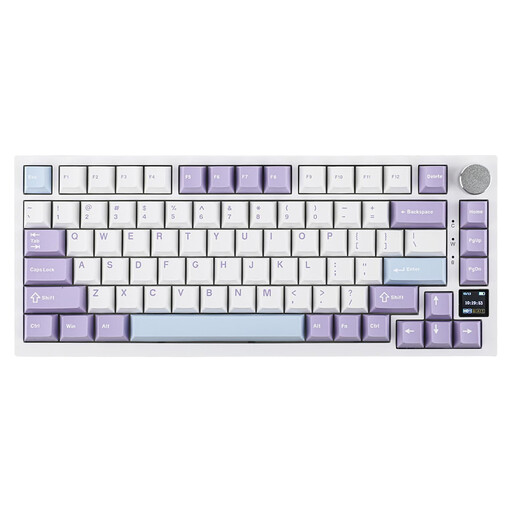
Ajazz AK820 Pro, mechanical keyboard, 75%, QWERTY US
A good fit if you’re looking for a compact layout and several connection options. Check that the layout suits the way you type.
The description lists 82 keys, Bluetooth 5.1, 2.4GHz and a wired USB-C connection.
Joybuy
 No image available
KEYSME Lunar 01, mechanical keyboard, 80%, QWERTY US, 4000mAh
An option if you want a compact layout and the choice of a wireless or wired connection.
The description lists Bluetooth, 2.4GHz and USB-C. The stated battery capacity is 4000mAh.
Joybuy
 No image available
Voxis B033 foldable Bluetooth keyboard with touchpad
A good fit if you’re looking for a foldable keyboard with a touchpad to use with a tablet, phone or computer.
The description lists 63 keys and folded dimensions of 152 × 97 × 12 mm. The stated weight is 0,3 kg.
Joybuy
 No image available
HP 725 wireless multi-device keyboard
An option if you want to switch between several devices and prefer a full-size layout. Bear in mind how much space the keyboard takes up.
The description lists two Bluetooth connections and a 2.4GHz receiver. The keyboard has a full-size layout and is 420,5 mm wide; it charges via USB-C.
Joybuy
Frequently asked questions
Can I use a separate keyboard with my tablet?
Yes, as long as your tablet and keyboard support the same connection. A separate tablet keyboard usually connects via Bluetooth. Also check that your tablet is compatible with the version you choose.
How can I avoid connection problems when I sit down to study?
Pair the keyboard with your device in advance and check which connection mode is active. Your device needs a suitable port for a USB receiver. A Bluetooth model works without a receiver if your device supports the required Bluetooth connection.
Can I type on a keyboard in any library?
Don’t assume every library has the same rules. Utrecht University Library may speak to visitors who are causing a disturbance, while the University of Amsterdam Library aims to maintain a quiet environment. Check the rules at your location and choose a suitable study space.
What if a keyboard I bought online is uncomfortable to type on or breaks quickly?
For online consumer purchases, you generally have a statutory cooling-off period of up to 14 days after delivery, although exceptions may apply. If a product doesn’t perform as you could reasonably expect under normal use, statutory consumer guarantees apply. ACM ConsuWijzer advises contacting the seller. The statutory guarantee isn’t a fixed period of exactly two years for every product.


