What should you consider when choosing one?
Start with the connection and layout for your device, then weigh up the typing feel, desk space and ease of carrying.
| What to consider |
What should you look for? |
Who is this important for? |
| Key noise |
Compare the typing feel and, if possible, try the keyboard yourself; manufacturers’ claims are not comparable measurements. |
If I’m typing in a shared reading room, I want to disturb others as little as possible without choosing keys that feel uncomfortable to me. Around 31% of consumers give key noise their highest priority. |
| Layout and typing space |
Check the layout on offer, key size and punctuation; consider whether a number pad would be useful. |
When entering lots of names, dates and source locations, I want keys that suit the way I type. Around 31% of consumers put accurate input first. |
| Portability and desk space |
Compare the dimensions when folded and unfolded; check that the keyboard will fit beside your device and sources. |
If I’m taking the keyboard to the library, I want it to fit in my bag and be practical to use at my desk. Portability is the main consideration for around 23% of consumers. |
| Connection and power |
Check Bluetooth support, whether there’s a suitable USB port, and the battery type or charging method. |
When using my own tablet or laptop, I want to know before I leave that the connection works and the keyboard has power. Around 15% of consumers give connectivity and power their highest priority. |
Joybuy products for library research
This selection includes folding and compact wireless keyboards, a keyboard and mouse set, a full-size version and a compact wired model. When choosing, check the layout, connection and available space. Also check the CE marking on the specific version.
 No image available
NAXSIR folding Bluetooth keyboard with magnetic stand, grey
This folding model is designed to be carried around and used with a phone or tablet via Bluetooth.
The product description lists scissor keys and describes typing as quiet; this is not an independent sound measurement. According to the description, it charges via Type-C.
View at Joybuy
 No image available
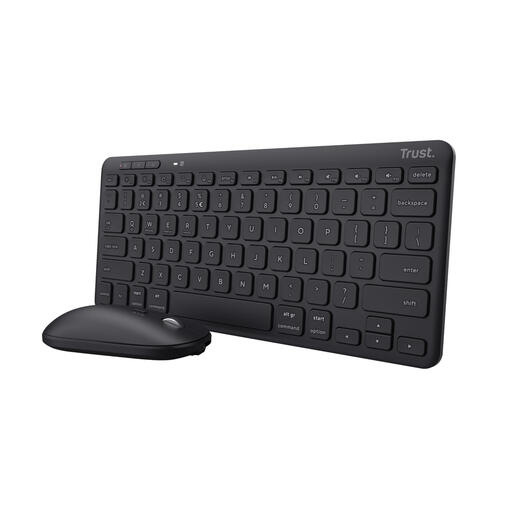
Trust Lyra wireless keyboard and mouse set, US QWERTY, black
This compact set could be a good choice if you want to take both a keyboard and mouse with you and switch between devices.
The product description lists Bluetooth and a USB receiver, rechargeable batteries and quiet scissor keys. This is a set, not a standalone keyboard; the layout is US QWERTY.
View at Joybuy
 No image available
Voxis B033 folding wireless keyboard with touchpad
This folding model could suit you if you’re short on space in your bag and want to use an integrated touchpad.
The product description lists Bluetooth, 63 keys and folded dimensions of 152 × 97 × 12 mm. The stated weight is 0,3 kg.
View at Joybuy
 No image available
Trust Vaiya full-size wireless keyboard with number pad, US QWERTY, black
The full-size layout with number pad could suit you if you enter lots of numbers and have enough desk space.
The product description lists dimensions of 440 × 130 mm, US QWERTY, a rechargeable battery and a connection via Bluetooth or USB receiver. Its full dimensions may make it awkward to carry or use on a small reading-room desk.
View at Joybuy
 No image available
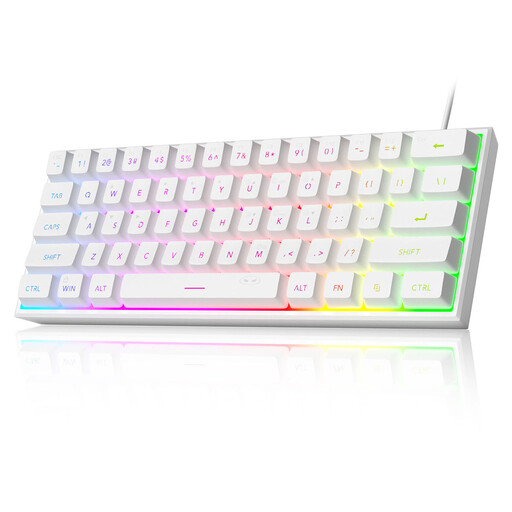
MageGee TS91 60% wired keyboard, 61 keys, US QWERTY, white
This compact model could suit you if your device has a suitable USB connection and you don’t need Bluetooth.
The product description lists 61 keys, US QWERTY and dimensions of 29,2 × 10,1 cm. The keys are described as ‘clicky’, so bear that in mind in a shared reading room.
View at Joybuy
Frequently asked questions
Will a Bluetooth keyboard automatically work with any library computer?
No, you shouldn’t assume so: Bluetooth support and permission to use it vary by device and location. Check support on your own laptop or tablet, and ask about the rules before connecting to a shared computer.
How do I prepare my keyboard for use in a reading room?
Pair it with your own device in advance, check the key layout and charge it if it’s rechargeable. The KB mentions baskets for carrying items such as laptops and writing equipment into reading rooms, and says that bags are not allowed inside. Rules may vary between libraries and rooms.
What are my rights if an online keyboard purchase isn’t right for me or breaks too soon?
According to ACM ConsuWijzer, online purchases generally come with a cooling-off period of up to 14 days after delivery. This is separate from your statutory rights if a product, when used normally, doesn’t meet what you could reasonably expect; the seller must then offer an appropriate solution. Check the terms that apply to your purchase.
Which product rules apply to a wireless keyboard in the Netherlands?
The Dutch Authority for Digital Infrastructure outlines EU requirements for radio equipment and the required CE marking. Check the marking on the specific version you want to buy; a product description or series name alone doesn’t show that a particular item meets the applicable requirements.
Does a workplace requirement for extended screen use also apply to my hobby research?
The regulations described by Arboportaal are aimed at employers and employees, and aren’t automatically a general requirement for private library visitors. The stated rule about more than 2 hours of screen use per day should therefore be understood in that work context.


