
Traveller with limited bag space
You work in short bursts on a phone or tablet and want to pack your keyboard away neatly. ProtoArc describes the XK04 as a folding model for short tasks; check the layout when unfolded before choosing it.


Choose based on the device you use and how much room you have between visits. A folding keyboard takes up little space when folded, while a non-folding model may be more comfortable for regular corrections. With either type, check the physical key layout, power source and whether you’ll actually be entering text during your breaks.
You work in short bursts on a phone or tablet and want to pack your keyboard away neatly. ProtoArc describes the XK04 as a folding model for short tasks; check the layout when unfolded before choosing it.
You view or edit vocabulary lists on more than one device and want to switch between them. Logitech, Trust and CHERRY describe models with multiple connections or device channels; check that the available connections are compatible with your devices.
You often correct words or example sentences and prioritise enough space between keys and a suitable language layout over the smallest packed size. In a comparison of Logitech models, RTINGS found the Pebble Keys 2 K380s less cramped than the Keys-To-Go 2; the testing methods were not the same for both models.
Choose this if: you mainly type short additions and have limited space in your bag.
Bear in mind: the smaller typing area when unfolded and the physical layout of the version you choose.
Choose this if: you want a slim keyboard you can pick up easily and have a stable place to prop up your phone or tablet.
Bear in mind: RTINGS found the Keys-To-Go 2 cramped to type on because its keys are close together.
Choose this if: you often correct words or switch between, for example, a tablet and a laptop.
Bear in mind: how much space you have in your bag and, if it uses a USB receiver or cable, whether your device has the right ports.
Choose this if: you only read your vocabulary lists between appointments and rarely enter text.
Bear in mind: typing on screen may be less convenient if you make frequent corrections.
| What to consider | What should you look for? | Who is this important for? |
|---|---|---|
| Packed size and set-up | Compare the folded and unfolded dimensions, how well it is protected in transit and the space you need to prop up your device. | If you have little room in your bag between appointments, you’ll want to know whether both the keyboard and your phone or tablet are easy to pack and set up. Around 33% of consumers rank packed size as their top buying priority. |
| Device compatibility | Check the operating system, Bluetooth support and whether you want to switch between paired devices. A USB receiver requires a compatible port. | If you use vocabulary lists on, for example, a tablet and a laptop, you’ll want to make sure the keyboard works with both and that switching between them suits the way you use it. Around 27% of consumers prioritise compatibility and switching between devices. |
| Key layout and typing comfort | Check the physical QWERTY layout and the selected input language. Google explains how to configure a physical keyboard layout on Android; some steps apply only to Android 14 and later. | If you regularly correct words and punctuation, you’ll want to be able to type characters where you expect them and enjoy a comfortable typing experience. Around 20% of consumers give key layout and typing comfort top priority. |
| Power and what’s included | Check whether the model uses replaceable batteries or a rechargeable battery, and which accessories you’ll need. Logitech lists replaceable coin-cell batteries for the Keys-To-Go 2; Trust describes the Lyra as rechargeable. | If you don’t want the battery to run flat between visits or to carry unnecessary accessories, check which power source and included items suit your needs. Around 20% of consumers prioritise power and additional costs. |
You type on the keyboard when it’s unfolded. A compact packed size alone tells you nothing about typing comfort or how much space you need to set up the keyboard and your device.
Compare both sets of dimensions and think about where you can use the keyboard securely during a break. ProtoArc positions the XK04 mainly for short tasks.
A different physical layout or an incompatible input language can make correcting words and punctuation awkward.
Check the exact layout of the version on offer and make sure your device’s physical keyboard setting matches it.
The Trust Lyra set also includes a mouse, which may be unnecessary if you’re only viewing or briefly editing vocabulary lists.
Check what’s included in the set and whether you need it for the way you plan to use it.
The Keys-To-Go 2 is a slim model with a key cover, while the Pebble Keys 2 K380s is a compact model that Logitech says can switch between three devices.
The Lyra is a compact, rechargeable keyboard, also available as a keyboard and mouse set.
The XK04 is a folding Bluetooth model for short bursts of typing on a phone or tablet.
The KW 9200 MINI is a compact, non-folding alternative with several connection options.
This selection includes folding keyboards for mobile use and wireless models for switching between devices. For each model, check that the layout, connection and dimensions suit the way you plan to use it.
 No image available
A folding model for mobile use with a phone or tablet; the product description mentions a detachable magnetic stand.
The title specifies a rechargeable model with an aluminium body.
 No image available
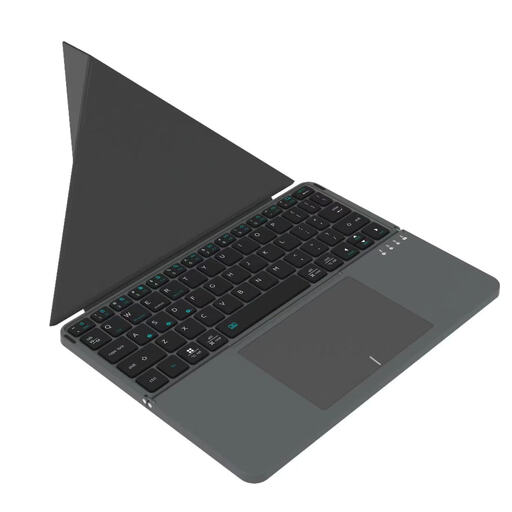
This folding model is designed to be portable; the touchpad lets you navigate as well as enter text.
The product description lists 63 keys, a rechargeable battery and support for iOS, Android and Windows.
 No image available
A portable folding model with a touchpad for navigation as well as text entry.
The product description lists 64 keys and folded dimensions of 157.5 × 98 × 15.8 mm. Bluetooth support is listed for phones, tablets and computers running iOS, Android and Windows.
 No image available
A compact set for switching between a phone, tablet and computer; the mouse may be unnecessary if you only use vocabulary lists.
The listed layout is QWERTY US English. Check that this physical layout suits the languages you use. The product description mentions Bluetooth and a USB receiver for up to three devices.
 No image available
A wireless alternative for switching between devices if you have room for a full-size keyboard.
The product description lists dimensions of 440 × 130 × 25 mm, a numeric keypad and a QWERTY US layout. It describes three Bluetooth channels and a USB receiver for up to four devices.
No. If you’re only reading, you don’t need an extra keyboard. Consider one if you regularly want to correct words, translations or example sentences while you’re out and about.
Put the keyboard into pairing mode, then select it under Settings > Connected devices > Pair new device. Google explains how to set the physical keyboard layout under System > Keyboard > Physical keyboard; some of the steps described are only available from Android 14 onwards.
It depends on the model: the Keys-To-Go 2 uses replaceable coin-cell batteries, while the Trust Lyra and ProtoArc XK04 are described as rechargeable models. If you use a receiver or cable, also check that your device supports the connection; additional costs vary depending on the version you choose.
When you buy online from a business, you generally have a statutory 14-day cooling-off period after delivery, subject to applicable exceptions and conditions as described by ACM ConsuWijzer. In the Netherlands, products must also meet legal quality requirements, with no single fixed statutory guarantee period. According to the Dutch government, the retailer is your point of contact if a product is faulty.