
Vandaag of morgen in huis

Kwaliteit gegarandeerd

Welkomstaanbiedingen ontgrendelen: GRATIS bezorging | Tot 80% korting | Gratis 30 dagen JoyPlus-proefperiode
Download de app
A flat car battery rarely happens at a convenient time. You might be in a car park, at a campsite or by the roadside when you discover that the engine will no longer start. A portable jump starter can be a practical emergency solution, but not every device is suitable for every car.
Many models look similar because of the large numbers displayed on the packaging. However, a high mAh rating or an impressive peak current does not tell the whole story. Below, you’ll learn which specifications really matter, which marketing pitfalls to avoid and what type of car jump starter suits your needs.
A rating such as 2,000A, 6,000A or 8,000A catches the eye, but it is not a complete indication of starting performance. Actual suitability also depends on the starting current, battery condition, cables, temperature and engine size.
So always check:
A jump starter for a diesel car or SUV generally needs more capacity than a model for a compact petrol car.
An ordinary portable power bank with USB-C can charge a phone, tablet or laptop, but it is not automatically suitable for starting a car battery. Special jump leads, a suitable output voltage and safety features are required for this.
For example, the Anker Nano Power Bank with 22.5W USB-C is designed for mobile devices. The Anker PowerCore III with 25,600mAh and 87W output is also a powerful power bank, but its product information does not mention a car-starting function. So do not use devices like these as an emergency jump starter unless the manufacturer explicitly states that they are suitable.
A jump starter with an air pump, torch, OBD2 adapter and multiple charging ports can be useful. However, extra features often make the device heavier and bulkier. Check whether you will actually use them and whether the core function is suitable for your car.
Also consider how it charges. A model with fast charging via USB-C will be ready for use more quickly on the road, but only if you have a suitable USB-C charger and cable.
Starting current is often shown as nominal or peak current. Peak current is a short-term maximum value; nominal starting current gives a better indication of the current the device can deliver while starting. So do not compare only the largest number.
Also check the stated engine size. A device for petrol engines up to 8 litres is not automatically suitable for a diesel engine of the same size. Diesel engines often require more power to start. Also check whether motorbikes, motorhomes, boats or hybrid vehicles are explicitly mentioned.
mAh is difficult to compare without the voltage. The energy capacity in Wh provides a more useful indication of the total stored energy. A larger battery may provide more starting attempts or charging cycles, but it will usually also add extra weight.
For occasional use in a passenger car, a compact model may be sufficient. If you travel with an SUV, motorhome or commercial vehicle, you are more likely to benefit from a more powerful jump starter with sturdy clamps and a protective storage case.
At a minimum, look for:
A jump starter is not a replacement for a faulty battery. Only use the device according to the instructions and stop immediately if the battery is leaking, swollen or visibly damaged.
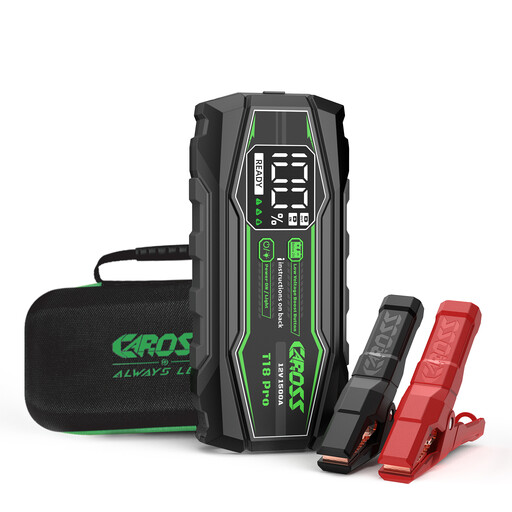
Why it suits this profile: This model is aimed at motorists looking for a straightforward 12V jump starter for a car, SUV or motorbike without lots of extra features.
The product information states 12V compatibility, a boost function and protection against sparks and reverse polarity. However, check your vehicle’s engine size beforehand.
1500A peak current, 16,000mAh lithium-ion battery, 2.3-inch display, QC 18W and a protective case.
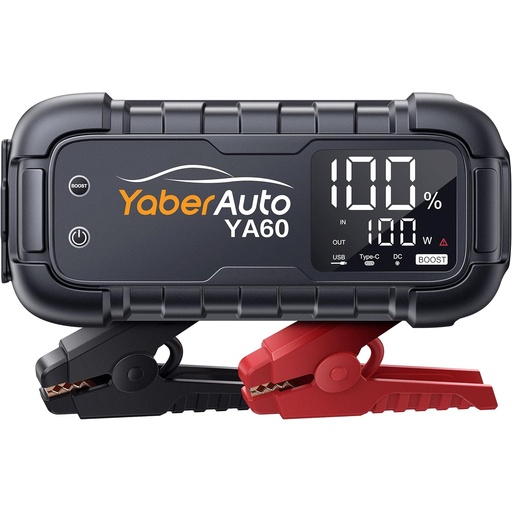
Why it suits this profile: Suitable for drivers looking for a powerful jump starter for several vehicles who also want to charge devices while on the move.
The stated specifications include 12V petrol engines and diesel engines up to 12 litres, as well as ten safety functions. According to YaberAuto’s own product information, a boost button is available for heavily discharged batteries.
8000A peak current, 26,800mAh, USB-C 65W, 150W DC output and 600-lumen lighting.
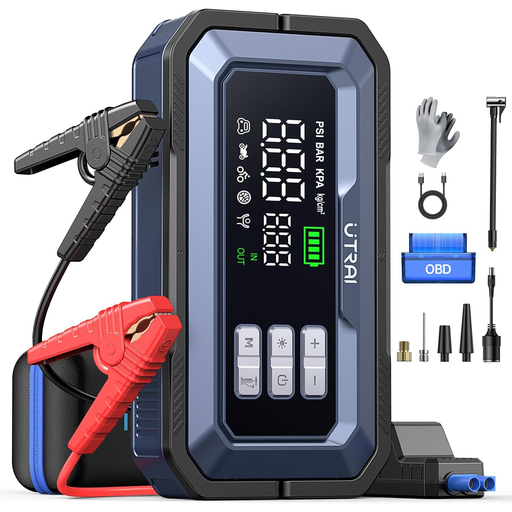
Why it suits this profile: A logical choice for travellers, motorhome owners, SUV drivers and anyone who wants to deal with a flat tyre as well as a flat battery.
The product description mentions an automatic compressor with pressure settings, temperature protection and ten safety functions. According to UTRAI’s own product information, the model is designed for 12V petrol vehicles and diesel engines up to 14 litres.
150 PSI air pump, 160W DC output, USB-C PD 18W, OBD2 adapter and 2,000-lumen lighting.
We’ve put together a complete, up-to-date list of products that fully meet these strict selection criteria and the applicable European safety regulations.
First, charge the jump starter sufficiently and switch off the vehicle. Connect the red clamp to the positive terminal and the black clamp to the negative terminal or a suitable earth point, as instructed in the manual. Activate the boost function if necessary and try to start the engine briefly. Remove the clamps once the engine is running. The exact sequence may vary between models.
Its lifespan depends on the storage temperature, charging habits and usage. Store the device in a dry place and do not leave it in extreme heat or cold for long periods. Check the charge level regularly. Some models recommend recharging every three to six months during extended storage; follow the manufacturer’s instructions.
The direct electricity consumption mainly comes from charging the internal battery. This usually costs very little, but a jump starter can lose capacity if left unused in a warm car for months. Checking it regularly and recharging it in good time will prevent you from being left with a flat emergency battery when you need it.
