
Vandaag of morgen in huis

Kwaliteit gegarandeerd

Welkomstaanbiedingen ontgrendelen: GRATIS bezorging | Tot 80% korting | Gratis 30 dagen JoyPlus-proefperiode
Download de app
A flat car battery often strikes at the worst possible moment: on a cold morning, at a campsite or after your car has been left standing for a long time. A portable jump starter can be a practical alternative to jump leads and help from another car. However, not every 12V car jump starter is suitable for every vehicle.
High amp ratings and large capacity figures catch the eye, but they don’t tell the whole story. You should also check compatibility with your engine, the safety features, charging options and how to store the device.
A 1500A, 2000A or 4000A jump starter sounds powerful. However, the quoted peak power is a momentary figure. It doesn’t automatically tell you how much starting power the device will deliver in all conditions. Cold temperatures, an older battery and a large diesel engine can all make starting more difficult.
So always check the stated vehicle compatibility. For example, a model may be described as suitable for petrol engines up to a certain capacity, but that doesn’t guarantee it will restart a completely flat or faulty battery.
Capacity in mAh indicates how much energy the internal lithium-ion battery can store. A high capacity is useful for multiple starting attempts or charging devices, but it isn’t the only factor that determines whether your engine will start. Maximum current output, cables, clamps and the condition of the vehicle battery also matter.
A lithium jump starter with a power bank function can also charge USB devices, but a regular power bank isn’t a car jump starter. So check that the product has dedicated jump leads and a 12V starting function.
Incorrectly connected clamps can cause damage. Look for features such as reverse polarity protection, short-circuit protection and overheating protection. A screen or status indicator can also help you check the charge level and connections.
Store your portable car battery booster in a dry place, away from extreme heat. Before setting off, check that it’s sufficiently charged. Even if you don’t use the device often, it’s a good idea to top it up periodically, following the instructions in the manual.
A 1500A model may be sufficient for a small petrol car, if the product description supports this. For an SUV, van, motorhome, boat or larger diesel engine, extra headroom can be useful. According to the product specifications, the OSRAM BATTERYstart 300 is suitable for petrol engines up to 6 litres and diesel engines up to 3 litres. The OSRAM BATTERYstart 400 is listed as suitable for up to 8 litres of petrol and 4 litres of diesel.
The GOOLOO GT4000S is listed as supporting 12V vehicles with engines of up to 12 litres for petrol or 10 litres for diesel. Treat figures like these as an indication of compatibility, and always check the manual and your vehicle details.
A 12V car jump starter is designed for typical cars, motorbikes and many light commercial vehicles. That doesn’t mean it’s suitable for a 24V lorry or bus. The CAROSS 12V Smart Jump Starter explicitly states that it isn’t suitable for 24V systems or the high-voltage batteries in electric vehicles.
A jump starter may also be insufficient if the battery is completely faulty. Some models have a minimum activation voltage, so check this before you buy.
A larger internal battery can be useful for multiple purposes, but it often makes the device heavier. Consider the balance between capacity, size and charging time.
Useful extras include:
A power bank function is particularly useful when travelling, but it shouldn’t come at the expense of keeping the device sufficiently charged to start your vehicle.
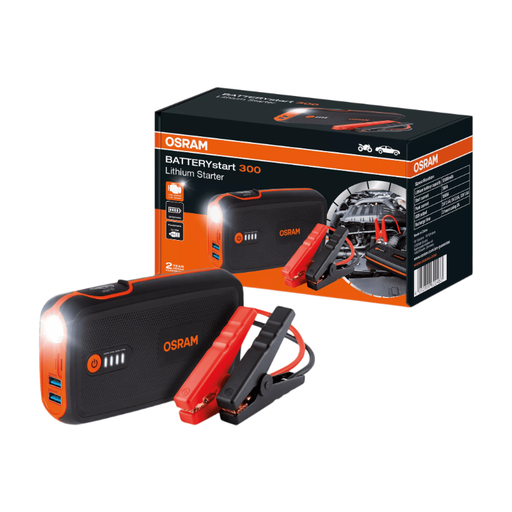
Why it suits this profile: This compact model is aimed at drivers of everyday cars and motorbikes who want to carry a portable jump starter without having to store a bulky device.
The product specifications list 1500A peak power, 12V operation and compatibility with petrol engines up to 6 litres and diesel engines up to 3 litres. This gives you a clearer basis for comparing suitability than the word ‘powerful’ alone.
13,000 mAh lithium-ion capacity, two USB ports and a built-in LED light; stated dimensions are 22 × 13 × 10 cm.
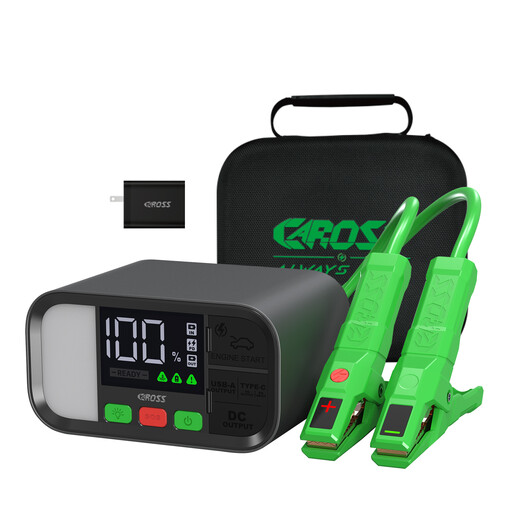
Why it suits this profile: A good choice if clear status information, a protective case and fast charging are important to you at home, on the road or while travelling.
The stated Smart Connect technology and non-polarised clamps are designed to help prevent incorrect connections. Always check the indicator and manual before use.
1600A peak power, 16,000 mAh capacity, 65W USB-C PD output, a 3-inch screen and a storage case.
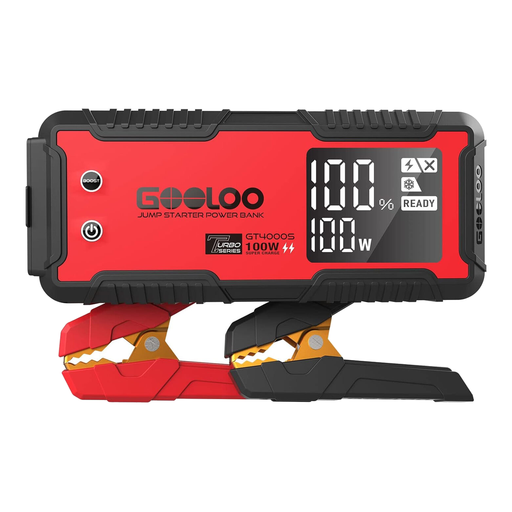
Why it suits this profile: A sensible choice for owners of SUVs, motorhomes, boats, pick-ups or other 12V vehicles who want a model with a higher stated engine compatibility.
As well as the stated 4000A, the product description lists a 3.2-inch screen and several safety technologies. This makes the status easy to see, but you should still follow the manual when connecting the clamps.
According to the product details, it’s suitable for up to 12 litres of petrol and 10 litres of diesel. It features 100W charging, three USB ports, a 15V/10A output and a 400-lumen light.
We’ve put together a complete, up-to-date list of products that meet these strict selection criteria and the applicable European safety regulations.
Don’t make repeated long starting attempts. Wait between attempts and, if in doubt, have the battery or vehicle checked.
Its lifespan depends on charging cycles, storage temperature and how it’s used. Store the device in a dry place, avoid extreme heat and recharge it according to the manual. A jump starter left discharged in storage for a long time may lose capacity.
Yes, if the model supports 12V and its stated compatibility matches your motorbike. Check the battery type, engine capacity and the manufacturer’s instructions in particular. A 12V model isn’t automatically suitable for a 24V system.
Usually not. A jump starter delivers a high current for a short time to start the vehicle. A dedicated 12V battery charger is designed to charge a battery in a controlled way. A jump starter with a power bank function can also charge USB devices, but it won’t always replace a regular battery charger.
