
Vandaag of morgen in huis

Kwaliteit gegarandeerd

Welkomstaanbiedingen ontgrendelen: GRATIS bezorging | Tot 80% korting | Gratis 30 dagen JoyPlus-proefperiode
Download de app
A flat battery often strikes at the worst possible moment: before you leave for work, in the supermarket car park or during a camping trip. A portable jump starter for your car can get you moving again without having to wait for another driver to help. Some models also work as a car battery booster, car power bank, LED emergency light and portable car air compressor.
However, not every model is suitable for every vehicle. The high amp ratings on the packaging don’t tell the whole story. Read on to find out what to look for and which popular options suit different needs.
A figure such as 2000A, 4500A or 7000A stands out straight away, but peak current is just one product specification. Check the stated starting current, battery capacity, engine size and engine type too. A model for a small petrol car won’t necessarily be suitable for a large diesel SUV.
Also check whether your vehicle uses a 12V system. A 12V jump starter is designed for many cars, motorbikes, vans and SUVs, but the maximum petrol and diesel engine sizes it can handle vary by model.
A jump starter delivers a short burst of power to start a vehicle. A car battery charger usually charges a battery slowly and steadily from mains power. A portable car jump starter won’t restore a worn-out or faulty battery. If the battery is damaged, frozen or badly worn, you may need help from a garage.
A jump starter with a compressor is useful if your tyre is low, but check the maximum run time. Some compressors need to cool down after about ten minutes. Automatic shut-off, a clear pressure display and several valve adapters make it easier to use.
Also check that the cables have protection against reverse polarity, short circuits, overloading and overheating. A CE mark may indicate relevant conformity, but on its own it doesn’t mean a product is suitable for your vehicle. Read the manual and check the manufacturer’s specifications.
Compare the stated engine size with that of your vehicle. According to the product specification, a compact model with a 2000A peak current may be enough for a small petrol car. Drivers of diesel vans, large SUVs or pick-ups will generally need more headroom.
Look out for the following:
Battery capacity is often shown in mAh. A capacity of 10,000mAh, as found in the EAFC, provides enough power for several starting attempts and charging USB devices, according to the product information. The actual number of starts depends on factors including the condition of the jump starter, the temperature and the vehicle battery.
Fully charge your emergency car starter before first use and check its charge level every few months. A model with a display makes this easier. The power bank function is handy for charging a smartphone, but the USB output isn’t the same as the jump-starting function.
For a jump starter with a compressor, a digital pressure display, preset modes, automatic shut-off and several nozzles are useful features. Consider the weight and dimensions too. A device weighing around 700 grams is easier to store in a glove compartment than a heavy model weighing more than one and a half kilos.
An LED emergency light with a steady beam, flashing mode and SOS signal can help if you need to work beside a dark road. Don’t shine the light directly into anyone’s eyes, and store lithium batteries somewhere cool and dry, away from extreme heat.
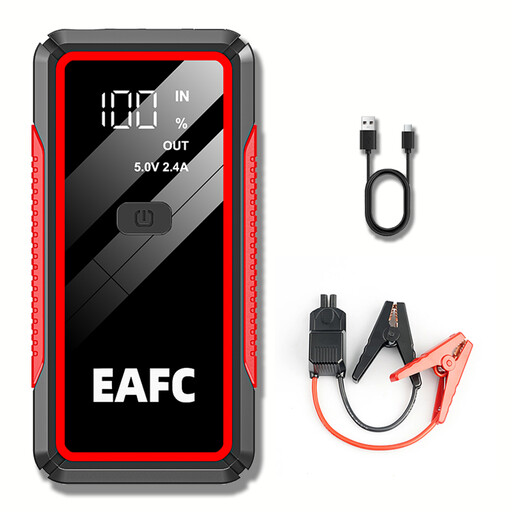
Why it suits this profile: A compact model weighing around 700 grams, ideal for drivers who mainly want to be prepared for a flat battery and have the option to charge a phone.
The product information gives clear vehicle limits: up to 6.0 litres for petrol and 4.0 litres for diesel. This makes it easier to check compatibility than relying on the amp rating alone.
2000A peak current according to the product specifications, 10,000mAh battery, USB output and an LED light with three modes.

Why it suits this profile: A good option for road-trippers and drivers looking for one device to start their vehicle, inflate tyres, provide light and charge several devices.
The specifications include a display, automatic shut-off when inflating and ten safety features. Before use, check the manual and the compressor’s limits.
26,800mAh according to the product listing, 150PSI compressor, USB outputs and a 3.4-inch screen.
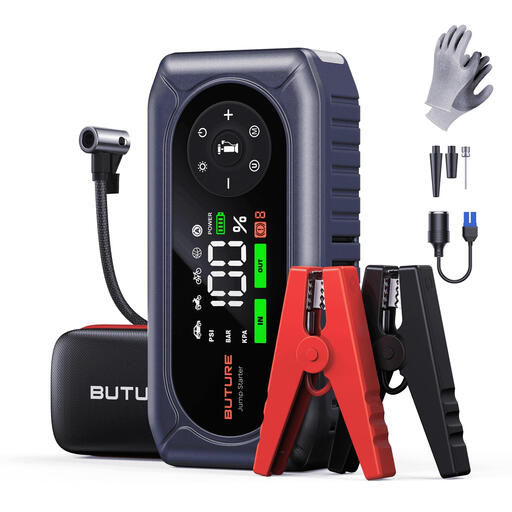
Why it suits this profile: A good fit if you drive a larger car, SUV, van or motorbike and want a tyre inflator built into the same device.
The product specifications state vehicle limits of up to 9.0 litres for petrol and 8.0 litres for diesel, as well as automatic compressor shut-off. Always compare these figures with your own vehicle.
4500A peak current, 150PSI compressor, five inflation modes, LCD screen and several safety features according to the product information.
We’ve put together a complete, up-to-date list of products that meet these strict selection criteria and current European safety regulations.
Don’t use a jump starter on a diesel or petrol vehicle if the battery is damaged or frozen. Regularly check the cables, clamps and casing for damage too.
Its lifespan depends on charging cycles, storage temperature and maintenance. Recharge it periodically, don’t leave it completely flat for long periods and avoid storing it permanently in a hot car. Follow the manufacturer’s charging and storage instructions.
Yes, if the product specifications confirm that it supports your diesel engine. Diesel engines often need more starting power than comparable petrol engines. Check the stated engine size, 12V compatibility and starting current.
You generally won’t pay extra to use it if you charge the device at home, but the compressor uses a relatively large amount of battery power. How long it runs on a single charge depends on tyre pressure, tyre volume and the model. Let the compressor cool down as instructed in the manual, then recharge the jump starter.
