
Vandaag of morgen in huis

Kwaliteit gegarandeerd

Welkomstaanbiedingen ontgrendelen: GRATIS bezorging | Tot 80% korting | Gratis 30 dagen JoyPlus-proefperiode
Download de app
A flat battery never comes at a convenient time. You're in a car park, on the hard shoulder, or on your own driveway, and the car won't respond. A portable jump starter for your car can be a lifesaver, but not every model suits every engine or situation.
Many buyers focus solely on the highest amp figure on the packaging. That's not always enough. A suitable car jump starter must match your vehicle's voltage, engine type, and the extra features you want. Below, you'll find out which specifications matter and which pitfalls to avoid.
A manufacturer often quotes a high peak current, for example 2,000, 3,000 or 4,000 amps. This is a short maximum value under specific conditions. Actual performance also depends on the battery condition, temperature, cables and engine size.
Always compare the stated combination of:
A model for a compact petrol car is not automatically suitable for a diesel campervan or van.
Most portable jump starters are designed for 12V battery systems. This applies to many cars, motorbikes, boats, campervans and SUVs. Heavy lorries and some commercial vehicles run on 24V.
Check your vehicle's handbook before connecting a 12V car jump starter. A 12V jump starter is not intended for a 24V system. Electric vehicles with a high-voltage battery are also outside this application; a jump starter may only be relevant for a separate 12V auxiliary battery, if the manufacturer allows it.
A jump starter with power bank or compressor can be handy, but these features don't automatically make the device a better jump starter. A built-in air pump also draws a lot of power. So look at the starting specs and safety features first, and only then consider the torch, USB ports or tyre pump.
For a small petrol car, a compact model may be sufficient. For a diesel engine, SUV, campervan, boat or van, more margin is wise. The product description of the GOOLOO models states specific limits. For example, the GP2000 is listed as supporting petrol engines up to 8.0 litres and diesel engines up to 6.0 litres. For the GP3000, the product description states up to 9.0 litres petrol and 7.0 litres diesel.
Treat these values as product specifications, not as a guarantee that every flat battery will start. A battery with internal damage, loose connections or a faulty charging system can still prevent starting.
Look for features such as:
According to the product description, the GOOLOO GP2000, GP3000 and A3 have multiple protection features. Always check the supplied manual and follow the connection sequence. In general, connect the red clamp to the positive terminal and the black clamp to the negative terminal or a suitable unpainted metal earth point. Starting attempts of 3 to 5 seconds are usual according to the stated instructions; then pause to avoid unnecessary strain on the cables and device.
A visible CE mark can indicate that the product meets certain European conformity requirements. The mark itself does not tell you what starting performance you can expect in your vehicle.
A lithium jump starter is relatively compact and easy to store in the car. However, the battery slowly drains even when you're not using the device. So recharge the jump starter periodically and store it in a dry place, protected from extreme heat and frost.
For the GP4000, the product information states that recharging every two to three months is recommended when the device is not used for a long period. Check the charge level before you set off. A car jump starter that's flat in the boot won't help when you break down.
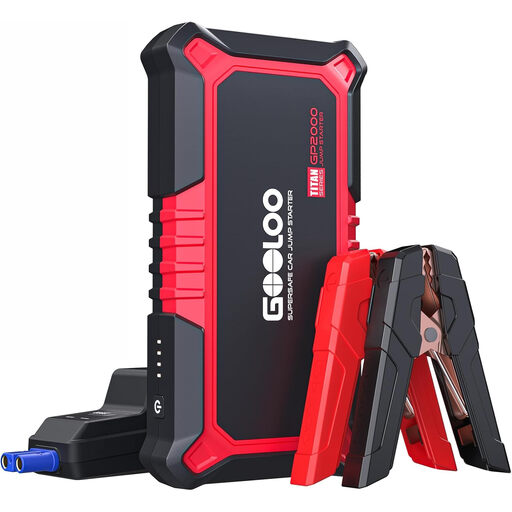
Why this fits the profile: This model is aimed at drivers of standard 12V cars, motorbikes and SUVs who want a compact emergency solution to take with them.
The product description states a clear limit of 8.0 litres petrol and 6.0 litres diesel. This means you don't have to rely solely on the amp rating.
According to the product information: 2,000A peak current, 400-lumen light, USB outputs and a weight of approximately 545 grams.

Why this fits the profile: A suitable choice for larger petrol or diesel engines in SUVs, campervans, boats and trucks.
The stated engine limits and 10 protection features make the comparison more concrete than just a general claim about power.
According to the product description: 3,000A peak current, USB and Type-C connection, 400-lumen light and operation at stated temperatures from -20°C to 60°C.
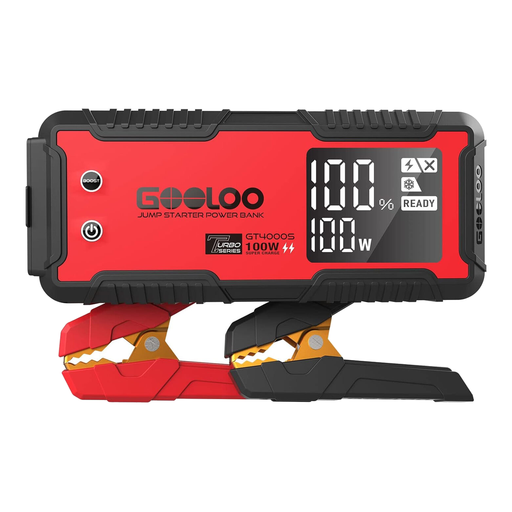
Why this fits the profile: Ideal for those who are often on the road with a campervan, boat, work vehicle or larger car and want to be able to recharge quickly.
The product description states support for 12V engines up to 12.0 litres petrol and 10.0 litres diesel. Do check this against your own vehicle's specifications.
According to the product information: 4,000A peak current, 100W Type-C charging, three USB ports, display and a supplied 100W car charger.
We've put together a full, up-to-date list of products that fully meet these strict selection criteria and current European safety regulations.
Do not use a jump starter with damaged cables, a leaking battery or visible damage to the device. If in doubt, contact a breakdown service or garage.
Yes, but only if the model is suitable for it. Diesel engines generally require more starting power. Check the stated diesel capacity, the 12V voltage and the recommendations in the manual.
The lifespan depends on charge cycles, storage temperature and maintenance. Recharge the device periodically, avoid prolonged heat and store it in a dry place. A model with a lithium battery should not be left completely flat for months.
Only a jump starter with a compressor has that function. The GOOLOO A3 states, according to the product description, a compressor up to 150 PSI, five inflation modes and automatic shut-off. The stated performance depends on tyre type, temperature and battery charge.
