
Vandaag of morgen in huis

Kwaliteit gegarandeerd

Welkomstaanbiedingen ontgrendelen: GRATIS bezorging | Tot 80% korting | Gratis 30 dagen JoyPlus-proefperiode
Download de app
A flat 12V battery often happens at the worst possible time: on your way to work, during a camping trip or after your car has been parked outside for several days. With a portable jump starter for your car, you can often get yourself moving again without needing another vehicle or roadside assistance. However, not every model with a high amp rating is suitable for your car.
The key question is therefore not which device makes the biggest claim on the packaging, but which car jump starter is right for your engine, how you use it and where you store it.
A figure such as 2,000A or 8,000A sounds impressive, but peak current is not the same as continuous starting current. Some product descriptions list both figures, while others only mention the peak. Where possible, also compare the starting current and check the stated engine capacity for petrol and diesel engines.
A 12V jump starter for a small city car is not automatically suitable for a large diesel SUV. Engine size, battery condition and temperature all affect how well it performs in real-world conditions.
A lithium jump starter rated at 20,000mAh does not always offer 20,000mAh of usable output capacity. Manufacturers may list an internal nominal capacity alongside a lower rated output. So check both figures rather than focusing only on the highest number.
A higher capacity can be useful if you expect to make several starting attempts or use the power bank function. The trade-off is often a larger size or greater weight.
Smart clamps can include features such as reverse-polarity, short-circuit, overheating and over-current protection. This reduces the risk of connecting the clamps incorrectly, but careful use is still essential. Always check the positive and negative terminals, follow the instructions and never use a jump starter with a damaged or leaking battery.
A CE or RoHS marking indicates stated conformity or compliance with material guidelines, but it does not by itself prove that every product is suitable for every car.
Most portable car battery boosters in this category are designed for 12V vehicles. Check that this matches the battery in your car, motorbike, boat, campervan or van. A 24V system in a heavy commercial vehicle is not automatically compatible.
Also check the stated maximum engine capacity. According to the product information, for example, a model may be suitable for petrol engines up to 6.0 litres and diesel engines up to 4.0 litres. These are the manufacturer's product specifications, not a guarantee for every real-world situation.
Choose a jump starter with smart clamps if clear status notifications and extra safety features are important to you. An LCD display can show the remaining charge level, so you do not set off with an almost flat emergency starter. Also consider the length and thickness of the cables, the insulation on the handles and whether the connection feels secure.
A boost function can help with some models when the vehicle battery has an extremely low voltage. However, check the minimum activation voltage in the instructions.
A compact car emergency starter is easier to store in a glove compartment, but a larger model may offer more connections and a higher capacity. Useful extras include:
Do not store a lithium device in direct sunlight or extreme heat for long periods. Recharge it periodically according to the instructions, even when you are not using it.
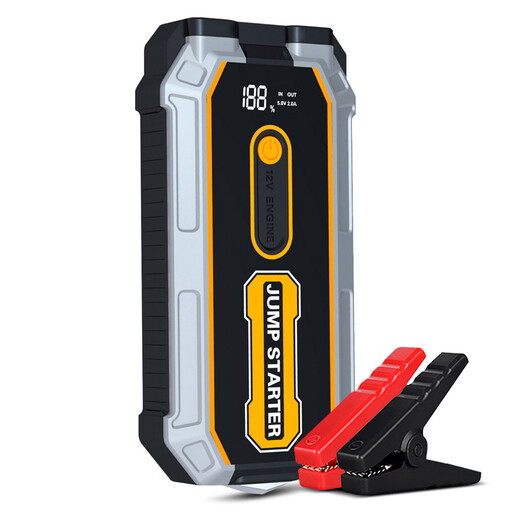
Why it suits this profile: According to the product information, this compact car battery booster combines a peak current of 1200A with a weight of approximately 330 grams. This makes it practical for a standard 12V car or motorbike, or where storage space is limited.
Alongside a 1200A peak current, the product information also lists a 600A starting current and 7200mAh rated output. This makes the relevant figures easier to compare.
LCD display, USB power bank function, LED light with three modes and support for 12V petrol and diesel vehicles according to the product specifications.
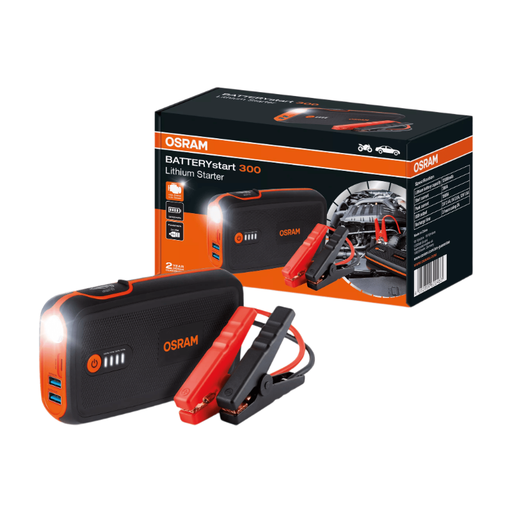
Why it suits this profile: According to OSRAM product information, this model is designed for 12V cars and motorbikes, with a stated peak current of 2000A and a 12V output for accessories.
Compatibility is linked to specific engine capacities: according to the product information, up to 8.0 litres for petrol and 4.0 litres for diesel. You should still check this against your vehicle's instructions.
16800mAh lithium-ion capacity according to the product specifications, dual USB port, LED light and a stated official two-year warranty.
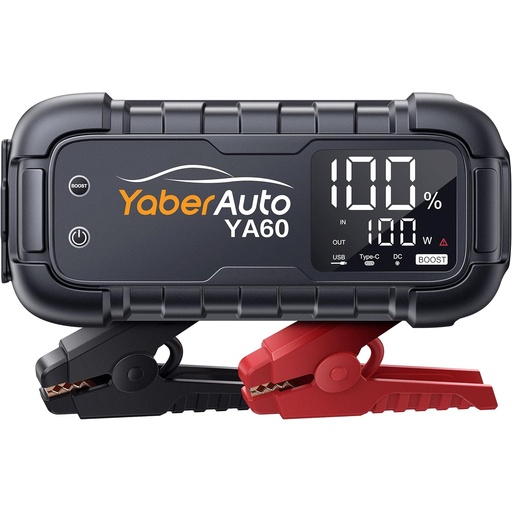
Why it suits this profile: According to the product description, this is a more advanced car jump starter for SUVs, campervans, boats and other 12V applications where extra connections are important.
The specifications list ten safety features, 8AWG cables and a BOOST button. This provides more information than simply quoting a high amp rating.
According to the product information, 65W two-way charging, 150W DC output, a 26800mAh battery and a 600-lumen light with three modes.
We have put together a complete, up-to-date list of products that fully meet these strict selection criteria and the applicable European safety regulations.
A jump starter is intended as an emergency solution, not as a replacement for maintaining a worn battery. If the problem keeps occurring, have the car's battery and charging system checked.
It can if the model is stated in its product specifications to be suitable for diesel engines. Diesel engines often require more starting power, so compare the stated diesel engine capacity and starting current with your vehicle. Also check that it is a 12V system.
Its service life depends on the battery type, storage temperature, charging frequency and maintenance. Manufacturers often recommend periodically recharging a jump starter that is not being used. Follow the instructions for this; a stated standby period is a product specification, not a general guarantee.
A portable 12V car battery booster is not designed to start the high-voltage battery of an electric car. Some electric cars do have a separate 12V battery, but always check the vehicle manufacturer's instructions before connecting an emergency starter.
