
Cooking with one saucepan
You want to be able to keep a small pan of sauce gently simmering after class. Pan detection, a suitable cooking zone and a low setting matter more to you than extra cooking zones.


If you mainly make one pan of onion sauce after class, start with a portable hob whose cooking zone suits your pan and whose low setting is easy to control. An extra cooking zone is most useful if you’re preparing other parts of the meal at the same time. For a built-in hob, you’ll also need to check the cut-out and electrical connection. The models mentioned are examples for comparing features, not verified recommendations for compliance or purchase.
You want to be able to keep a small pan of sauce gently simmering after class. Pan detection, a suitable cooking zone and a low setting matter more to you than extra cooking zones.
You’re looking for a portable hob and want to check in advance that your socket, electrical circuit and available space are suitable. The Consumentenbond describes portable induction hobs with one, two or four cooking zones.
You want to prepare the sauce and other parts of the meal at the same time. So compare not only the number of zones, but also the available power when several zones are in use.
Start with your pan and the simmering control you need. Then decide whether you want one or more zones, and whether a portable or built-in hob is right for your kitchen.
| What to consider | What to look for | Who is this important for? |
|---|---|---|
| Gentle simmering | Compare the diameter of your pan base with the cooking zone and check how well the hob can be controlled at low settings. The Consumentenbond assesses simmering, among other things, by measuring the temperature on the lowest setting for 30 minutes. | If I’m making one small pan of onion sauce, I want the hob to detect the pan and make the low setting easy to control. Around 36% of consumers in this cooking scenario prioritise gentle simmering. |
| Portable use | Check the connection requirements for the exact model, as well as your socket, electrical circuit and available worktop space. | If I don’t want a cut-out in my worktop, I’m looking for a portable hob that suits my space and connection. Around 29% of consumers prioritise simple installation without built-in fitting. |
| Cooking at the same time | Check how many pans will fit and how the power is shared between the zones in use. | If I want to use other pans as well as the sauce, I need enough usable zones and power. Around 21% of consumers prioritise cooking several things at once. |
| Built-in installation | Measure the cut-out and check the installation and connection requirements for the specific model. | If I want a permanent cooking setup for more extensive use, the cut-out and connection need to suit the hob. Around 14% of consumers prioritise a permanent built-in setup. |
A high peak power rating doesn’t tell you how a hob performs on its lowest setting. The Consumentenbond measures simmering at a low, constant temperature; ETNA explains that many induction hobs pulse the power at low settings.
When comparing models, look at the low setting and how the pan and zone work together, rather than focusing only on boost functions or maximum power.
On a hob that shares its available power between the zones in use, cooking on several zones at high settings may be limited. The Consumentenbond describes the limitations of portable hobs around 3500 W compared with more powerful built-in hobs.
Check the connection rating, how the power is distributed and which other appliances are on the same electrical circuit.
A built-in hob may require electrical work or changes to the worktop, depending on your existing kitchen and connection.
Pan detection and heat distribution depend on the magnetisable base and how the pan base compares in size with the cooking zone.
Check the base of your saucepan and compare it with the size of the cooking zone before choosing a hob.
The ACM points out that your statutory guarantee applies alongside the seller’s guarantee.
Before choosing paid-for additional cover, compare its terms with the statutory rights you already have.
Inventum offers both a portable single-zone hob, the KI120T, and a portable four-zone hob, the VKI6010ZIL.
The KIV12ZIL is a portable two-zone hob, for example, if you want to use a second pan alongside the sauce.
The Bosch PIX631HC1E is an example of a 60 cm built-in hob with four zones and a FlexZone.
The Severin DK 1031 is an example of a portable hob with two zones.
Below you’ll find portable hobs for one or two pans, along with a pan suitable for induction. Check each product to make sure you’re looking at the type of hob or cookware you need.
 No image available
A portable single-zone hob for cooking with one pan.
2000 W; 10 levels; settings from 60–240 °C; 8 presets and a timer.
 No image available
A portable two-zone hob for using a second pan alongside the sauce if needed.
The product description lists independently controlled 1500 W and 1000 W zones, and five temperature settings.
 No image available
A portable single-zone hob for a compact cooking setup.
1000 W and five power settings; the product name mentions use at home, on campsites and in campervans.
 No image available
A portable single-zone induction cooker for anyone using one pan on a separate cooking surface.
The product name lists 220V/240V/2100.
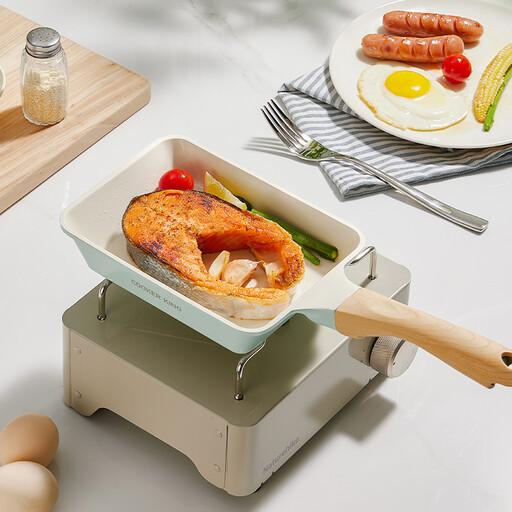 No image available
The product name describes a non-stick pan suitable for induction, not a hob.
The stated dimensions are 18 × 13 cm. Check that the base of the pan is suitable for the cooking zone you choose.
Check whether the base is magnetisable and whether its size suits the cooking zone. A pan that’s significantly smaller may not be detected, so check your pan before buying a new one.
No, it depends on the exact model and the connection it requires. Inventum says the KI120T needs an earthed socket. For other portable and built-in hobs, check the requirements for the specific model and have any installation work assessed.
You can’t tell from the number of settings or peak power alone. ETNA explains that many induction hobs pulse the heat at low settings. Look for simmering test results and check that your pan is a good match for the zone.
You may need to buy a suitable pan or make changes to the electrical connection or worktop. What’s required depends on the model you choose and your existing kitchen.
CE marking is required for electrical equipment within the scope of the EU Low Voltage Directive, including equipment for 50–1000 V alternating current. The Netherlands Enterprise Agency explains that CE marking is the manufacturer’s declaration of conformity, not an independent safety mark.