
Stock cook with limited worktop space
You want to simmer a pan of stock and put the hob away afterwards. Also measure the space around the appliance that you’ll need to use it safely.


Start by checking the base diameter of your stockpot and how much space you can safely leave around it. If you’re using one pan, a single-ring hob is a sensible option to compare. Choose induction if your pan is compatible, or compare a conventional electric hob if it isn’t. For both types, check the connection and heat settings: a timer or the number of settings won’t tell you how gently your stock will simmer.
You want to simmer a pan of stock and put the hob away afterwards. Also measure the space around the appliance that you’ll need to use it safely.
You want to keep using your pan, so you’ll need to check in advance that its base is compatible with your chosen hob type and cooking zone.
Once the stock has come to the boil, you’ll want to be able to turn the heat down and keep an eye on what’s happening in the pan.
The Netherlands Nutrition Centre recommends simmering vegetable stock on the lowest setting for one hour after bringing it to the boil. So don’t just look at the features on paper: consider your pan size, available space and the connection you’ll need.
| What to consider | What to look for | Who is this most relevant for? |
|---|---|---|
| Adjusting the heat while simmering | Check whether you can set the heat low. A timer is no substitute for keeping an eye on the pan. | Once the stock has boiled, I want to turn the heat down and check that it’s simmering gently. Around 36% of consumers prioritise heat control when simmering. |
| Worktop space and safe positioning | Measure the appliance and pan, and allow for the clearance specified in the manual; a second cooking zone needs extra space. | With a small worktop, I want to know in advance whether the hob and pan will fit, with enough clearance around them. Around 29% of consumers give available worktop space top priority. |
| Using an existing pan | Induction requires a magnetic pan base; also compare the base diameter with the model’s requirements. The Consumers’ Association and Milieu Centraal explain how to check pan compatibility. | I want to keep my stockpot and check first that it will work with the hob. Around 21% of consumers prioritise compatibility with their existing pan. |
| Connection and positioning | Check the required connection and the rated power of the exact model, as well as what else will be running on the same circuit at the same time. | I want to know whether the hob is suitable for my socket and what else is connected to the same circuit. Around 14% of consumers make their existing electrical supply their top purchasing priority. |
Your pan and the specified clearance also need to fit in the space you’re using; otherwise, the setup may not be suitable.
Measure the pan base and the full space available, and check the manual for the required clearance before buying.
A timer or adjustable setting won’t tell you how the stock will cook in your pan. The Netherlands Nutrition Centre’s recipe calls for prolonged cooking on the lowest setting.
Use the settings as points of comparison, then check while cooking that the stock continues to simmer gently.
An induction hob needs a suitable magnetic pan base, and the pan size must also be compatible with your chosen model.
Test the pan with a magnet and compare the base diameter with the model specifications. If the pan isn’t suitable, compare a conventional electric hob.
Two cooking zones take up more worktop space, and the total power matters if you’re using several appliances at once.
Check the hob’s rated power and what else will be running on the same circuit at the same time. Depending on the hob and your existing installation, the connection may need extra consideration.
The KI120T is a single-ring induction hob to compare if your pan falls within its specified size range.
The KP-6185 is a conventional single-ring hob, while the IK-6178 is a single-ring induction model. Compare them separately, as they have different pan requirements.
The KP 1092 is a conventional electric hob to compare if your pan isn’t suitable for induction.
The 303010 is a single-ring induction hob to compare if you’re looking for adjustable heat and a timer.
The DO332IP has one induction zone, while the DO333IP has two zones to compare if you want to use a second pan at the same time as your stockpot.
This selection includes portable single-ring hobs for making one pan of stock, with both induction and conventional electric models. Before buying, check that your pan is compatible with the model you choose. For the specific product, check the product information for the CE marking; the Netherlands Food and Consumer Product Safety Authority explains the applicable requirements for electrical products.
 No image available
A single-ring option to compare if you’re using one pan of stock and want to adjust the heat in steps.
1000 W, five power settings and dimensions of 21,5 × 21,5 × 4,7 cm. Induction requires a suitable magnetic pan base.
 No image available
A portable single-ring model to compare if you’re using an induction-compatible pan and want to adjust the heat.
The description lists eight power settings, a timer of up to three hours and cookware with a flat base measuring 12–26 cm. Induction requires a suitable magnetic pan base.
 No image available
A portable single-ring induction hob to compare if your pan has a suitable ferromagnetic base.
The description lists ten power levels, temperature settings of 60–240 °C, a 180-minute timer and a cooking zone for pans measuring 12–23 cm.
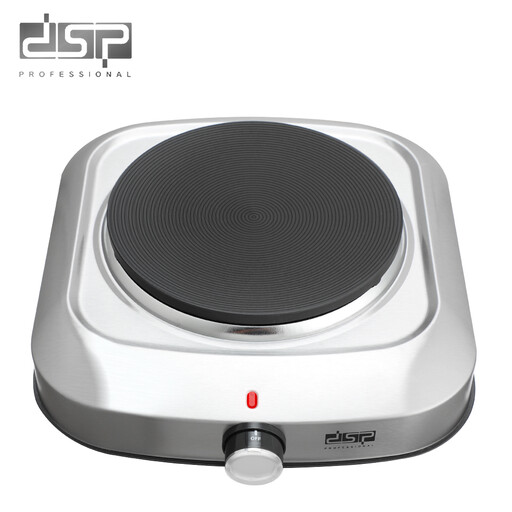 No image available
A conventional electric single-ring hob to compare if your pan isn’t suitable for induction; check that the pan base fits the heating plate.
1500 W, an 185 mm heating plate and adjustable temperature control.
 No image available
A freestanding single-ring induction hob to compare if your pan is compatible and you want to adjust the heat.
The description lists 2000 W, ten power levels, a timer of up to three hours and a pan size range of 12–26 cm. The stated appliance dimensions are 392 × 368 × 100 mm. Induction requires a suitable pan.
Bring the ingredients to the boil, then simmer the stock on the lowest setting for one hour, as recommended by the Netherlands Nutrition Centre. Adjust the heat according to what’s happening in your pan; the timer can’t assess how the stock is cooking.
Not necessarily. First check whether the pan base is magnetic, then compare its diameter with the requirements of your chosen model. Milieu Centraal suggests using a magnet as a simple check.
It depends on the exact model. According to the Consumers’ Association, most freestanding induction hobs can be plugged into a standard earthed socket, but more powerful models may need a different connection. Check the manual and plug, and consider the other appliances running on the same circuit at the same time.
In the Netherlands, you can contact the retailer to resolve the issue. According to the Dutch government, there is no fixed statutory two-year warranty period; what you can expect from a product depends, among other things, on the product itself and the information you were given with it.
The Netherlands Food and Consumer Product Safety Authority states that CE marking is compulsory for electrical products covered by the relevant product regulations. This is a product requirement; a CE marking on its own doesn’t prove that a specific item has been independently tested.