
Cooking with a large soup pan
You want to check first that the base and weight of your full pan are suitable for a stable cooking zone. A description such as ‘suitable for large pans’ does not give you all the measurements you need.


Start by checking the base size and weight of your full soup pan, then check the permitted pan size and load for the specific appliance. For one suitable pan indoors, a standalone induction hob may be all you need. Cooking with two pans at once, using a pan that is not suitable for induction, or cooking outdoors without mains power calls for different options, each with its own limitations. A stated power rating or keep-warm function does not prove that a large pan of soup will cook evenly or stay at a food-safe temperature.
You want to check first that the base and weight of your full pan are suitable for a stable cooking zone. A description such as ‘suitable for large pans’ does not give you all the measurements you need.
You’re cooking somewhere where the available sockets, other appliances on the same circuit and workspace may limit your options. The Consumers’ Association and the Fire Service highlight points to consider when using electricity and setting up temporary cooking areas.
You want to cook soup and a side dish at the same time on separately controlled zones, and check that both pans will fit side by side.
Suitable if: you’re using one pan at a time indoors, its base is magnetic and the pan is within the size range for your chosen model.
Bear in mind: there’s no second cooking zone. Inventum specifies a pan size range of 15–20 cm for the KI120T; CASO Design lists 12–24 cm for the PRO Menu 2100. Check the connection requirements and the instruction manual too.
Suitable if: your pan is not suitable for induction, or you want to control two pans separately.
Bear in mind: the Tristar KP-6245 has two hotplates measuring 15,5 and 18,5 cm; together, they do not make one larger zone. Severin lists one 18 cm cast-iron hotplate for the KP 1092. Compare your pan with each individual hotplate, and remember that a hotplate stays hot after use.
Suitable if: you’re actually cooking outdoors and are not using a suitable mains connection.
Bear in mind: the Campingaz Camp’Bistro 3 manual specifies outdoor use only, gives a pan size range of 12–26 cm and allows only CP250 or CP250 SP cartridges. So don’t use this model in a community hall or tent.
| What to consider | What should you check? | Who is this most relevant to? |
|---|---|---|
| Pan and load capacity | Measure the flat base of your pan, compare it with the stated pan size range and check the permitted load in the manual. For induction, the base must be magnetic; Milieu Centraal suggests using a magnet as a practical test. | If I’m using a full pan of soup, I want to know whether both the base and weight are suitable for the cooking zone. Around 33% of consumers put pan fit and load capacity first. |
| Power and set-up | Check the connection, the power requirements of appliances running at the same time and the clear space specified in the manual. Ideally, plug a high-powered appliance directly into a socket. If you use a cable reel, fully unwind it, as the Fire Service advises. | If you’re relying on the available sockets in a temporary cooking space, you’ll want to know in advance which appliances can run together. For around 27% of consumers, the power set-up is the top priority. |
| Controls and keeping food warm | Check the control settings and whether a timer or automatic shut-off can switch off the hob. Stir the soup and check the temperature of the food itself if you need to keep it warm. | If I’m making soup to serve later, I want to be able to adjust the cooking and check the soup’s temperature. Around 20% of consumers prioritise adjustable heating and serving. |
| Using two pans at once | Compare the size and spacing of the zones with both pans, and check the power per zone and the total connected load. | If you want to heat soup and a second dish at the same time, separate zones that suit both pans are useful. Around 13% of consumers put cooking two dishes at once first. |
| Outdoor cooking without mains power | Check that the cooking area is genuinely outdoors, what fuel the appliance needs and what pan size the manual allows. The Campingaz Camp’Bistro 3 manual specifies outdoor use only. | If I’m cooking outdoors without mains power, I want an appliance whose fuel and conditions of use suit the location. Around 7% of consumers name this as their top consideration. |
The stated power rating doesn’t tell you whether the pan base is within the permitted size range or whether the appliance can support the full pan’s weight.
Measure the base and check both the pan size range and maximum load in the manual for the exact model.
Separate hotplates are designed for suitable pans on each individual zone; their combined power is not all available under one soup pan.
Compare your soup pan with one zone and use the second for a separate pan.
The manual says the Campingaz Camp’Bistro 3 must only be used outdoors. A tent is not a suitable indoor space for this model.
If you’re cooking in a community hall, don’t use this appliance. Check the manual and cooking-location requirements for any other gas appliance.
A function label doesn’t show how warm the soup stays in different parts of the pan.
Stir the soup and check its temperature yourself. If you’re selling food at an event, follow the relevant food safety regulations.
The KI120T is a compact single-zone induction hob for a suitable pan, designed to plug into a grounded Dutch socket.
The conventional electric KP-6245 is an option if you want to use two separately controlled pans.
The KP 1092 is a conventional single-zone electric hotplate for anyone who doesn’t want to use an induction pan.
The PRO Menu 2100 is a single-zone induction hob for a pan with a base within the stated size range.
The Camp’Bistro 3 represents the gas option for cooking outdoors.
This selection includes portable hobs for one or two pans, an infrared hotplate and a gas appliance for outdoor use. For each model, check that your pan, cooking space and available connection are suitable, using the product information and manual.
 No image available
The two zones may suit you if you’re cooking soup and a second dish at the same time.
The product title lists two cooking zones and five temperature settings. Induction requires a magnetic pan base.
 No image available
A single-zone option if you want to heat one pan at a time and place the hob on a table.
The product title lists one cooking zone, five settings and 1.000 W. The pan base must be suitable for induction.
 No image available
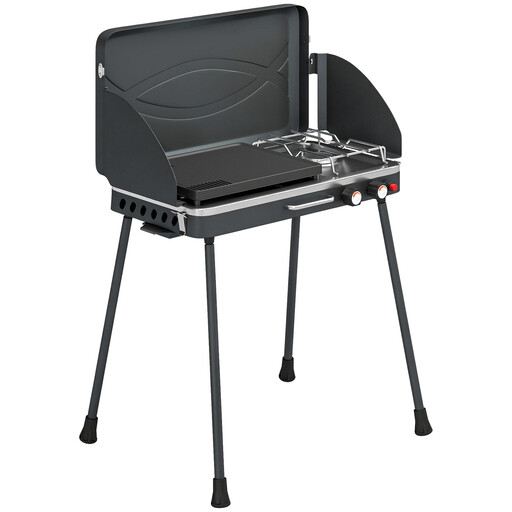
This gas option is intended for outdoor cooking where you can follow the product’s conditions of use.
The product information lists two 3,5 kW burners and says it can be used with a cooking pan. Use outdoors only and place on a stable, non-flammable surface.
 No image available
An alternative to consider if you want to use a pan that isn’t suitable for induction.
The product information lists 3.500 W, a timer and touch-button and dial controls. The description says it is compatible with ceramic, glass, stainless steel and cast-iron pans, among others. The surface gets hot and can cause burns, so keep children away.
 No image available
This portable single-zone hob may suit you if you want to use one pan at a time with an electrical connection.
The product title lists 2.100 W and 220/240 V; the description mentions automatic pan detection and multiple power settings. The pan base must be suitable for induction.
It can if the base is magnetic and its diameter falls within the size range for the exact model. If the pan is full, check the permitted load in the manual too; Milieu Centraal suggests using a magnet as a practical way to check the base.
Don’t rely on the plug alone: check the connected load and which appliances are running at the same time. The Consumers’ Association warns that some freestanding induction hobs cannot be used on the same circuit as another electrical appliance. The Fire Service recommends plugging high-powered appliances directly into a socket where possible and fully unwinding any cable reel in use.
No. The function name doesn’t tell you what temperature the soup reaches. Stir the soup and use a suitable thermometer to check its temperature if you’re keeping it warm. If you’re selling it at an event, the Netherlands Food and Consumer Product Safety Authority (NVWA) requires safe preparation and storage and recommends a digital probe thermometer for perishable foods.
According to the NVWA, food safety rules apply to food sold at a market or event, whether the seller is a business or an individual. The NVWA says anyone who prepares and sells food several times a year needs a HACCP food safety plan. This page on selling food does not draw the same conclusion for a one-off community meal where food is given away for free, so first check how the event is organised.
No. The manual for this specific model specifies outdoor use only and names a tent as a place where the appliance must not be used. This is the manufacturer’s instruction for this model, not a general statement that every gas appliance is legally banned from all indoor use.