
Cooking creamy leeks in one pan
If you’re using one pan, you’ll want a compact cooking space and the ability to adjust the heat while frying the leeks and warming them with cream.


Start by considering your pan, the available worktop space and the power supply. Then compare how easily you can adjust the heat while cooking. Induction is suitable if your pan has a magnetic base; if it doesn’t, a hob with a cast-iron heating element could be an alternative. Wherever possible, plug a high-power appliance straight into a socket: the Fire Service advises against using an extension reel or multi-socket adaptor.
If you’re using one pan, you’ll want a compact cooking space and the ability to adjust the heat while frying the leeks and warming them with cream.
Space, the available power supply and safe use around other appliances and people all matter. A second cooking zone is only useful if you genuinely need to use it at the same time.
Before choosing induction, check whether your pan has a magnetic base. If it doesn’t, compare non-induction electric hobs too.
If you’re making creamy leeks in a shared kitchen, the key things to consider are heat settings, the power supply, available worktop space and whether your pan is compatible.
| What to consider | What to look for | Who is this important for? |
|---|---|---|
| Adjusting the heat | Controls, adjustable settings and the temperature range of the exact model. | If I’m frying leeks and then warming them with cream, I want to be able to adjust the heat as I cook. Around 26% of this group prioritise heat control. |
| Power supply and safe use | Stated power output, the instruction manual, clear space around the hob and other appliances on the same circuit. | In a shared kitchen, I want to know what else is using the same power supply and where I can safely place the hob. Around 26% of consumers prioritise the power supply and using the hob alongside other appliances. |
| Worktop space and cleaning | Dimensions, space around the hob and the model’s cleaning instructions. | If I share the worktop, I want to know whether the hob will fit and when it’s safe to clean or put away. Around 21% of this group prioritise limited worktop space and tidying away. |
| Using a pan you already own | Test the base with a magnet and compare its diameter with the hob’s compatible pan size. | If I want to keep using my current pan, I’ll first check whether it works with induction. Around 16% of this group prioritise pan compatibility. |
| Using two pans at once | Check the number of cooking zones, available space and stated power output when using them simultaneously. | If I want to cook something else in a second pan while making the leeks, one zone won’t be enough. Around 11% of this group prioritise being able to cook more than one thing at a time. |
An induction hob only works with cookware that has a magnetic layer in its base.
Test the pan with a magnet and compare the base diameter with the size supported by the model you’re considering.
Several appliances in a shared kitchen may draw power at the same time. The Fire Service advises plugging high-power appliances straight into a socket rather than using an extension reel or multi-socket adaptor.
Check the stated power output and instruction manual, and bear in mind any other appliances on the same circuit.
A heating element gets hot itself; with induction, the pan can also transfer heat to the surface after use.
Follow the exact model’s instructions on residual heat and care. Wait until hot parts have cooled safely before cleaning or putting the hob away.
Inventum offers both a single-zone induction hob and a two-zone model with electric cooking zones.
Tristar offers, among other things, single-zone models with induction and with a cast-iron heating element.
Severin offers both induction models and the non-induction, single-zone KP 1091 hob.
IKEA offers the portable TILLREDA, with one induction zone, as an extra cooking space.
This selection features portable, single-zone induction hobs for adding a compact cooking space. Check that your pan has a magnetic base, and that the power supply and safety information for the exact model are suitable for your shared kitchen.
 Image unavailable
Suitable if you’re looking for one portable induction zone and want to adjust the heat as you cook; your pan must be induction-compatible.
IAGREEA’s product information lists 2000 W, 8 power settings, temperature control from 60–270 °C and compatible pans from 12–26 cm.
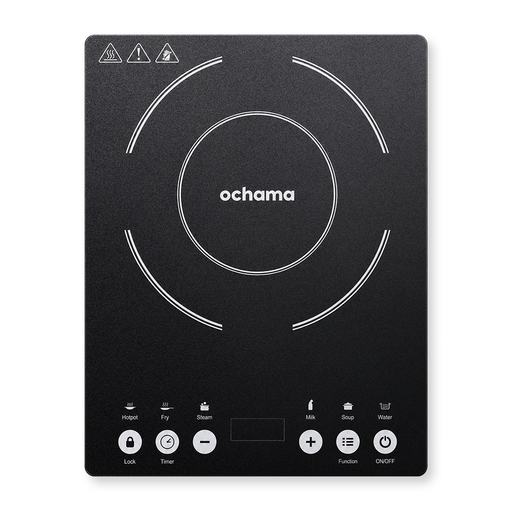 Image unavailable
A single-zone option if you want to adjust the heat using the available settings as you cook; use a pan with a magnetic base.
ochama’s product information lists 2000 W, 10 heat settings, touch controls and 6 pre-programmed functions.
 Image unavailable
Worth comparing if you’re looking for one zone with adjustable heat; check that your pan falls within the stated size range.
Fritel’s product information lists 2000 W, 10 power settings, temperature control from 60–240 °C and cookware from 12–26 cm.
 Image unavailable
An option to compare if you’re looking for a portable induction hob with adjustable heat; use a pan with a ferromagnetic base.
Rommelsbacher’s product information lists 10 power levels, temperature settings from 60–240 °C and pans from 12–23 cm.
 Image unavailable
Suitable if you’re looking for one portable induction zone with adjustable heat; your pan base must be induction-compatible.
Rommelsbacher’s product information lists 10 power levels, temperature settings from 60–240 °C, pans from 12–23 cm and dimensions of 36,5 × 28,5 × 7 cm.
Only if the pan base is suitable for induction. Milieu Centraal advises checking it with a magnet; then compare the pan size with the range supported by the model you’ve chosen.
Place the hob on a stable surface as instructed in the manual, keep the surrounding area clear and stay nearby while cooking; these are the Fire Service’s recommendations. For the TILLREDA, IKEA advises wiping away food residue after use with a damp cloth and mild detergent. For other models, follow their cleaning instructions and let hot parts cool first.
No. According to the Dutch government, the seller must provide a solution if a product is faulty. The Netherlands has no fixed statutory two-year guarantee period; what you can expect depends, among other things, on the product, its price and the information provided at the point of sale.
Electrical equipment covered by EU low-voltage rules must meet the applicable product safety requirements. EUR-Lex gives the voltage ranges as 50–1.000 V AC and 75–1.500 V DC. The European Union’s Your Europe website explains that the manufacturer is responsible for meeting the applicable requirements and applying the CE marking. Check the information for the exact model; a CE marking is not an independent performance test.