If you’re making curry in one pan, compare single-ring induction hobs with adjustable power, provided your pan is induction-compatible and within the stated size range. If you want to make curry and a side dish at the same time, a double-ring model makes more sense, but check your worktop space and the total power rating. If your pan isn’t suitable for induction, consider a conventional electric hob and check each model’s safety information and placement requirements.
Which hob is right for you?
Making curry in one pan
You want to make potato curry on a single portable cooking zone and adjust the heat as you cook. Compare the controls with the pan you’ll actually be using. Inventum, IKEA and Tefal describe single-ring induction models with different settings and pan requirements.
Making two dishes at a workshop
You want to make curry and a side dish at the same time in separate pans. In that case, two cooking zones, enough worktop space and the available power supply are all important. Princess and Tristar describe double-ring hobs, but they are different types.
Using a workshop pan you don’t know
You don’t know in advance whether the shared pan is suitable for induction. Check the pan before choosing: induction requires a magnetic base, while a conventional electric hob with heating elements is another option.
What should you look for when choosing?
Single-ring induction hob
Choose this if: you’re making curry in one pan and its base is magnetic and within the hob’s stated size range.
Bear in mind: you’ll need to make a second dish elsewhere or after the curry; the settings don’t automatically tell you how evenly the curry will simmer.
Double-ring induction hob
Choose this if: you have two induction-compatible pans and want to make curry and, for example, rice at the same time.
Bear in mind: the hob needs more worktop space, and its total power rating must be suitable for the other appliances on the same circuit.
Conventional electric hob
Choose this if: you want to use the pan you have without relying on it being induction-compatible.
Bear in mind: the cooking zones and residual heat need to be taken into account on a shared worktop.
| What to consider |
What should you check? |
Who is this important for? |
| Adjusting the heat |
Compare the controls and the lowest available setting on the exact model; keep an eye on the curry as it cooks. |
If you’re making curry in one pan, you’ll want to be able to adjust the heat without relying on a second cooking zone. Around 33% of consumers prioritise heat adjustment for cooking in one pan. |
| Cooking two dishes at once |
Check that both zones can be operated separately, that your pans will fit and what the total power rating is. |
If you want to make curry and a side dish at the same time, two zones and enough space are useful; around 25% of consumers prioritise being able to cook two dishes at once. |
| Pan compatibility |
Ask which pans are available; for induction, check that the base is magnetic and within the stated size range. |
If you have to use the pan available at the workshop venue, you’ll want to know in advance whether it will work with your chosen hob. Around 25% of consumers prioritise being able to use the pan provided. |
| Where to set it up |
Measure the available space and follow the instructions for the surface and ventilation clearance; check the power supply too. |
On a shared worktop, the hob and pan must fit without blocking the required clearance. Around 17% of consumers prioritise having a suitable place to set up the hob. |
Common mistakes
-
Checking only that a pan is ‘induction-compatible’
Even a pan with a magnetic base must fit within the size limits of the hob you choose.
Before buying, check both the material and the diameter of the pan base, then compare them with the specifications for the exact model.
-
Choosing a double-ring hob without checking the electrical circuit
Two cooking zones and other workshop appliances may all draw power at the same time. The Consumers’ Association warns that freestanding induction hobs can be limited when several zones are used on a shared circuit.
Compare the total power rating with the other appliances on the same circuit. Don’t assume that both zones can always run at full power at the same time.
-
Moving a conventional electric hob straight after switching it off
Hobs with heating elements may still be hot after cooking, so take extra care on a shared workshop worktop.
Keep participants away from the cooking zone and let the hob cool according to the instructions before moving it.
-
Confusing an extended warranty with your statutory rights
An extended or manufacturer’s warranty doesn’t replace your right to a product that meets acceptable standards. The Government of the Netherlands explains that there is no fixed statutory warranty period covering all products in the Netherlands.
Compare the terms of any additional cover with your statutory rights, and keep your proof of purchase.
Brands compared
Inventum
According to Inventum, the KI120T is a single-ring induction hob for pans with a stated diameter of 15–20 cm.
- Inventum lists 2000 W, ten settings, a timer and a keep-warm function.
- The pan must be suitable for induction. Follow the model-specific instructions for a flat, heat-resistant surface and ventilation clearance; the stated features aren’t the result of a cooking test.
Princess
According to the manufacturer, the Princess 303011 has two induction zones for cooking with two suitable pans at the same time.
- The manufacturer lists 1300 W and 1800 W per zone, giving a total of 3100 W.
- Check the available space and total electrical load; the power settings don’t prove how evenly a curry will simmer.
Tristar
According to Tristar, the KP-6245 is a conventional electric hob with two cooking zones.
- Tristar lists separately adjustable zones and a total power rating of 2500 W.
- The heated zones need to be handled with care and allowed to cool; the manufacturer’s specifications aren’t a comparative performance test.
IKEA
IKEA describes the TILLREDA as a portable single-ring induction hob.
- IKEA lists a 170 mm induction zone and a power rating of 2000 W.
- The pan base must be magnetic. A single cooking zone won’t let you heat two pans at once.
Tefal
According to Tefal, the Everyday Slim IH2108 is a single-ring induction model with preset settings and manual controls.
- Tefal lists seven power settings from 300–2100 W and a height of 45 mm.
- These features don’t prove that a particular curry will cook evenly. Check the exact model and pan size.
Hobs at Joybuy
This selection includes single-ring and multi-zone induction hobs, as well as portable hobs with heating elements, to suit different pans and workshop set-ups. Before buying, check the safety information and CE marking for the exact model. As the NVWA explains, CE marking is required for electrical products covered by the relevant EU rules.
 No image available
Portable induction hob with two zones
Suitable for a workshop where you want to make curry and a second dish at the same time, provided both pans are induction-compatible.
The product description lists two independently controlled zones, rated at 1500 W and 1000 W.
Five temperature settings are listed. Check that your pan bases fit and that the power rating is suitable for the venue.
View at Joybuy
 No image available
Portable induction hob, 1000 W
An option to compare if you’ll be using one pan at the workshop and a single cooking zone is enough.
The title lists five power settings; the product description gives a power rating of 1000 W.
Induction requires a pan with a magnetic base. Check that the pan size and power rating are right for your cooking.
View at Joybuy
 No image available
Portable DTL06 infrared hob
An alternative to consider if you don’t want an induction hob and would rather avoid induction pan requirements.
The product description lists a power range of 0–3500 W, a timer and dial and touch-panel controls.
The hob gets very hot during use. Keep children away and follow the instructions for using it on a stable, heat-resistant surface.
View at Joybuy
 No image available
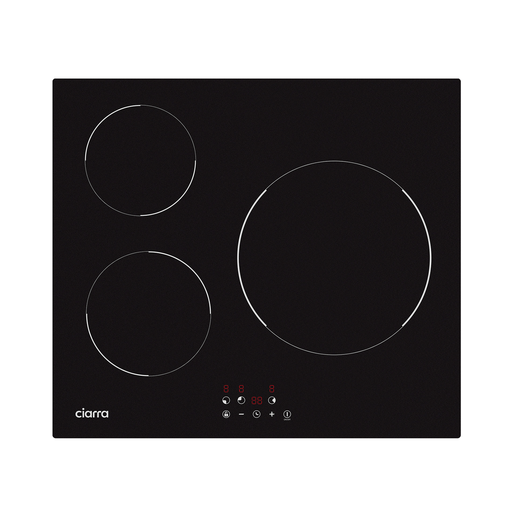
Ciarra CRGBIH3 induction hob, 3 zones
Three zones may suit a set-up where you’re making several dishes at once, provided you have enough space and suitable pans.
The product description lists a total power rating of 5600 W, nine power settings and a timer of up to 99 minutes.
Check the required power supply and available space. Induction requires pans with a magnetic base.
View at Joybuy
 No image available
ochama portable induction hob, 2000 W
Worth comparing for a workshop where you’ll use one pan at a time on a portable induction zone.
The product title lists 2000 W; the product description mentions ten heat settings and six preset functions.
The product description lists a child lock. Check that the pan has a magnetic base and that the venue’s power supply is suitable.
View at Joybuy
Frequently asked questions
How can you check whether the workshop pan will work on an induction hob?
Check that the pan base is magnetic and compare its diameter with the specifications for the exact model. For example, Inventum gives a range of 15–20 cm for the KI120T; this won’t necessarily apply to other hobs.
What should you check about the power supply for a portable hob?
Compare the hob’s power rating with the other appliances on the same circuit and follow the instructions. The Fire Service recommends plugging high-power appliances directly into a socket where possible; if you use a cable reel, unwind it completely.
How should you position and clean a portable hob after the workshop?
Follow the instructions for the exact model on positioning, cooling and cleaning. For the KI120T, Inventum specifies a flat, heat-resistant surface and at least 10 cm of ventilation clearance at the sides and rear.
Is CE marking required for an electric hob sold in the Netherlands?
CE marking is required for electrical products covered by the relevant EU rules. The NVWA describes the Low Voltage Directive for electrical equipment within the applicable voltage range. The marking is a declaration by the manufacturer and isn’t, by itself, an independent test of a specific item.
Which food safety rules might apply to a cookery workshop?
The NVWA requires food businesses that prepare, process or sell food to have a food safety plan or hygiene code based on HACCP. Whether this applies to a particular workshop depends on the organiser and the activity.


