
Vandaag of morgen in huis

Kwaliteit gegarandeerd

Welkomstaanbiedingen ontgrendelen: GRATIS bezorging | Tot 80% korting | Gratis 30 dagen JoyPlus-proefperiode
Download de app
A portable hand fan is useful on a hot train journey, at the office, at a concert or while out walking. However, mini hand fans vary considerably in airflow, battery life, noise level and ease of use. A compact body does not automatically mean that a fan will perform comfortably.
Anyone who focuses only on a high wind speed or long battery life could be in for a surprise. Below, we cover the most important considerations, followed by practical product choices for different situations.
Manufacturers usually quote the runtime on the lowest setting. On a powerful setting, the operating time is often considerably shorter. For example, a rechargeable hand fan with a 5,000mAh battery may run for several hours or even a full day, depending on the selected speed.
Always check:
A powerful hand fan with a concentrated air outlet can produce noticeably more noise than a model designed for quieter use. This matters in a quiet workspace, during a meeting or on the train. A quoted noise level is only useful when the measurement distance and conditions are also clearly stated.
A quiet hand fan therefore does not necessarily need to have the highest airflow. Look for the right balance between comfort, speed and noise.
A pocket fan that fits easily into a coat pocket can become tiring to hold for long periods. The buttons may also be too small, or the fan may be difficult to position securely on a desk. In practice, a carrying strap, foldable stand or neck support often makes more difference than an additional speed setting.
Pay attention to safety too. Keep fingers, hair, loose clothing and jewellery away from moving blades. A hand fan is not a toy and should not come into contact with water or rain.
Airflow is sometimes stated as wind speed in metres per second, for example 3.5 m/s, 5.1 m/s or up to 10 m/s. These figures come from the product information and do not tell you everything about how large the cooled area feels. The shape of the outlet, the distance from your face and the motor also play a part.
For everyday use, three to five settings are usually easy to manage. If you want to adjust the airflow very precisely, look for a model with stepless control or a 0–100 setting. Use a high setting mainly when you need the extra airflow; this generally helps to reduce power consumption and noise.
A USB hand fan usually uses a built-in lithium-ion battery. A larger battery can provide longer runtime, but it often also makes the device heavier. For commuting, a capacity of 2,500mAh may be sufficient. For camping, festivals or long days of travelling, 5,000mAh may be more practical.
Also check that the supplied cable is compatible with your charger and whether you can use a USB port, power bank or laptop. Charge the battery in a dry place and stop using it if you notice swelling, leakage, smoke or unusual heat. Do not attempt to dismantle a built-in battery yourself.
A fan for use on the go should suit the way you intend to use it:
Check the dimensions too. A model weighing around 130 to 180 grams is easy to carry. A neck fan often weighs more because it is worn around your neck. So do not choose based on battery capacity alone; carrying comfort matters too.
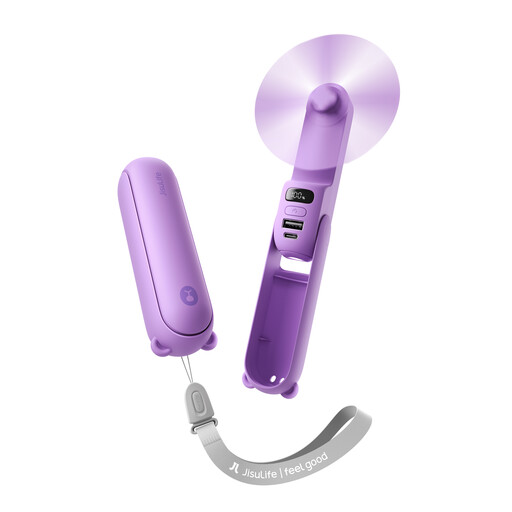
Why it suits this profile: A compact mini hand fan for travellers and commuters who want a torch and power bank function as well as cooling.
According to the product information, the LED display shows the fan speed and remaining battery level. The foldable design keeps the device from taking up unnecessary space.
2500mAh battery, three speed settings, USB charging, approximately 130 grams and three functions in one body.
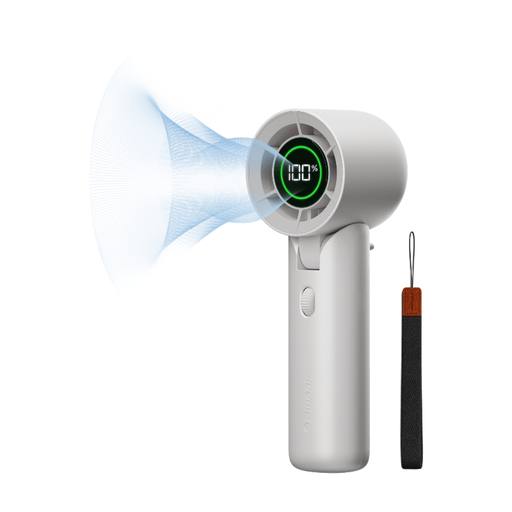
Why it suits this profile: Suitable for the office, train and bedroom when an even airflow and low quoted noise level are important.
The quoted noise levels range from 23 to 46 dB. According to the product information, the runtime of up to 32 hours applies on the low setting, making the usage conditions clear.
0–100 control, USB-C, head tilting up to 75 degrees and a quoted weight of 0.3 kg.
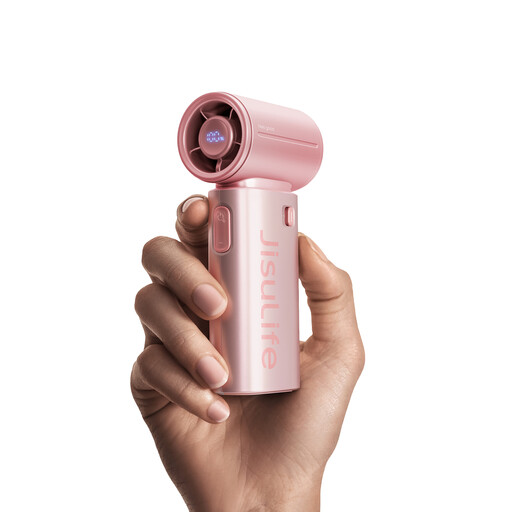
Why it suits this profile: For concerts, festivals, camping and outdoor use, where directed airflow matters more than whisper-quiet operation.
The five settings let you choose between a gentle and a powerful airflow. The display shows the speed and battery level, so you are less likely to run out of power unexpectedly.
5000mAh battery, quoted wind speed of up to 10 m/s, five settings, carrying strap and a weight of approximately 180 grams.
A handheld model gives you control over the direction, but you have to hold it. A neck fan is hands-free and suits walking, working or cycling, although you need to consider its weight and fit. According to the product information, the JISULIFE Portable Neck Fan Life 4 has five settings, a 5000mAh battery and a quoted runtime of 2.5 to 16.5 hours. The bladeless design prevents direct contact with moving blades, but hair and loose clothing should still be kept away from the air intakes.
When using a fan around your neck, make sure the strap is securely fastened, that you have sufficient freedom of movement and that you follow the manufacturer’s warnings. Do not use a neck fan while driving if it could distract you.
We have put together a complete, up-to-date list of products that fully meet these strict selection criteria and the applicable European safety regulations.
It depends on the battery capacity, motor speed, daily usage time and selected setting. A model with a larger battery can run for longer, but it may also take longer to charge fully. Always check the quoted runtime on multiple settings rather than looking only at the highest figure.
Many models can be charged this way, provided that the power bank’s output matches the required USB connection and voltage. Check the manual and use a cable suitable for the device. Do not place a fan under clothing or inside an enclosed bag while it is charging.
Power consumption is generally low, but the cost depends on the wattage, charging time and how often you use the device. A lower setting usually requires less energy than the maximum speed. A display showing the battery level helps you plan charging in good time and avoid unnecessary charging cycles.
