
Vandaag of morgen in huis

Kwaliteit gegarandeerd

Welkomstaanbiedingen ontgrendelen: GRATIS bezorging | Tot 80% korting | Gratis 30 dagen JoyPlus-proefperiode
Download de app
A portable hand fan is handy on the train, at the office, at a festival or on a hot day at the campsite. But it’s not wise to focus only on claims such as “turbo”, “powerful motor” or “long battery life”. A small fan might look impressive on paper, but in practice it could be too loud, run out of charge quickly or feel awkward to hold.
This buying guide explains which specifications really matter and which rechargeable hand fan is right for you.
The stated running time usually applies to the lowest setting. A fan with a battery that lasts, for example, 18 to 22 hours may run for considerably less time at its highest speed. Check whether the running time is given as a range, such as 3–19 hours or 3–22 hours.
Also consider the charging time. A 5000mAh battery will usually offer more capacity, but the product specifications for some models say it can take 4 to 5 hours to charge fully. For your daily commute, a shorter charging time may be more practical than a larger battery.
A higher wind speed isn’t automatically more comfortable. At the office, on the train or during a conversation, you may prefer a gentle breeze. For outdoor use, a powerful pocket fan can be useful.
So look at:
A quiet portable fan is particularly useful at work, in the bedroom and on public transport. Bear in mind that the noise level may increase at higher settings.
A mini fan should fit easily into a bag or coat pocket, but tiny buttons and a smooth casing can make it harder to use. A wrist strap, safety lock or adjustable head may be more useful than a small size alone.
For a neck fan, the strap should be securely fastened and should not be left loose around young children. Also check whether the model is designed to be worn around the neck or used by hand only.
A USB hand fan is practical because you can charge it via a laptop, power bank, car charger or suitable USB adapter. Check the type of connection. USB-C is handy if you already use USB-C cables, but always check what’s included in the box.
A 2500mAh battery is often enough for light use. According to the product information, a model with 4250mAh or 5000mAh offers more capacity, but may be a little heavier. The stated running time depends on the speed setting and how you use the fan.
More speed settings give you greater control. Three settings may be enough for everyday use, while five settings or adjustment from 0 to 100 are useful if you want to fine-tune the airflow.
Consider the difference between a broad, gentle breeze and a concentrated jet of air. A turbine-style or blade-shaped design may direct the airflow more precisely. According to the stated product specifications, certain JISULIFE models reach wind speeds of up to 10 m/s. Treat this as a product specification, not a guarantee that everyone will experience the same level of cooling.
Size and weight matter when you’re travelling or heading to a concert or festival. A model weighing around 180 grams is portable, but a wrist strap or desk stand may be more comfortable if you’re holding it for a long time. A folding personal fan can also be placed on a table.
Also check:
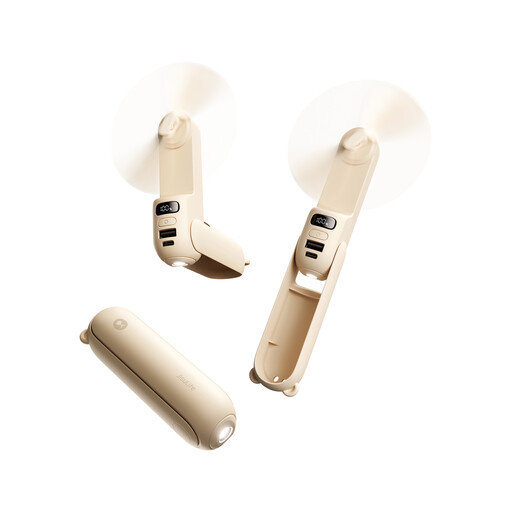
Why it suits this profile: This compact model combines a fan, power bank and light. With a stated 2500mAh battery and a running time of 15–24 hours according to the product information, it’s suitable for everyday use and travel.
The LED indicator shows the remaining battery level, and the fan has three settings. This means you don’t have to rely solely on a general maximum running-time claim.
Stated charging time of 1–2 hours, foldable design, plus power bank and light functions.
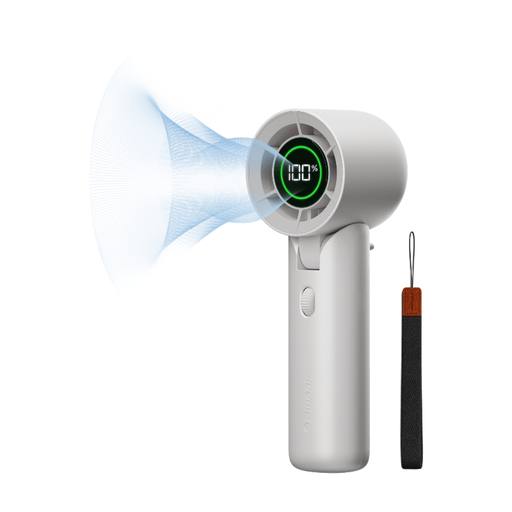
Why it suits this profile: The stated specifications list a noise level of 23–46 dB, a USB-C connection and up to 32 hours of use on the low setting. That makes it well suited to the office, train journeys and extended use.
The product specifications state both minimum and maximum noise levels. You can also adjust the speed from 0 to 100, rather than choosing from just a few fixed settings.
23–46 dB according to the product information, a 75° tilting head and USB-C charging.
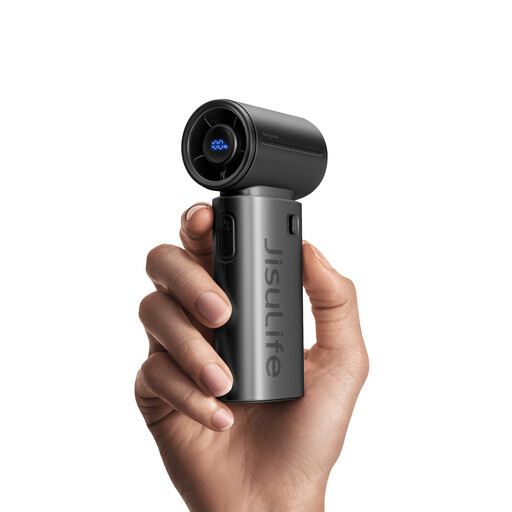
Why it suits this profile: According to the stated JISULIFE product specifications, this model has a 5000mAh battery, five settings and a maximum wind speed of up to 10 m/s. Its size and weight of 180 grams make it suitable for concerts, travel and outdoor activities.
The LED display shows the battery status and speed setting. This lets you keep an eye on power use instead of running out of charge unexpectedly.
5000mAh battery, five speeds, LED display and a stated running time of 3–22 hours, depending on the setting.
We’ve put together a complete, up-to-date list of products that meet these strict selection criteria and comply with the applicable European safety regulations.
A portable fan usually contains a lithium-ion battery. Use a suitable USB power source and don’t charge the device if the casing, cable or connection is damaged. Stop using it if it becomes hot, emits smoke or an unusual smell, or if the battery swells.
Keep fingers, hair and loose clothing away from the blades. Don’t use the fan in the rain or in a damp room unless the manufacturer explicitly states that it’s suitable for such use. Clean the casing with a soft, slightly damp cloth and don’t immerse the device in water.
When buying, also check the product information, warnings, manufacturer details and applicable consumer rights within the EU. Any stated CE marking or safety claim should be verifiable against the product and its accompanying documentation.
Running time varies depending on battery capacity and speed. The supplied product specifications give examples ranging from around 3 hours on a high setting to 18, 22, 24 or even 32 hours on a low setting. Treat maximum running times as an indication of what to expect with light use.
Yes, as long as the model is compact, rechargeable and light enough. Check the venue’s rules in advance, especially for concerts and festivals. A wrist strap, safety lock and visible battery display are useful when you’re out and about.
A small fan typically uses little energy per charge. Actual consumption depends on the battery, charging time and speed setting. You can charge it regularly via a laptop or power bank, but always use a suitable USB power source and follow the manufacturer’s safety instructions.
